
Posts in "Long Posts"

Let's Save the World A Lot: #AASL Fan Activism Workshop Recap

Last Thursday night, I attended the workshop “From Stories to Action: Inspiring Heroes for Our Own World” at the American Association of School Librarians conference. The workshop was presented by Janae Phillips, Director of Leadership & Education for the Harry Potter Alliance. It was the highlight of the conference for me. I left energized and eager to get involved.

The event began with an introduction to HPA - who they are and what they do. Their tagline is “We turn fans into heroes.” Their focus is on fan activism, which they define as “engaging in activism through storytelling and fandom by drawing parallels between popular media and real world social issues.”
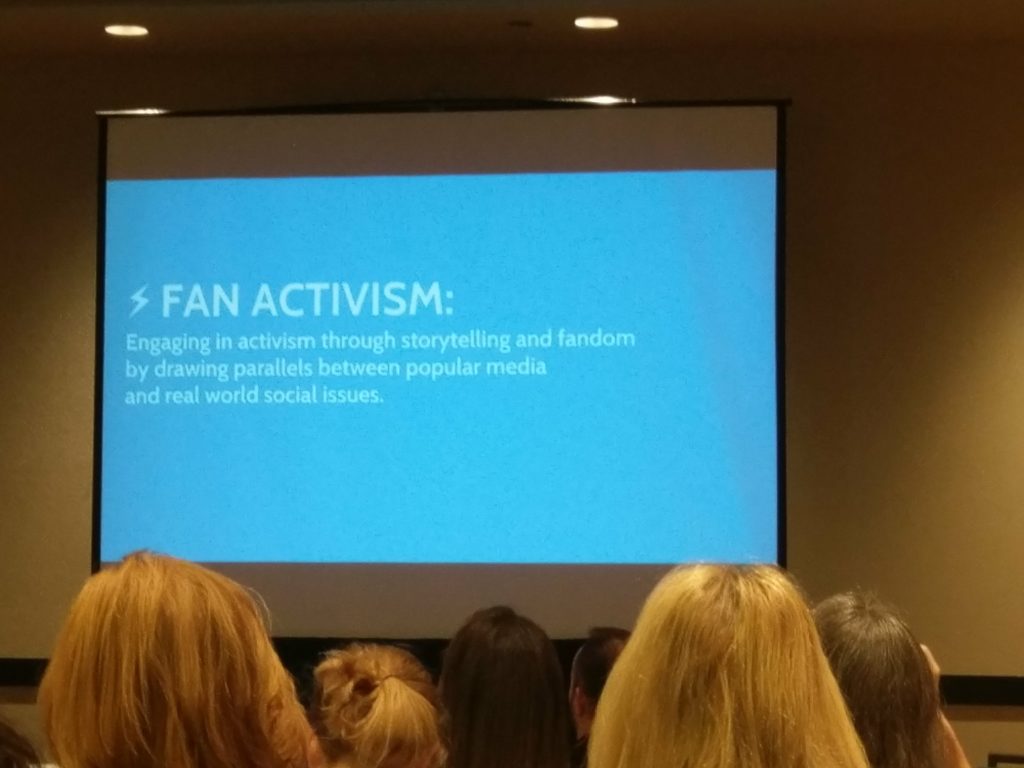
Fan ActivismJanae shared her background in leadership development, describing the social change model of leadership development as the model she used:
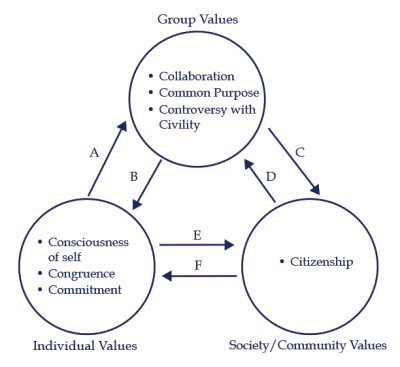
Social Change Model of Leadership Development

With a quick Google I discovered that this model is commonly used for student leadership development in higher education. If you want to read about it, there’s a lot of scholarly literature out there. From what I can tell, it was first introduced in this book.

Janae then pointed out that most of the stories that inspire modern fandoms hew pretty closely to Joseph Campbell’s Hero’s Journey:
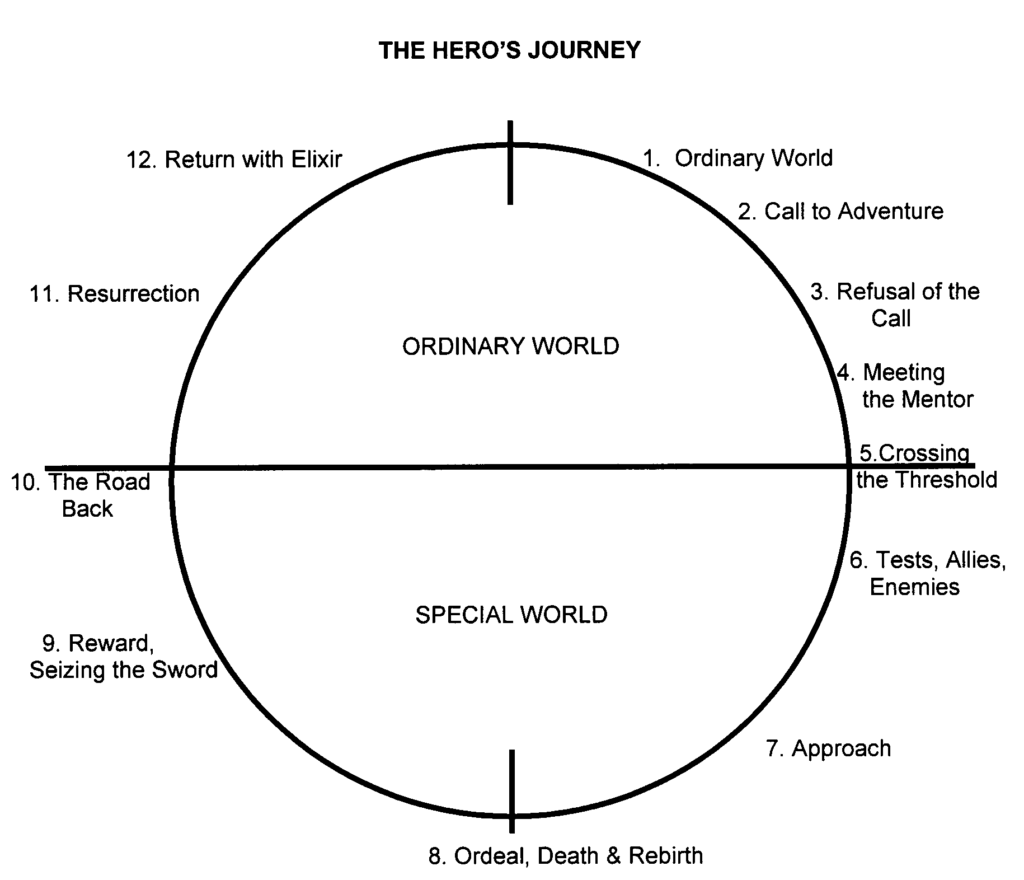
Hero's Journey

You can read more about this in so many places, but I hear people talk about The Hero with a Thousand Faces the most. I’m ashamed to say I’ve never read it. Maybe I’ll try and squeeze it into my dissertation literature review somehow. (Here’s the part where I admit that this Hero’s Journey aligns closely with Western literature, and naturally has some limitations with respect to its value for analyzing stories cross-culturally.)

Janae introduced the idea that literally overlaying the leadership model on the Hero’s Journey illustrated the promise of using the power of stories to create activist leaders. You can line up the Individual part of the model with the beginning of the journey, see how tests, allies, and enemies might align with group values, and then the Society/Community part aligns with the resurrection and return. (I couldn’t really see if this is how Janae’s version lined up, but I think it probably is.)

Now that we had a theoretical foundation for connecting stories and social change, Janae introduced the innovation adoption curve and discussed the fact that most activist efforts target innovators & early adopters, leaving middle and late adopters out. These individuals - who might be ready to be activists, if they are just introduced to it the right way - can be approached via their own fandoms.

[caption id=“attachment_3288” align=“aligncenter” width=“640”]Innovation Adoption Curve Janae’s version had adorable Harry Potter theming with the Dark Mark over on the Laggards end. I got this version from Jurgen Appelo of management30.com.[/caption]
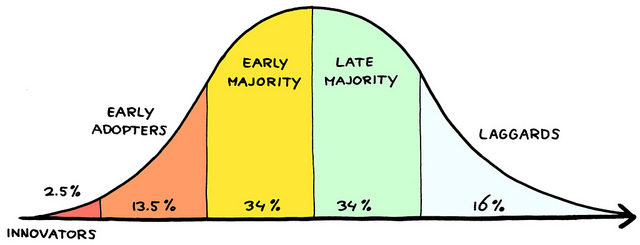
She likened middle and late adopters to Neville Longbottom, who at the beginning of the Harry Potter series is overwhelmed and not really sure how to help in the fight against Voldemort, but by the end of the series is protecting the world with as much strength as any of his peers.
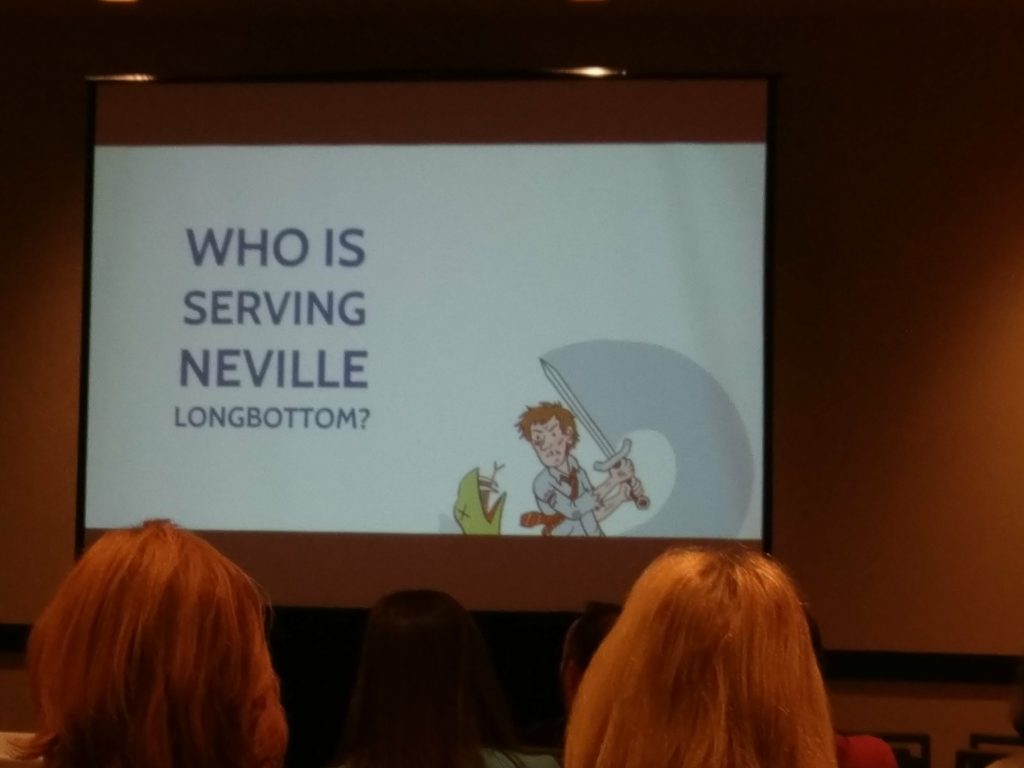
Who is serving Neville Longbottom?

Janae explained that someone who feels they lack the expertise to have a grounded discussion of a social justice issue like racism might be more ready to have that conversation if it is grounded in their own area of expertise - their fandom. She offered here the example of using how Muggle-born and the children of Muggle/Wizard pairings are treated in Harry Potter to get at the idea of racism.

She also pointed out that stories can serve as inspiration for specific actions. For example, in the world of Harry Potter, eating chocolate is an antidote to a dementor attack. Harry Potter-themed chocolate is a real-world product. Janae shared the “Not in Harry’s Name” campaign, in which the HPA lobbied Warner Brothers to ensure all HP-branded chocolate is ethically sourced:

Next up was the workshop part. We divided into groups by fandom (Buffy, Hamilton, Star Wars, HP). First we discussed WHY we loved the texts from these fandoms. THEN we brainstormed possible activist projects that could come out of those. (I was the one who kept calling for a Buffy group, and I got my wish.)

We closed with a sharing, a recap, and information about how we can get involved in the HPA.

Janae finished with a couple of key points that really resonated with me and made me feel energized about my work as a scholar looking at connected learning and culturally sustaining pedagogy, finding ways librarians can leverage youth interests and culture to learn, grow, and make the world a better place.

First, JOY itself is an act of resistance. The bad guys, whomever they may be, want us to be down and defeated. Doing things that make us joyful is part of resisting them.

Second, connecting your activism with something you love gives you the energy to keep going. Social justice work is hard. It’s demanding and exhausting. It’s easy to feel like it’s too hard and we should quit. But if your activism is grounded in a work of art you enjoy and a community of other people who also love that art, that can give you what you need to stick with it.

Finally, I want to close with a question that came up in my group: how do you know which fandom to have motivate activities for the youth you’re serving? The answer, of course, is whichever fandom excites them. You don’t have to know about Dementors or Neville or Muggles or House Elves to find ways to connect Harry Potter to activism, because people who love it, when talking about it, will share with you things that will naturally fit. Let kids share with you what they’re into - find ways for them to bring it in - and as you learn about it, you will find ways to help them think through its connection to the real world and how they can use that to make the world better. To decrease worldsuck, if you will.
What I'm Learning: Cosplay

This is the start of a new series on What I’m Learning. Interest-driven learning is both my key area of research interest and how most of my hobbies get picked up. I consider myself an expert learner. And I firmly believe that there’s value in sharing the process of the things in which we are experts, in providing models for other people. So I’m going to let you in on the ground floor and give you a perspective on what I’m learning. And we’ll start with something that I’m feeling extra inspired to take up right now: cosplay.

What is cosplay? It’s dressing up in costume as a specific character from media or history. You see it most often at fan conventions. It’s distinct from, though has a lot in common with, any other time you might wear a costume - for Halloween or to perform in a theatrical or dance production, for example.

Why am I getting into cosplay? I have an extensive background of being into costuming. It’s essentially an extension of playing pretend, which is one of my favorite things. My first cosplay (specific media character as opposed to generic idea like “magician”) was my Halloween costume when I was 3 or 4: the Blue Fairy from Pinocchio. My mom is an incredible seamstress, so I often had very detailed costumes growing up.

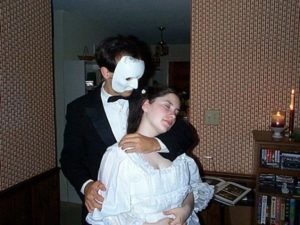
[caption id=“attachment_3250” align=“aligncenter” width=“300”] In a detailed replica of Christine’s Phantom of the Opera wedding dress, with my then-boyfriend now-husband, 1999.[/caption]
I’ve always loved dressing up and, while I don’t care to wear make-up for day to day life, I also really enjoy special effects make-up and hair/wig styling.

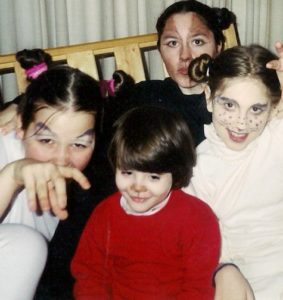
[caption id=“attachment_3251” align=“aligncenter” width=“283”] With my sister (right), brother (bottom), and a friend (left) as Cassandra, Rumpleteazer, Skimbleshanks, and Jellylorum from Cats, 1999.[/caption]
As a dramatic art major in college, I had to work in the costume shop for a semester. I learned more about make-up and drafting patterns. I also did some sewing and ended up creating a custom-fitted dress that was so detailed in terms of fit that the director the costume shop said I could get into couture.

But you know, life.

Life is crazy and I’m easily overwhelmed, so I haven’t pursued much making my own costumes and accessories or doing hair and make-up. I’ve done some closet cosplay and crocheted accessories, but besides using the hashtag #cosplaygoals to note things I’d be excited to dress up as, I haven’t really engaged.

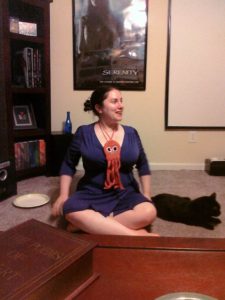
[caption id=“attachment_3252” align=“aligncenter” width=“225”] Dressed as a lady from the Fruity Oaty Bars commercial in Serenity. Sitting beside the best cat.[/caption]
There’s a whole community around cosplay, but I have only briefly looked into it, admiring others’ work. But it’s time.

Why now? Honestly? Because this article popped across my Twitter feed, and because I’ve been at loose ends waiting for my next hobby to find me. I need something that I can do at home, in small chunks of time, but will eventually have a big payoff. Cosplay fits the bill.

What next? Here are my steps:

  1. Get inspired. The most inspiring cosplay I've ever seen is this cosplay of Maui from Moana. Not only does it beautifully address issues of representation in terms of both race and body type, it's an example of  many different skills that come into play: materials selection, inking, wig styling, jewelry creation, prop creation, programming, wiring. This quote kind of sums it all up:
    "Cosplay is a blend of science and art, and being able to develop my craftsmanship skills and partner them with my performance abilities creates a magical experience. I thrive in these little pockets of shared sunshine where we can step outside of our ordinary lives and create the world we've imagined.
  2. Start reading. My earliest step when learning anything new is to research it pretty deeply. The SLJ article I linked above provides a few good places to start, so I'm starting with those, beginning with The Hero's Closet: Sewing for Cosplay and Costuming. If reading isn't how you like to learn things, the post includes some great videos. You can also seek out expert cosplayers and find out what they have to share. The names of several are mentioned in the SLJ article.
  3. Attend an event. I'm very lucky that Cosplay America is happening this weekend essentially in my backyard. With a toddler in tow and my husband out of town, I can't really swing a full three-day convention, but I'll be going on Sunday.
  4. Recruit a partner-in-crime. This kind of thing is always more fun when it's social. I think I've gotten both of my siblings on board with digging deeper into cosplay, though I'll be taking the lead. My brother will be joining me at Cosplay America.

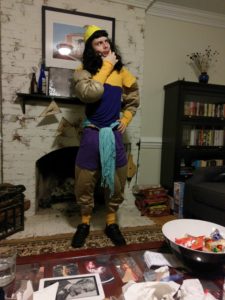
    [caption id=“attachment_3253” align=“aligncenter” width=“225”] My brother as Kronk from The Emperor’s New Groove.[/caption]
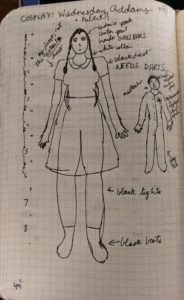
     

  5. Make a plan. I don’t have a lot of great costumes on hand right now, so I’ll be closet cosplaying as Wednesday Addams at Cosplay America. If I can find suitable clothing for the toddler, he’ll be going as Pubert.

    [caption id=“attachment_3254” align=“aligncenter” width=“184”] Notes in my Bullet Journal about my Wednesday closet Cosplay Plans.[/caption]
So that’s where I’m starting. Stay tuned for updates!

Inspirational Research: Improvising our Way through Tragedy: How an Improv Comedy Community Heals itself through Improvisation

It can be easy when you’re immersed in academia to kind of forget what the point is. I’m starting a series where I write about scholarship that I’ve found inspiring. Today I’m starting with Jason Scott Quinn’s Improvising our Way through Tragedy: How an Improv Comedy Community Heals itself through Improvisation.

Why did I read this?

I’m (still) working on a study I started a year ago as a project for my Advanced Qualitative Methods class. Sadly, I didn’t go through IRB, so I can’t publish anything from the study. I’ll just say that I am looking at how learning happens in the context of an improv team, specifically a team that performs the Harold. I picked this site not because it’s key to my research interests (though I can certainly argue that improv is a fruitful environment for connected learning), but because I knew it would be easy to get access.

As a smaller assignment leading up to the full report on the study, I’m doing a small literature review. I’m specifically looking at studies on improv comedy with an eye to their conceptual frameworks, use of theory, and audience. I came across this article in the course of doing my literature search for this lit review.

What’s so inspiring about it?

Content: This is an article about how the NYC improv community used dialogue and performance to heal after 9/11. I mean, that right there pushes a ton of my inspiration buttons. Anything that brings together community, healing, and performance is going to tug at my heartstrings. Also, it’s about improv, and while I’m taking a break of indeterminate length from performing and watching improv due to early parenthood and some other stuff, I still find improv fascinating.

Methodology: This is a qualitative study  using autoethnography. Before I started this project, I wasn’t sure about autoethnography. I thought it sounded self-indulgent. But as I’ve gone through the process of collecting data and reflecting on my own experiences with improv, as well as my experiences with other communities, I’m really beginning to see the value of research that connects the personal to the broader world.

Presentation: This is what really makes this an inspirational piece for me, though. The results of this study are presented as a performance piece. This piece integrates quotes from message board postings, monologues, and improvisational performance. It provides an excellent model for me of how to use this kind of representation. It’s something that the assigned readings for my qual methods class touched on, but it offers a model that speaks very directly to my interests. Sadly, my final presentation for the class will have to be fully digital and thus won’t incorporate improv like this piece did. I wish it could, though, and this has been really helpful in thinking about how, if I ever do research on improv in the future, I might represent those results.

Should I read this?

If you’re interested in how improvisation can be a part of research presentations, absolutely. Also if you just like to read about improv, yes. Quinn’s language is accessible and will introduce you to some interesting theory you might not already know.

On not doing great

Sometimes I’m not doing great. Sometimes I’m struggling. In these times, though, I’m usually doing okay. I need sometimes to express that I’m not doing great, but I worry and minimize it, because I am doing okay, and I don’t want people to worry unnecessarily. Not even okay is really bad for me and happens only rarely. But my perception is that if I say I’m not great, people hear that I’m not okay.

I’m still working out how to communicate about how I’m doing.

Lessons Learned from a Week and a Half of

I worked through the first two weeks of Wendy Belcher’s Writing Your Journal Article in 12 Weeks in about a week and a half. Here I am at the beginning of her Week 3, and she suggests writing up what you learned and sharing it, so that’s what I’m doing here.

A few reminders about my situation before I begin: I am the mother of an 11-month-old son, a full-time graduate student doing 4 credit hours of coursework and 5 credit hours of dissertation work, a research assistant with a 20 hour a week position, chronically ill with endocrine and autoimmune diseases, and a dilettante who feels all the joy is sucked out of life if I don’t get to spend at least a little time on personal interests.

And yes, all of that is relevant to my writing process.

Challenges

Managing time and attention is my biggest challenge. I have fifteen hours of paid childcare a week, plus whatever gifted childcare I receive from family members including my son’s grandparents and solo time his dad spends with him. It’s not a lot of time, and I don’t even use it that productively. I’m easily distracted and if I can’t focus I can’t write.

Also? It’s hard to work when I’m responsible for supervising a toddler. But there’s definitely more than 15 hours worth of work to do to meet my 56 hour obligation (36 hours coursework/dissertation + 20 assistantship), so I’ve got to figure out how I can get some work done when I’m with him, or start giving up sleep.

If I haven’t sorted out everything I need before a work session I putter and am at a loss. This is a skill I want to get better at: taking a little time at the beginning of a work session to plan, and at the end to wrap up.

If I don’t get writing done early in the day, I don’t get it done at all.

Solutions

One solution that has really been working for me is using the Pomodoro method to churn out four Pomodoros (25 minute blocks of work) in a row. I have four primary areas of work responsibility, each with writing involved: parental leave makeup work, dissertation hours (where I’m using the #12weekarticle techniques), coursework, and my assistantship. I rotate through these areas, doing one Pomodoro in each, and even if that’s all I get done in a day, I have at least knocked out two hours of solid work.

Working in spaces where I can’t hear the baby is huge. I go to a coffee shop or the library or even my back porch and I’m infinitely more productive than I am when I’m within hearing range of him - even two floors away, I can hear my sister nannying him, and it’s a distraction. Especially when he gets upset. So spending more time in those other spaces is totally worth the little bit of time it takes to get set up in them. (This back porch thing has been amazing - sunlight, a cool breeze, and concentration - thanks, autumn!)

Dedicating the time I need to setting up the plan for a work session has been going well, but I’m still working on the wrap-up part of things.

I need to ask for help from my husband at the beginning of a day - have breakfast with him and the baby, then whisk myself away for a couple hours - rather than waiting for him to check in with “Didn’t you need to get some writing done today?” because if it doesn’t happen before noon, I’m already too tired to get started.

Next Steps

  • Spend half an hour at the end of each childcare-protected work session planning both what work I can get done when I’m with the baby and what work I will do in my next protected work session.
  • Spend half an hour at the beginning of each childcare-protected work session planning what I will do for the rest of the work session.
  • Continue to work in spaces away from the baby.
  • Get my work session in first thing after exercise and breakfast.

My Upcoming Paper Topic #12weekarticle #AcWri

Hello, The Entire Internet, my writing partner. How’s your writing going?

Today’s assignment from Writing Your Journal Article in 12 Weeks is to get really clear on my paper topic before writing an abstract about it. Again, I’m supposed to call somebody on the phone or meet with them in person and talk about it. Again, I’m not logistically in a situation where that is an option right now (sleeping baby on the bed next to me!), so I’m blogging instead.

Am I afraid of someone scooping me if I blog about my paper topic? A little. But then, I’ve already shared my poster about it on the open web. Anyway, I’m more interested in open scholarship and sharing my process than I am worried about getting scooped. So here we are. I’m going to give you a preview of the article I’m writing.

I’m writing about special education training for preservice school librarians. School librarians, like other educators, are responsible for serving students with disabilities. School libraries are environments that are different from the classroom, and thus, I would argue, serve special education students in unique ways. I suspected that very few school librarians received training in how to do this in their school library education programs, and that even fewer were required to undergo such training. To find out, I performed a content analysis of the websites of all of the American Association of School Librarians-approved school librarian education programs, looking at their program requirements and course offerings. I looked at both course titles and descriptions, when available. I found that most programs don’t provide coursework that is specific to the school library; they outsource it to education programs. Some do require it for anyone who isn’t a teacher, but they assume that if you already have a teaching certificate, you’ve already received sufficient education in this area. A few school library education programs in New York, where there has been a specific initiative targeted at improving this type of education, both require this type of training and offer coursework specific to educators working in school libraries rather than classrooms. I would suggest that more programs should offer and even require this type of training, and that these programs in New York have the potential to serve as models for future coursework to be developed.

So let me open it up to you, Internet. Did I summarize the work clearly? What questions do you have? Engage with me here and in the comments I’ll try to do this again, but more succinctly. And then after that, I’m going to try to get this down to one sentence.