
So I’m reading my dissertation and I think it’s… Good? Like it was written by somebody who knows what they’re talking about? I take this as evidence that I know what I’m talking about. 📝
Posts in "Research"
About to start reading and marking up this thing in preparation for next week’s defense, at which I will boldly go where (to my knowledge) no Hirsh has gone before. 📝
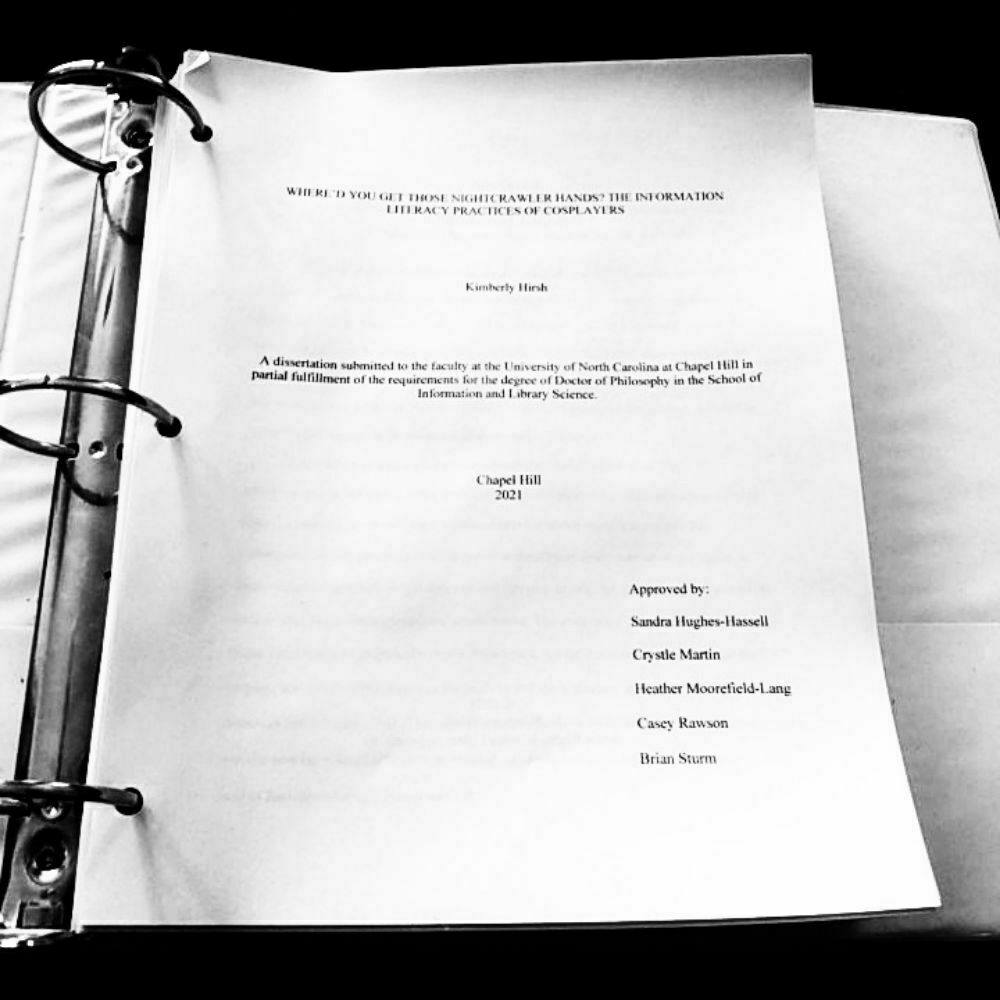
I have now met all my pre-defense scholarly obligations (paper draft & guest lecture) so I guess it’s time to prepare for my defense. googles makeup tutorials 📝
True story, my dissertation includes the statement, “I was wrong.” 📝
SAVE THE DATE! My dissertation defense is set for April 14th from 1 - 3 pm. It will be held via Zoom. SILS dissertation defenses are open. Please get in touch with me if you’d like the Zoom details. 📝
Dissertation Draft Finished + Pandemic Parenting and My Body
I sent off the introduction chapter for my dissertation to my advisor a few minutes ago. I also decided to do a total page and word count for the whole thing. And while I was doing that I made the mistake of reading the comments on the methods chapter. Which are good and helpful comments and not that dramatic, but IMPOSTOR SYNDROME, am I right?
Mostly what I’m dealing with is that both of the committee members who have looked at that chapter were like “This theoretical framework part needs it’s own chapter.” It won’t actually be creating a whole chapter from scratch, but it does feel a little like it will. And so my jerk brain is like, “Why didn’t you write that? Why haven’t you done that already? Why didn’t that occur to you? UGH. Your dissertation is frivolous, thin, unimportant, has nothing to contribute, and is basically just you dicking around. You’ll graduate probably because you have a kind committee but what subpar work.”
My brain doesn’t seem to know we’re in a pandemic.
Before I go on, here are the stats: in its current iteration, my dissertation is 155 pages and 31,084 words. I started data collection in April. I went from initiating data collection to a finished draft in 6 months, working on it for half-days, while caring for my child in the morning and writing in the afternoons.
This is no small achievement, regardless of the contribution my research makes to the field.
And I simultaneously worked on my assistantship, which involved designing a semistructured interview protocol, conducting 3 interviews, and coding 14 interviews.
I had planned to start my data collection earlier. I had planned to be writing close to full-time hours, because I had expected to get a dissertation fellowship, making this a non-service year. Things have gone very differently than I planned, and I have a first draft of my dissertation to show anyway.
I may kick off my revisions with a dissertation bootcamp Jan 11 - 15. We’ll see.
–
Something that only occurred to me yesterday, although of course it’s been going on the whole time I’ve been a mother, is that I hold my child’s emotions in my body. So when my kid sobs three or four times in one morning and throws a couple of tantrums, I can’t just hand him off to my mother-in-law and then sit down to work. My body just won’t allow it.
Giving myself permission to recognize the impact my kid’s emotions have on my body is something I sorely needed, and I really hope it will help me moving forward.
Okay. Gonna have lunch and then maybe go to Bean Traders to get some curbside pickup “I did it!” treats.
I'm having trouble with my dissertation discussion.
My goal for November’s #AcWriMo was to write the discussion chapter for my dissertation. After finishing that chapter, all that would be left would be a couple of pieces of my introduction that should go quickly.
I’m revising my plan, in light of Pat Thomson’s post about rebooting #AcWriMo2020 goals.
This chapter has been a beast. I had no idea where to begin. I looked at advice. I looked at other people’s discussion sections. I pondered while putting my kid to bed and came up with good ideas. I’ve been snatching odd moments here and there to jot down notes when something occurs to me. But figuring out how to put it all together? That has been a beast.
Today I Googled “dissertation discussion chapter stuck.” This brought me the gift of a couple of posts from The Thesis Whisperer. “The Difficult Discussion Chapter” helped me understand that my problem is common, that it is likely attributable to exactly what I thought it was (the difficulty in turning my data, which is easy to describe, into a set of knowledge claims, which requires more creativity).
“How do I start my discussion chapter?” gave me permission to reconsider my dissertation structure. In it, Dr. Mewburn says,
Before you worry about the discussion chapter too much, consider whether you need to treat the discussion as a separate section at all.
This confirmed a gut feeling I started having yesterday as I was plugging away at the five pages I did manage to get written. It felt so weird trying to talk about my data’s meaning pages and pages away from where I represented the data itself. The similar studies I looked at had integrated their discussion sections with their findings sections. I felt like I needed to do the same thing. So trying that is my next step.
I emailed my advisor to let her know that I would be integrating the discussion into the findings chapter, and that the conclusion chapter would be shorter and focus on implications, limitations, and recommendations for future research and practice. I also told her that this change, plus the fact that I lost two weeks of November to election anxiety and a multiday migraine, meant that I was pushing my self-imposed deadline out from November 30 to December 4. (It will probably be December 6, now that I think about it. I get a good chunk of quiet writing time on Sundays.) I then plan to take one week to finish the introduction, and then will take from December 14 - January 18 off before launching into a month of revisions before sending the dissertation to my committee to review ahead of my defense.
I don’t know if this is going to make things easier. I hope it will. I’ll let you know how it goes. (I also totally will write up my data analysis process eventually, I promise.)
I did what I wanted during my PhD and I regret nothing.
Six months ago today, Inger Mewburn published the post, Where I call bullshit on the way we do the PhD. From where I sit, things are not better or different six months later. In the post, Mewburn encourages PhD researchers to shift their focus from traditional markers of academic success such as publishing in peer-reviewed journals to other activities that might be more helpful in a career beyond academia. I thought I’d write about how I’ve done this over the course of my PhD and the kinds of things I learned.
Performance Production
In my first year and a half of the PhD program, I produced improv comedy. I produced an independent improv team as well as a monthly show that invited other independent teams to play. I got no publications out of this (though I did build relationships that supported four class assignments during that time). I did, however, learn about managing groups of people’s schedules, keeping in contact with performers, and keeping people motivated when stuff was not going well. These are skills that I could use in any event management capacity, especially one that involves speakers or performers.
Podcasting
I started a podcast about Buffy the Vampire Slayer. This podcast is not at all about my research or my data. It does, however, require the technical skills of recording and editing, the social skills of recruiting and managing guests, and the analytical skills of viewing the episode and determining topics of conversation. I created what is essentially a theoretical framework of BtVS that rests on three pillars:
- the literalization of the saying “high school is hell”
- the deliberate disruption of horror film tropes
- the manifestation of what I call “Spiderman moments,” when Buffy faces and must resolve a conflict between her responsibilities and desires as a teenager and her responsibilities and desires as a Vampire Slayer
This will work for Seasons 1 - 3. If I keep the podcast going, the framework will probably need revision from Season 4 on.
Blogging and Web Development
In the spring of my second year, I first learned about the IndieWeb and have since then been working to build my website as a true home for me on the web and expand my blogging practice. It led to my first keynote invitation and allowed me to share my experiences with dissertating and PhD work. My blog post, “A Start-to-Finish Literature Review Workflow,” is by far my most viewed post. I don’t know where I would publish something like this but it’s definitely not my disciplinary journals. It helped so many more people than I would have helped publishing an article about school library leadership or something in a journal that school librarians don’t even have access to.
Developing Self-Employment Ideas
I’ve been engaging with resources like Katie Linder and Sara Langworthy’s podcast, Make Your Way, and Jen Polk’s Self-Employed PhD strategy sessions. These have helped me learn so much and make connections that have led to potential freelance gigs.
Going to Conferences that Sound Interesting
If I were looking to be really tenure-track ready in my field, I would be going to ALISE or ASIS&T, and I may go to those someday. But left to my own devices, I recently chose to present at the Fan Studies Network North America conference. Not only did I have an awesome time and meet great people, I also connected with an editor at an academic press who expressed interest in receiving a book proposal from me based on my dissertation research. If I focused on disciplinary expertise, I wouldn’t have attended this conference.
Identifying Models of the Kind of Scholarship I’d Like to Do
Dr. Mewburn discusses the importance of current scholars modeling behavior for future scholars. I’ve been following the work of Casey Fiesler since encountering her via the Fansplaining podcast. Dr. Fiesler does a great job modeling a variety of ways to engage as a scholar, including public writing and experimenting with TikTok.
The Moral of the Story
Get to PhDone, but as much as possible, spend time doing the things you want to do, because they will give you marketable skills, build your network, and lead you to more of what you want to be doing. If you focus on what people steeped in the old ways of academia tell you, not only will you still have a hard time finding a job, you also won’t have any fun.
The burnout is real.
From September 8 to October 2, I attended a virtual dissertation writing boot camp.
I have childcare each day from 1 pm to 6 pm. I have standing meetings on Tuesdays and Wednesdays at 2. The Bootcamp ran from 2 - 5 each day that week, so my Tuesday and Wednesday meetings were moved back to 1. I had no time between my mother-in-law’s arrival and my meetings to do any getting set up. On the other days, I spent that first hour transitioning my kid and getting everything I needed together for the boot camp.
Every day that week at 5 I was too exhausted to take advantage of that last hour of childcare for anything but rest.
I wrote an entire chapter of my dissertation that week; it was probably about 25 pages by the time I was done.
At the end of the boot camp, we talked about what we were going to do to carry our momentum forward. I blathered about my little routines to help me settle in at the beginning of my workday.
I took a week off from dissertating after the boot camp. I did none of my routines.
The following week, I spent most of the week at the Fan Studies Network North America conference, which was amazing. But the schedule was such that, again, I didn’t really do any of my routines.
The week after that, I filled in the remaining gaps in the three dissertation chapters I had written. This was not heavy work, and it’s a good thing.
I told myself I was going to write my discussion chapter as part of NaNoWriMo, but as we all know, the US election was on November 3 (not just presidential; I was concerned about down-ballot races too, esp. NC senate). And then there were days of waiting. Who could get work done during that time?
Not me. Not on my dissertation, anyway. (Throughout all of this I have continued doing work for my assistantship.)
Over the weekend I thought to myself, “Monday will be the day. Monday will be the day that I get back into my routines.”
Reader, I did not get back into my routines Monday.
I didn’t on Tuesday, either.
Only today did I move in that direction: I meditated for 3 minutes with Headspace. I wrote a couple of “morning” pages (but not a full 3). I did a Tarot card pull.
I got The Star. It was the right card for today.
I started generating ideas for a process for creating my discussion chapter.
It feels silly to say. But that’s where I am.
Image is a detail of the 10 of Wands from the product image for the Wayhome Tarot at the Everyday Magic website. It’s a great deck. I highly recommend it.
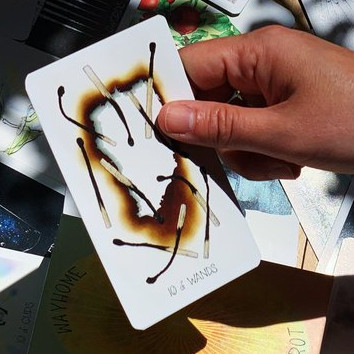
Current status: counting “figuring out which book will tell me how to write my discussion chapter” as my dissertation activity for the day. (It’s Making Sense of Qualitative Data by Amanda Coffey & Paul Atkinson.)