🔖 Read The Coronavirus’s Next Move (The Atlantic) by Katherine J. Wu.
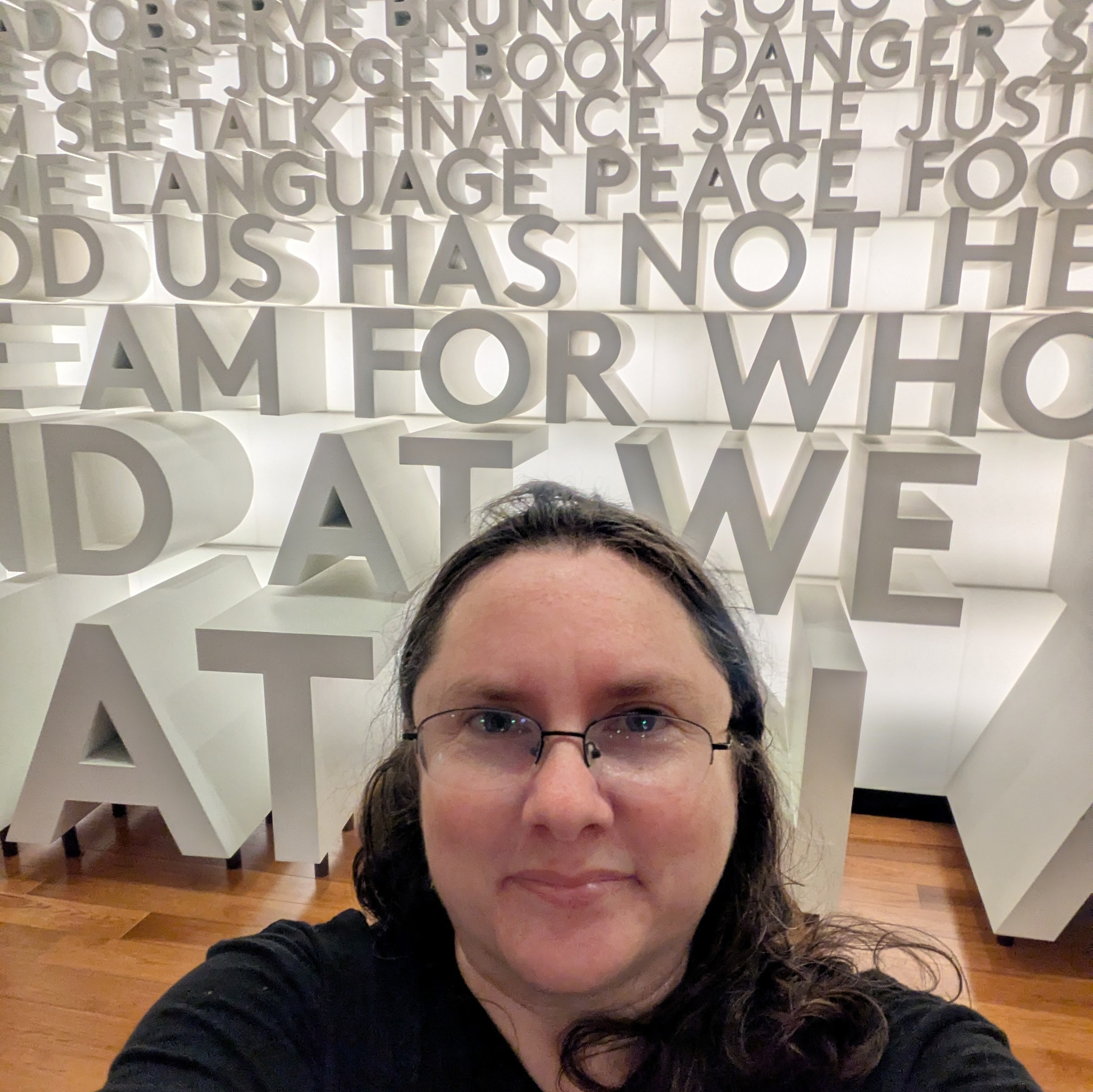
Planet Word Museum in Washington, DC
Hi there! I'm Kimberly Hirsh. My pronouns are she/ her/hers. I'm somebody's mom. I work as a school librarian. I have a PhD in information and library science. I love to read, play tabletop and video games, and make things. I used to perform in theater and improv comedy and I may one day again. I have been extremely online since 1993 and still enjoy tinkering on the web. I manage multiple chronic illnesses. I'm married to my kid's dad. We have a cat.
Want to get in touch? You can reach me by email.
Recent posts
Hi scholars. Can you point me to a scholarly definition of “space” that would encompass space broadly constituted, including physical space, digital/virtual space, and mental/emotional space? Asking for my IMLS-funded project’s Connected Learning Summit roundtable.
Fostering Information Literacy Through Autonomy and Guidance in the Inquiry and Maker Learning Environments - Koh et al, 2020
Koh, K., Ge, X., Lee, L., Lewis, K. R., Simmons, S., & Nelson, L. (2020). Fostering Information Literacy Through Autonomy and Guidance in the Inquiry and Maker Learning Environments. In J. H. Kalir & D. Filipiak (Eds.), Proceedings of the 2019 Connected Learning Summit (pp. 94–101). ETC Press.
This is a quick note that I’m really excited about this conference paper I found that builds a bridge between connected learning (my broad research interest) and information literacy (my specific disciplinary interest). I’m going to explore it more and dig into the connection later, but I’m psyched to find a new paper on this.
🔖🎮 Read Inside the fight to save video game history.
Great intro to the copyright issues at play in the conflict between game companies and museums & libraries over providing access to old games.

Finished reading: Winterkeep by Kristin Cashore 📚
Cashore’s GRACELING was the book that fixed me after THE NAME OF THE WIND broke me (because I love it so). This is the 4th book in the Graceling Realm series and while it took me a while to get into, I ended up loving it.
🔖📚 Read “The Invisible Kingdom” Shines a Light on Women’s Chronic Pain.
Another great interview with Meghan O’Rourke. Here are some quotes that stood out for me this time:
I used to say to one of my doctors that I didn’t care that I was in pain. The thing that undid me was the brain fog and the fatigue, because they subsumed my entire being. They washed away any effort of will that I might have. And so they made it impossible for me to write.
This is so true for me. I can tolerate a lot of physical pain. I didn’t know how much until with health coaching, hard work, and a good doctor I started to feel better. But I couldn’t, still can’t, push through fatigue and brain fog.
[With invisible illness] there’s no one coming to your bedside, there’s no meal chain organized.
I didn’t think about this just now but I have absolutely seen this play out with my mom. She’s been dealing with autoimmune disease for about 30 years. I don’t think she or my dad felt it was reasonable to ask for help with that, and so often when anyone in our family has talked about it, we’ve been met with advice about going gluten-free, doing acupuncture, meditating… These are all good and valuable things, but the contrast with the outpouring of questions about how people could help after her leukemia diagnosis is striking. Instead of “Oh you should try this” it’s “What can I do for you?” I suspect there were days when my mom was at her worst with Hashimoto’s that she was as low energy and could use as much help as she needs now.