Also, I love being on podcasts, so if you need a guest for yours, hit me up.
I guested on a podcast for the first time in almost 5 years! And I only talked about BtVS a little! Check it out: Micro Monday, Episode 80
Current wishlist: Everything BtVS on Hot Topic
Changing my research plans in light of COVID-19
All friends & students who are in the midst of dissertation data collection - I know recent events have made the process even more stressful. I hear & acknowledge the worries. Reach out to your supervisor/chair/colleagues/mentors - we can talk through options & possibilities.
— 𝔻𝕣. 𝕃𝕖𝕚𝕘𝕙 𝔾𝕣𝕒𝕧𝕖𝕤 𝕎𝕠𝕝𝕗 (@gravesle) March 11, 2020
My kid has been sick the past few days. Today is our first day back at Montessori/co-working space since last Friday, and while I’ve been pondering how the spread of coronavirus will impact my research the whole time we’ve been out, today I actually plan to figure out what I’m going to do about it.
Yesterday, Governor Roy Cooper declared a State of Emergency in North Carolina. The press release includes several suggestions. The one that is pertinent to my research is this one:
NC DHHS recommends that people at high risk of severe illness from COVID-19 avoid large groups of people as much as possible. This includes gatherings such as concert venues, conventions, church services, sporting events, and crowded social events.
One of the key pieces of my research involves interviewing and observing at conventions. I’m not sure whether or not I am at high risk of severe illness from COVID-19, though I suspect I am, due to having pre-diabetic Polycystic Ovary Syndrome and autoimmune thyroiditis. Autoimmune disesases don’t make one automatically immunocompromised, but I don’t trust that there aren’t some hidden conditions going on in my body that would make me such. Additionally, I spend a lot of time with my son’s grandparents on both sides of the family, and all of them are in high risk categories. Even though so far none of the cons I was planning to use as field sites have been canceled, I am reluctant to attend conventions myself.
The interview protocol I’m using requires participants to create a graphic representation of their information horizon, drawing themselves in relationship to the resources they use when they have an information need related to cosplay. My plan was to do the interviews in person, giving participants blank paper.
One potential solution is to add more cons - further afield than the initial 50-mile radius I’d originally planned to maintain - that are occurring later in the year, in hopes that coronavirus risk will be reduced by then.
But with the situation changing so rapidly, I don’t feel comfortable relying on that.
So of course, I’m considering how to conduct these interviews online. I have access to Microsoft Zoom through my university, which provides excellent quality for video calls and easy recording. In one sense, this would actually be easier than a face-to-face interview. Except for the graphic representation piece. I could have participants draw on the Zoom whiteboard, but that would require me to give them a tutorial in the whiteboard features. What my colleague/committee member Casey Rawson suggested, and what I’ll most likely do, is have participants draw on some paper at their homes, then both hold the paper up to the webcam for me to see and take a photo of the paper and email/text/DM it to me.
I was concerned as to whether this shift would change my IRB exemption, but after examining the type of exemption I have, I don’t think it will. It is no less secure or protective of participants’ privacy than face-to-face interviews, and in some ways, it is moreso.
That still leaves the question of observations. Part of the unique contribution of my study is that it is the first to examine a blended affinity space, a set of spaces where people gather around a common interest both online and in-person. (Earlier studies looked at World of WarCraft but not BlizzCon, and Minecraft but not Minefaire.) If things go very badly and there are no cons, well, that changes things quite a bit.
On the other hand: Everything is data, so seeing how participants in the cosplay affinity space itself handle avoiding cons or con cancellation will be instructive in and of itself.
Whew.
I’ll figure it out.
I really just want to graduate before I’m 40, y’all.
Hi, I’m Kimberly, and today I’m wearing yoga pants with combat boots.
Rather than an elbow bump, I’m planning to replace handshakes and high fives with a forearm bash. www.youtube.com/watch
Reintroducing Genetrix, curating stories about creative mothers
Last January, I launched Genetrix, a newsletter to curate stories of creative mothers. After sending two issues, I started to get overwhelmed by the enormity of the task. But I felt called to it again recently, so I changed up how I’m doing it. Now it’s a newsletter/blog. It’s now hosted on Tumblr and syndicated via Micro.blog @genetrixletter, RSS, MailChimp, Twitter, and Facebook. The rest of this post will be the intro post from there. Please check it out if you like.
Welcome to Genetrix!
How did we get here? I’d been collecting articles and books about motherhood and art for months when Electric Literature published Grace Elliott’s “Why Do I Have to Choose Between Being a Writer and a Mother?” in which she writes:
I am having such trouble finding narratives of women who are mothers and artists, or mothers and musicians, or mothers and writers — stories in which women are both, without their struggle to be more than a mother overwhelming them… [I am] looking for a narrative in which creative women do not have to choose between abandoning their work or their children. I hope to find a story of women who live as men do: loving and ambitious, child-raisers and artists.
As a mother and a writer, this spoke to me on a soul level. Reading this immediately followed my participation in Kim Werker’s Daily Making Jumpstart Live, two weeks of attempting to make something daily. In the course of that process, two weeks during which sometimes my two year old son didn’t nap, I found my relationship with creativity and making changing. At first, I had ambitions of crocheting rows and rows a day, preparing elaborate meals, maybe taking up woodworking. In the middle, I started to count mixing some chai concentrate with almond milk as my making for the day. But by the end, I was, in fact, chugging along with crochet, knocking out a giant doily shawl over the course of a week. Some days I could be a mother and a creative person, and other days I couldn’t.
Elliott’s writing and this experience confirmed for me that I needed to seek out the stories of other creative mothers. And my natural inclination is to share the stories I find. Hence, this blog.
What are we doing here? Like motherhood itself, creating and curating this blog will be a process of trial and error. I’ll be sharing links to blog posts and articles that inspire me and can serve as a launching point into our journey at the intersection of creativity and motherhood. I’m hoping to include reviews of relevant books and media, and conversational interviews with actual creative mothers. But please tell me what you would like to see in this space. I’m especially interested in ideas for how we can build a community of people interested in stories of creative mothers.
Who am I? I’m Kimberly Hirsh, and I’m a mother, performer, writer, and crafter. Most of my creativity these days is used to produce academic writing as part of my doctoral work toward a PhD in information and library science. If you want to get to know me better, you can check out my website.
I’m a white, American, raised Christian but currently agnostic and a little witchy, chronically ill but without other disabilities, vaguely straight, monogamously heterosexually partnered, legally married, postgraduate educated, middle class cis woman. I’m a full-time graduate student with a part-time assistantship.
My son was conceived after three years of PCOS-driven anovulatory infertility via intercourse with no medical assistance other than metformin, born of my body, delivered vaginally, and while the labor, birth, and aftermath definitely came with some trauma, it was relatively uncomplicated.
I’m blessed/lucky/privileged to have my parents, my partner’s parents, and our siblings all living close by and able to help with our son. He and I spend five mornings a week at a coworking space/Montessori School, but I am his primary caregiver. We live in a suburban neighborhood in a medium-sized city with many organizations and activities designed to support young children and their families.
A note on inclusion… All those characteristics and experiences mentioned above obviously affect my lens on creativity and motherhood. I’m going to deliberately seek out perspectives different than my own, but I’m also going to mess up. Please feel free to let me know when I do and to share stories and perspectives I miss.
Who counts as a creative mother? For our purposes, a mother is anyone who identifies as a mother. As for a definition of creativity, well, I’m thinking here of writers, artists, performers, designers, architects, crafters… But that definition is a floor, not a ceiling.
🎙️ Listened to Mighty Creative, episodes:
📺 Watched Star Trek: The Next Generation, season 1, episode 23, “Skin of Evil.”
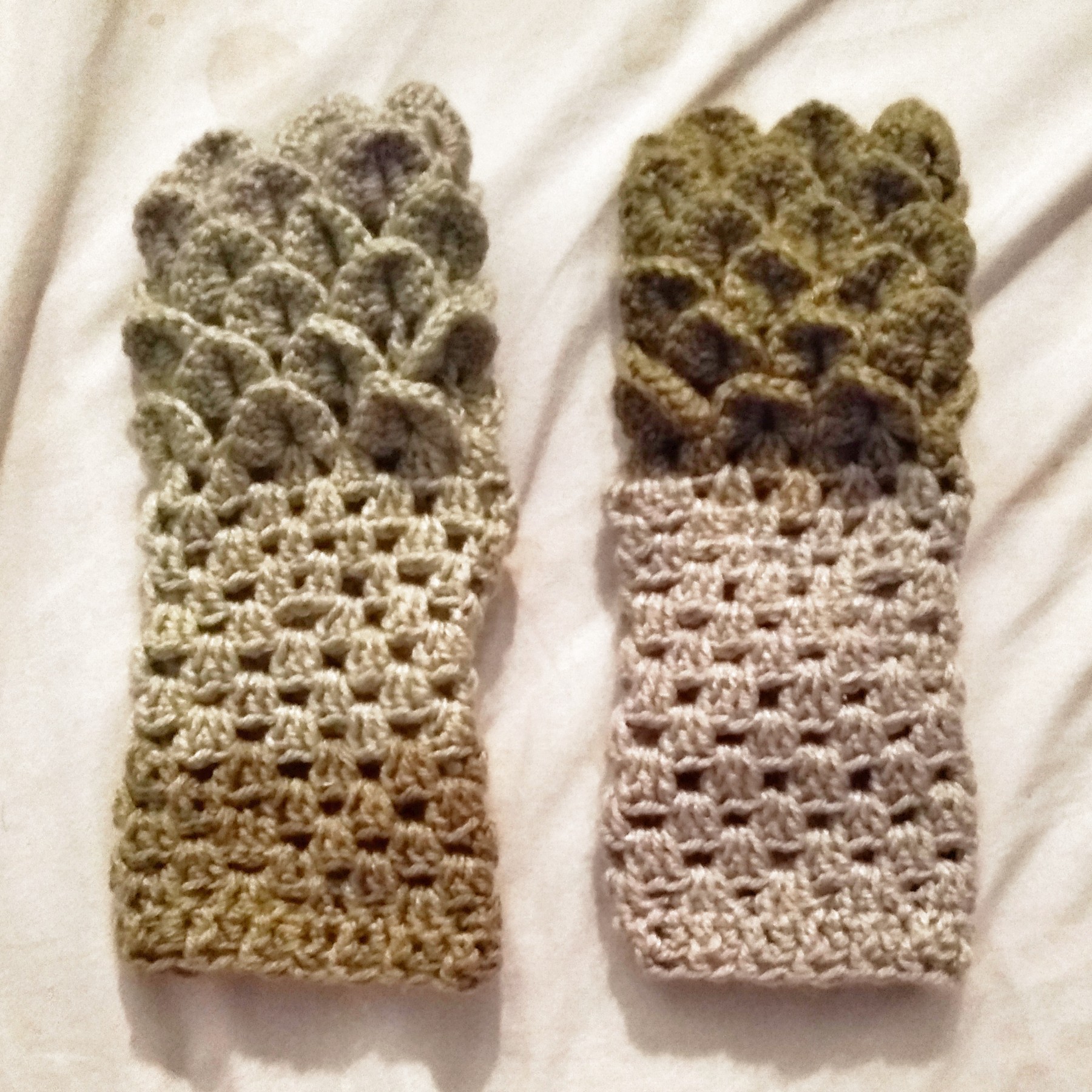
🧶 Finally finished crocheting these dragon scale fingerless gloves. They’re a birthday gift for my sister. Her birthday is January 18… 😬