My sister’s friend Connor shared this hilarious Les Mis parody dedicated to teachers with us.
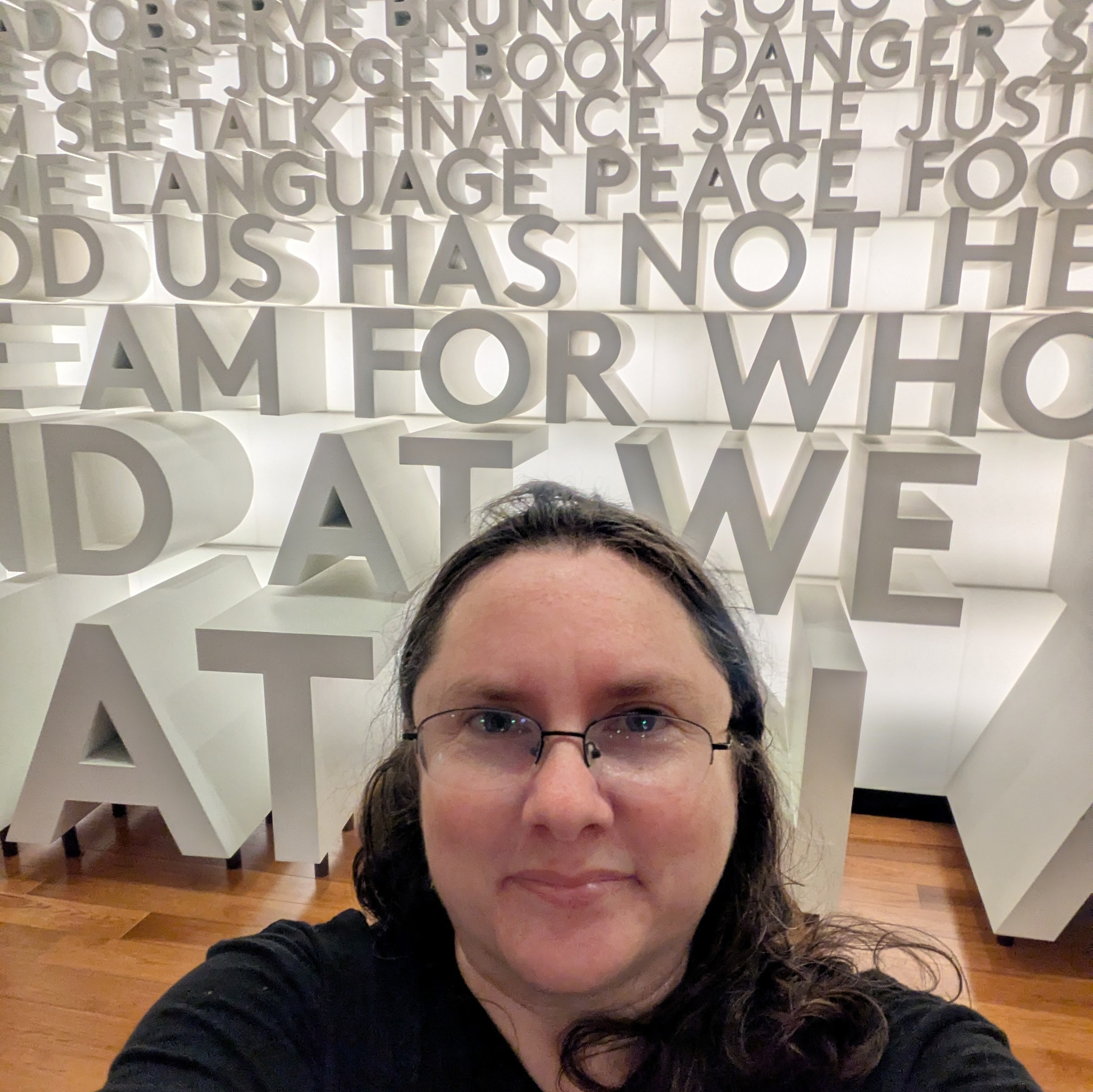
Planet Word Museum in Washington, DC
Hi there! I'm Kimberly Hirsh. My pronouns are she/ her/hers. I'm somebody's mom. I work as a school librarian. I have a PhD in information and library science. I love to read, play tabletop and video games, and make things. I used to perform in theater and improv comedy and I may one day again. I have been extremely online since 1993 and still enjoy tinkering on the web. I manage multiple chronic illnesses. I'm married to my kid's dad. We have a cat.
Want to get in touch? You can reach me by email.
Recent posts
I like The Muppets (2015) TV show more than I thought I would. 📺
 _My brother gave me [this Muppet version of The Phantom of the Opera ](https://www.penguinrandomhouse.com/books/546080/muppets-meet-the-classics-the-phantom-of-the-opera-by-gaston-leroux-and-erik-forrest-jackson-illustrated-by-owen-richardson/) a couple Christmases back, and I have genuinely never felt more seen in my entire life._
Back in June 2019, M. and I visited the Center for Puppetry Arts in Atlanta, GA while accompanying W. on a work trip. They have a whole gallery devoted to Jim Henson’s work. My family has always been a Muppet family, I suppose because my parents had only been married a couple of years when The Muppet Show started airing and I wasn’t born until it had been on the air for four years. I saw it a great deal, so it must have been available in second-run syndication. And then of course there were the movies, which I watched many a time.
This visit to the Center for Puppetry Arts reminded me of my long-standing affection for The Muppets, something I hadn’t thought about overly much since purchasing the Blu-Ray of the 2011 movie The Muppets, which I adore. Truly, coming around a corner from the Sesame Street part of the gallery to the Muppet part of the gallery, I saw Kermit the Frog sitting on a director’s chair in a glass case and it was like seeing an old friend. I think I may actually have said hello to him.
Since that trip, I have slowly been bringing M. into my Muppet obsession. I think it may have begun with this adorable clip of Kermit and a little girl on Sesame Street:
and continued with “Mahna Mahna”:
I’m not sure what order the rest of it all proceeded in, but it involved the Kermit stuffy I bought at the Center for Puppetry Arts, an old Muppet Babies Kermit stuffy from my childhood, a squeaky Muppet Babies Miss Piggy toy that my sister found in her house, some Muppet picture books that are probably over 35 years old (and not in great condition), and The Muppet Movie. Through all of these activities, our household is in the throes of Muppet Fever, and I love it. M. has been especially obsessed with Muppets Most Wanted, he says because he likes that there are two frogs in it (not counting Robin’s brief cameo). We used an audiobook on a doublet set of the novelizations of the two most recent Muppet movies. He falls asleep to it every night.
Earlier this week, when we had just finished watching Muppets Most Wanted and he said he wanted to watch more Muppets stuff, we decided to try the 2018 Muppet Babies. I had tried it once before and not been able to handle the CG-ness of it, but I will try just about anything for him. It’s actually super cute and has some phenomenal jokes and references for parents.
Since I hadn’t liked this before but was finding it fun now, I decided to try the muppets.. I had been very excited when it was announced, and immediately turned off by the clear references to The Office which is just not for me. I didn’t like the mockumentary style and I was really displeased by the character design for Kermit’s not-Miss Piggy-but-still-a-pig girlfriend. But that was 2015, and this is now! So I started it.
I’ve really been enjoying it. The writing is sharp; the showrunner was one of the writers on Muppet*Vision 3-D, which does a brilliant job of capturing Muppetness. There was an uproar when the show came out about its depiction of relationships, sexuality, and alcohol use as being inappropriate for a “family” property, but one of the earliest Muppet specials was called The Muppet Show: Sex and Violence, so that really doesn’t bother me.
I think the show gets better further in to the run, as the really familiar bits of character come out.
One critic compared it to Studio 60 on the Sunset Strip, but I think it really has a 30 Rock vibe.
One of my favorite things about it is how very much screentime Uncle Deadly gets. He leaped into my top 3 muppets (after Kermit and Piggy) after I saw him in the 2011 movie and, upon researching him, discovered that he is the Phantom of the Muppet Show.
Anyway: I have loved watching this show and am looking forward to the episodes I have remaining. I have been reminded that I have no other OTP that I cling to as fiercely as I cling to Kermit/Piggy.
Finally, if you, too, are obsessed with Muppets, especially if you have seen The Avengers and understand fandom tropes, please go read what is possibly my favorite fanfiction ever written, Avengers: Earth’s Muppetest Heroes.
Our family's social distancing schedule
I wanted to share our family’s current weekday schedule, mostly to help other people feel okay about theirs. This isn’t what every day looks like, but it’s a good sense of ours.
7 - 8 am Get up somewhere in there.
8 - 8:30 am Laze about, take meds, go to the bathroom, do puzzles, read, snuggle
8:30 am - 9 am Family breakfast
9 am - 10 am W gets to work; K & M do activity - most recently from either Fun at Home with Kids or Hands on as We Grow
10 am - 11 am Free play in the playroom, snack
11 am - 12 pm Screen time (lately, the new iteration of Muppet Babies)
12 pm - 1 pm Lunch as a whole family
1 pm - 3 pm W goes back to work, audiobook and quiet bedroom play (I rest in M’s room during this time)
3 pm - 4 pm Snack, playroom free play
4 pm - 6 pm Screen time (more Muppet Babies, maybe Muppets Most Wanted)
6 pm - 7 pm Family dinner (both making and eating)
7 pm - 8 pm Stories
8 pm Lights out
You’ll notice there is absolutely no space for me to get any work done in here. That’s not sustainable long-term, though I was willing to accept it for this week and treat it effectively like spring break. In the future, I’m hoping we’ll get a 4 or 5 hour block of grandma time in there many a day so I can really get to work. If that doesn’t work out, one of the screen time blocks will probably be W & M together while I go off to get a couple of hours of work in.
Me getting rest is prioritized pretty highly here, too. I’ve been in the middle of an autoimmune flare for I don’t know how long, and have had many a coronavirus anxiety spiral. My sleep is… Not great.
Also, there’s not specific time blocked in here for getting outside. We do make an effort to get outside every day, sometimes for a family walk, sometimes sidewalk chalk in the culdesac, sometimes just catching some fresh air on the porch. I want to move toward more deliberate outside time and/or indoor physical activity next week. I also want to provide M. with resources to follow his interests. He wants to learn about robots and turtles next week, he says. He’s indicated that he wants to prioritize turtles over robots, but is interested in both.
Anyway, there’s no real deliberate learning and there’s absolutely zero teaching; the activities are fun things mostly to keep me from completely losing it. I do them first thing because genuinely by 10 or 11 I feel like I’ve already used up my spoons for the day.
So yeah. It looks structured, but it’s not. This is more of a DESCRIPTIVE schedule than a PRESCRIPTIVE schedule. It’s just kind of what’s been happening. I hope it’s helpful.
From my last note, which said only “It me,” you may be wondering “What she?” I was trying to include this image. It. It me.
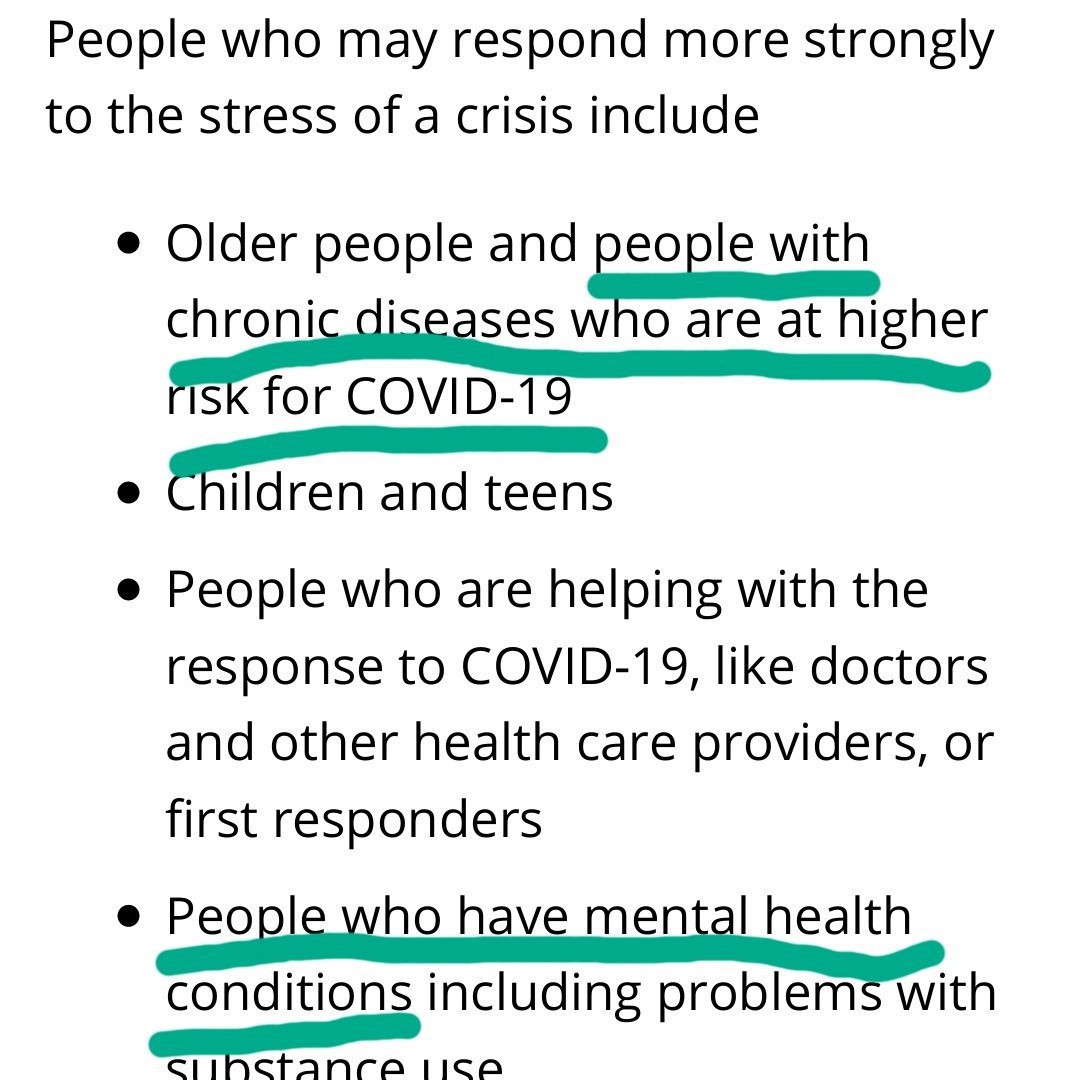
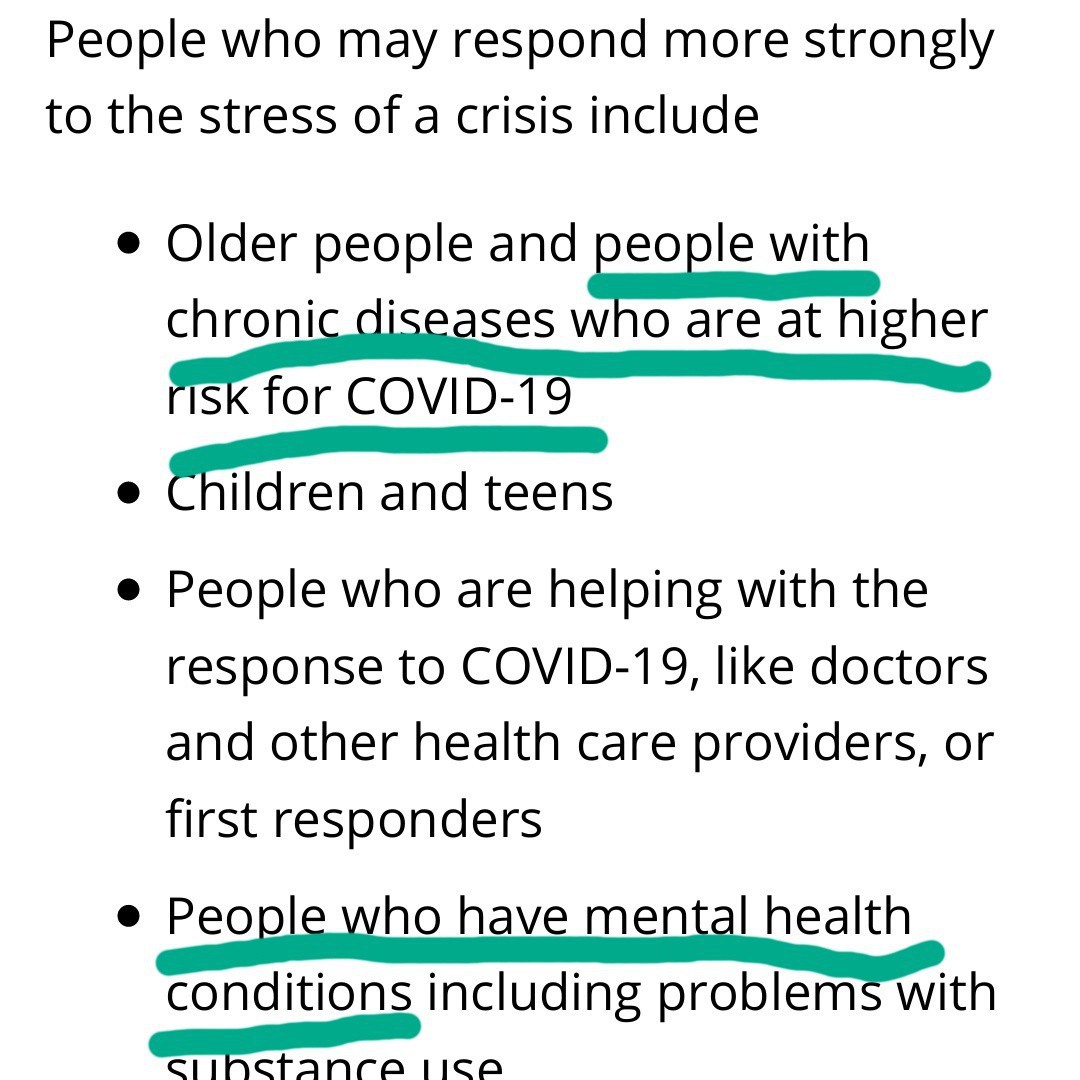
It me.
Life has been extra intense from March 6 until now. I missed a dissertation fellowship application that was due 3/15 (only $3K but that would fund some travel). There are two I’m eligible for due at the end of the month, no word about whether those dates will be changed.
What I'm doing about my pandemic anxiety
Something in me has broken, and now I am cracked, open and vulnerable. For the first time yesterday, I set my armor of humor aside and sat with the fact that, as a high-risk person, I am scared. I am scared not because I think coronavirus will kill me; I am scared that it will incapacitate me for any time at all, that it will place a huge burden on my family. I am scared that I will have to be kept away from my child. I don’t think I have it, but I’m scared that if I get it, this will be the outcome.
In November 2018, I had walking pneumonia. It was miserable. If that’s what a “mild” case of pneumonia is, I don’t want to know what a moderate one feels like. My husband, W., was out of town, I was on my own with my kid, M. I don’t know why I didn’t seek out more help from my family. W. came home and we almost immediately set out for Charleston as a family; I could have stayed home with M. by myself for a few more days, but that didn’t really sound like convalescing. So with what my doctor had said was inflammation but not yet infection (this was before the walking pneumonia diagnosis), I traipsed about Charleston with my kid. Our last day there, at breakfast, my lungs actually started feeling wet and gurgly inside them. I made an appointment to see my doctor as soon as we got home. (I was past the worst of the coughing at this point, so I thought I was on the mend. Ha.)
I came home, she diagnosed me with walking pneumonia, gave me some antibiotics, and an order for an x-ray if I didn’t start improving in the next couple of days. I took ONE DAY to stay in bed all day, and then felt like I better get back to helping with my kid, since he is basically my only family responsibility and it never feels great to me to ask the person who provides 85% of our income, cleans, does laundry, does dishes, and does yardwork to take on more childcare than he normally does. (He’s basically primary caregiver on weekends, too. He is remarkable.) I don’t think it was apparent to anyone else except maybe my mom how sick I was. Including M. and W. I think they thought I was a little unwell.
I got better, though pneumonia - even walking pneumonia - takes several weeks before you get as strong as you were before. And I don’t think I ever really got close to my pre-pneumonia level of strength and energy (which itself was not that great, because chronic illness). My lungs still feel a bit wobbly whenever I get anything respiratory.
I don’t want to feel like I did then.
I also am increasingly believing that the current disruption to life which has led me to be a stay-at-home mom more and a scholar less is going to continue for longer than I originally anticipated. And it’s kind of hard to feel like cosplay research is important right now (though honestly, it’s actually information literacy research and that feels VERY important right now). So I’m re-evaluating what I want to direct my attention to right now.
I’m not doing great with combatting social isolation. My introversion combined with flare up/world state low energy makes me less likely to initiate communication, so I’ve been trying to stay connected in more passive ways. But my efforts to stay connected, which have consisted mostly of scrolling Micro.blog and Twitter, have now driven me into middle-of-the-night anxiety spirals, so I’m taking action to disrupt those. Here are the things I’m doing.
Getting my news once per day via email. I get The Skimm for national and world news, the Indy Primer for local news (though it also covers national and world news), and the Wired coronavirus update for coronavirus-specific news.
Only looking at notifications/mentions. I am not going to scroll Twitter or Micro.blog anymore, as each time I do it throws me into an anxiety spiral. I’m only looking directly at my notifications or mentions. I have pinned these pages in Firefox as top sites, so I can go to them without having to navigate timelines or feeds to get to the notifications/mentions.
Consciously connecting with communities I know will alleviate my anxiety. Mostly, this is Kim Werker’s Community of Creative Adventurers right now.
Committing to doing more with my hands and living in my body. In the middle of the night, a balm for my anxiety came over me: GARDEN. This works on a couple levels, because gardening is a soothing activity, and also because I’m in this panicked near-survivalist mindset and if I can garden, I can learn to grow my own food, and then it won’t matter if the grocery store doesn’t have strawberries. (Obviously that’s a more long-term outcome, but I’m feeling pretty dire right now.) So I got out my copy of You Grow Girl and visited Gayla Trail’s blog, where I found a blog post from her that perfectly echoed my mindset. So this is where I’m at right now.
Watching Muppets Most Wanted with my kid as many times as he wants. It’s bizarre to me that he prefers this to the 2011 The Muppets, but whatever. This song, in particular, delights me every time. (Also, Tina Fey. Tina Fey delights me as well.)
When my kid’s preschool announced that they would be closing, I had plans to blog daily about my experiences in the middle of this widespread social distancing experience. But I’ve found myself without the energy. I told W. I just want to crawl into bed and I said, “I don’t know if this is 3+ years of parenting catching up with me, or an autoimmune flare, or just the world.” He suggested it’s probably a combination of the three. Bakara Wintner did her live weekly Tarot reading from her bed. This feeling is a mood.
But @colinwalker and @hutaffe have both written about how this is a time for blogging (here and here, respectively) and I really do believe they’re right. So when I can blog, I will.
At present, my child is absorbed in playing with miniature water beads that we made together yesterday. This activity is for sure a winner: we made them together and he is contentedly pouring them between different containers now and has been for about 45 minutes.
Some background on me informs my social distancing experience somewhat. I have Hashimoto’s thyroiditis, which is definitely an autoimmune disease, and polycystic ovary syndrome, which may or may not be. Advice on whether having an autoimmune disease makes one at a higher risk for acquiring coronavirus is mixed, but Mary J. Shomon, a thyroid patient advocate who I trust, published a report suggesting that autoimmune patients should at least act as if they are at a higher risk, even if they are not. This is the point from which I’ve been operating.
I’m a graduate student, a doctoral candidate with a research assistantship. This means that all of my work at present is research driven: my current projects involve collecting data for my dissertation and transcribing data for a study my RA supervisor is doing.
I have a 3 year old son who usually spends a half-day in Montessori while I work on my research in the co-working space on the other side of the building. This is the only time I do work; the rest of my time is spent caring for him or recovering from caring for him because as mentioned, autoimmune disease. (My primary symptom is fatigue, and life is a constant calculation about what I have enough energy to do and how much energy it will cost me to do something. For more on this, see the Spoon Theory.) For about six hours a week, my mother-in-law is with him, and during that time I usually rest or make dinner. On the weekends, my husband spends a lot of time with him, and that’s when I rest or do what little housework he leaves for me. I’m very blessed in that my husband, W., takes care of basically every household task: cleaning, laundry, dishes, packing M’s lunch and snack, getting M. dressed. I hope this won’t always be the case, but right now, my jobs are keeping M. alive, keeping myself alive, and going to school.
W. works at a university library full-time as the director of their copyright and digital scholarship center. Both my university and his university have encouraged social distancing, so he is working from home. He is working fairly normal hours, adjusted due to his not having to commute. From 9 - 5, he is holed up in our bedroom, doing work. He has a lot of virtual meetings these days, as you might imagine, and is also finishing up some pretty big grant applications.
So. W. has to do his work and Montessori is closed. This means that grad school, which has been more of a side gig than my main deal ever since M. was born, has basically been pushed entirely to the side. I can’t work on research at the same time as I’m caring for him, even if he is distracted by TV, because I need to get in as close to a flow state as a mom can get. And then again, when I get mother-in-law time (which is a risk we’re accepting, really, as she has been out in the world and seeing massage clients and getting acupuncture herself but we’ve decided the risk is worth the help), I use it to rest. Or cook dinner.
On top of all of this, M. is going through a super clingy phase. He’s been for most of his life pretty happily to play independently, but not as much these days.
Still, we’ve worked out some routines that make this all easier. We get up in the morning and snuggle a bit and then have breakfast. We play for a while, and then at 11:30 we might watch a couple of episodes of TV, or go outside. We go outside for a bit - on a walk if M. feels up to it, or just to the front or back porch for some fresh air if not. We come inside, put on an audiobook, and M. plays quietly in his room while I rest in there. (He insists now that he can never be alone without a grown up, which is quite a change from a couple of months ago when he was eager for alone time.) We get up and play some more, watch a little more TV, have dinner, read stories, go to bed.
I sneak off to my bed as soon as he’s asleep, and sometime between midnight and 5 am, he asks me to come back to his room. (That part is the same as when preschool was open.)
This is hard and I often want to just resort to 8 hours of screen time a day, but I’m trying not to.
I’m concerned about the impact all of this will have on my dissertation progress, but I’m also surrendering to this being where the world is right now.
And I’m thinking about what I might do one day when I’m employed again, whether that’s self-employment or employment by an organization. These days, I’m leaning toward research communication and higher ed outreach, something alt-ac that lets me translate research for the public. Public humanities or public social sciences, if that’s a thing. (I’d love to do scicomm for Marine Science but I don’t think I have the science background necessary. Still might try, though.) Or professional development, or publishing. Kind of the same stuff I’ve been thinking about this whole time.
I’ve been squeezing in some video game time here and there and did my first Twitch stream yesterday. I created a new channel called momtroidvania. I’m playing Castlevania: Symphony of the Night for the umpteenth time (though I’ve only beaten it once) and found that really fun.
I’m reading Blue Mind and Going Alt-Ac. I’m hoping to do more comics reading soon, too. Take advantage of that whole Marvel Unlimited thing.
We watched Frozen II. I cried a lot, just like when I saw it in the theater.
But mostly, I just want to rest and rest and rest. I have not yet talked M. into just staying in bed all day, and I don’t think I’m likely to.
I know I’ll miss all of the snuggles and clinginess when he’s a teenager. Somehow knowing that doesn’t make me not want to sometimes have my body to myself right now. (I foolishly thought my body would be my own after weaning. Whoops.)
And yet this clingy guy is the cutest person ever who is super sweet and makes me laugh. Kids. They’re a lot of work, but they’re worth it.
M. asked “How old is Darth Vader?” I calculated using this timeline & told M., “41, the same age as your daddy.” M. said, “That’s a big, big number for an old, old Sith Lord.”
Social distancing day 4, no preschool day 2: M is enjoying these miniature water beads from FunatHomewithKids.com.