
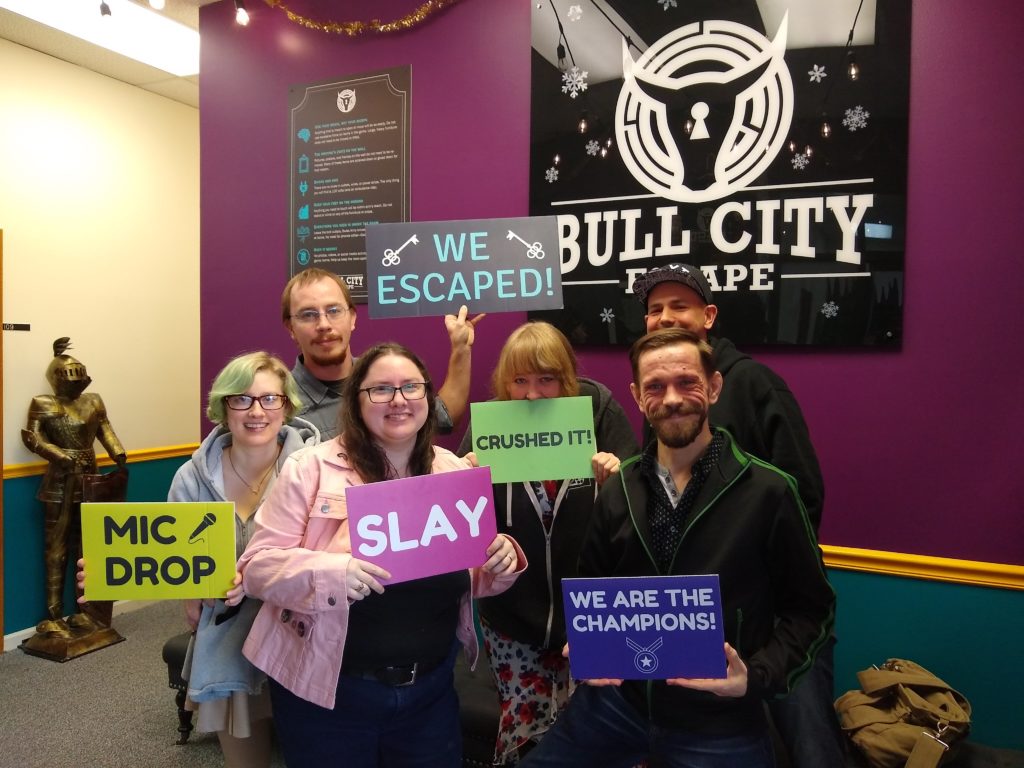
Have now escaped 100% of @bullcityescape's rooms. And we'll be back when they make new ones!
Have now escaped 100% of @bullcityescape's rooms. And we'll be back when they make new ones!
I’m here for improv in libraries AND I recommend checking out FairPlayMN’s documents on levels of intimacy & boundary check-ins as part of your programming prep. Understanding that the first thing you have to YES AND is the fundamental dignity of your scene partner is crucial.
Writing music and reading music are different music. My writing music is video game or film scores. My reading music is chill beats, piano, quiet instrumental stuff. What about you? What’s your writing music? What’s your reading music?
I need to be reading & writing about information literacy as a sociocultural/sociotechnical practice, but I think swiss cheese Mom-brain is incompatible with Practice Theory. I just can’t handle words like “ontological” and “epistemological” when I’m running on 2 weeks of poor sleep because of my kid teething and never napping.
I’m trying to find a word to help me navigate these times in 2019. Something having to do with cycles… Being like the moon or like water… Working hard at high tide? Still figuring it out.
Today I listened to Lindsay Mack’s amazing first episode of the new version of her podcast, in which she discusses birth, death, and thresholds with doula/mom/actor/comedian Erica Livingston of Birdsong Brooklyn. It was so phenomenally healing. I might try to listen again and take notes so I can share the moments that really stood out. I haven’t fully processed my birth trauma, even though my kid is 26 months old. I so appreciate being given permission to see myself as postpartum forever, because that’s the reality of parenthood, isn’t it? Thank you so much Lindsay and especially Erica for this wondrous bit of medicine.
I wrote 2 pages about new models of information literacy in affinity spaces today, or about 968 words.
I’m trying a new thing with my writing. Usually my process is Read > Take Notes > Concept Map > Outline > Write, the whole paper at once. But right now I’m trying a thing where it’s Read > Take Notes > Quick Outline > Write for just a small chunk of the paper and I’m really liking it.
I’ve probably read that this was a good way to write in a million places, but I can’t identify any of them right now.
There are lots of gaps, but I wouldn’t even know those gaps were there before I started writing, so there we are. If you’ve been struggling, maybe try this more cyclical writing process.
I find myself admiring people who seem together. They are well-coiffed. Their clothes are carefully styled. They welcome you into their homes and effortlessly manage to make it feel like everything is totally fine and will continue to be so. They are pleasant. They are calm.
I recently gave myself permission to accept that I will never be one of these people.
Smooth and collected will never be part of my personal brand.
Then I gave myself permission to think about what is, naturally, part of my personal brand, and go all-in on that. Here’s what I came up with:
“I forgot to create a personal brand” card by Emily McDowell. You can buy it! There’s also a mug and a magnet.

Just read all of Friends with Secrets and cried and I think there’s a lot of journaling in my future?
Me, to W— this morning: I don’t know if you can cast every musical with the characters from Daniel Tiger’s Neighborhood.
Him: Challenge accepted!
Y’all, I’m scholarlily-enamored of my committee. (Scholarlily is a new adverb. I give it to you.) Everyone on it is so cool and down-to-earth and does interesting work.
Want to know how to get an awesome committee like mine? Well, I can’t tell you, but I can tell you how to request that someone serve on your committee. After meeting to discuss my prospectus and where we thought my comps should go, my advisor and I planned for me to request that certain people serve on my committee, with her sort of taking over committee organization/management after they agreed to serve.
In my department, a dissertation committee consists of five people and at least one of them must be external to the department. We identified four people to be on my committee; the advisor is always the chair of my committee. We chose two professors from within the department, and two from outside the department. Here’s my prospectus in case you want to review it again. And here’s my committee:
Sandra Hughes-Hassell: My advisor. She’s on the committee of course because she’s my advisor, but also because of her interest in youth services.
Casey Rawson: A friend, colleague, and classmate from my MSLS days. She’s a professor of research methods, so she is my research methods expert. Youth services is also an area of research interest for her. In addition to her areas of research expertise, she has personal interests in fandom and crafting, both of which make my topic of interest to her.
Brian Sturm: A professor who taught me in my MSLS days. He studies immersion, and boy is cosplay about being immersed, right? Also helpful to have on the committee because of his expertise in youth services.
Heather Moorefield-Lang: My first external committee member. She’s got expertise in qualitative and has done a lot of research on makerspaces. Because I see making as a key element in cosplay, I wanted her on my committee. She also used to be a theater teacher and I am a lapsed theater person, so I expected there might be some good personality fit there. (I’m pretty sure I was right.) I didn’t know her, but I’d interacted with her some on Twitter and Sandra had met her at the Tennessee Association of School Librarians conference.
Crystle Martin: My second external committee member. If you’re basing your whole study on providing confirming evidence for/extending someone else’s study, it’s nice to have that person on your committee. She’s also a Connected Learning expert, and that’s a framework I definitely want to bring into my dissertation work, as it’s kind of my whole reason for getting a PhD. I also had expected a good personality fit here, as we share interests in fandom and gaming. (She once spoke on a panel called “What Buffy the Vampire Slayer Has to Teach Us about Games, Education, and Self-directed Learning,” soooo…) I had met her once about three and a half years ago, when she came to campus for a visit and I was working in the School of Education.
So Sandra and I settled on these four people to ask to serve, but then it was up to me to actually contact them. I looked around on the internet for examples of how to invite people to be on your dissertation committee and found a little advice but no clear templates. So, keeping in mind the advice from the blog post The Basics of Professional Communication, Part I, I set about constructing my own, which I will share with you in just a moment.
But first, a note: please remember that you are requesting a service, not conferring an honor. Serving on committees is part of professional service for faculty members. But also, if they accept, they are doing you a favor. So try to keep that in mind in your verbiage.
Now, three templates for asking someone to be on your committee! But be sure to read after the templates for one more note.
1. Someone you already know well (in my case, Brian and Casey)
Dear [Recipient Name]:I hope this semester is treating you well. [Include some more conversational detail if you like.]
I am in the process of putting together my dissertation committee, and your expertise in [recipient’s area] would be very helpful. Would you be willing to be on my dissertation committee? I’ve written a brief draft prospectus for my dissertation research that you can review here: [link to your prospectus]
[Information about who will follow up - you or your advisor; scheduling a first meeting; any additional information you might provide later such as a bibliography]
If you have any questions, feel free to email me. Thank you for considering this request.
Sincerely, [Your name/email signature]
2. Someone you’ve met but don’t know well
Dear [Name]:My name is [your name], and I am a [your year] doctoral student at [your institution and department] working with [your advisor]. For my dissertation, I am planning to research [your topic/research question]. [A one-sentence reminder of when and how you met.]
I am in the process of putting together my dissertation committee, and your expertise in [recipient’s area] would be very helpful. Would you be willing to be on my dissertation committee? I’ve written a brief draft prospectus for my dissertation research that you can review here: [link to your prospectus]
[Information about who will follow up - you or your advisor; scheduling a first meeting; any additional information you might provide later such as a bibliography]
If you have any questions, feel free to email me. Thank you for considering this request.
Sincerely, [Your name/email signature]
3. Someone you’ve never met
Dear [Name]:My name is [your name], and I am a [your year] doctoral student at [your institution and department] working with [your advisor]. For my dissertation, I am planning to research [your topic/research question].
I am in the process of putting together my dissertation committee, and your expertise in [recipient’s area] would be very helpful. Would you be willing to be on my dissertation committee? I’ve written a brief draft prospectus for my dissertation research that you can review here: [link to your prospectus]
[Information about who will follow up - you or your advisor; scheduling a first meeting; any additional information you might provide later such as a bibliography]
If you have any questions, feel free to email me. Thank you for considering this request.
Sincerely, [Your name/email signature]
Some notes:
When selecting what to call the recipient in the greeting, here are my general guidelines:
All of the people I requested to be on my committee accepted, and we had our first meeting last week, which is why next time on Dissertating in the Open, I’ll write about Your First Meeting with Your Committee!
Thanks to Jegged.com for the Final Fantasy VII Party Select Screen Image.