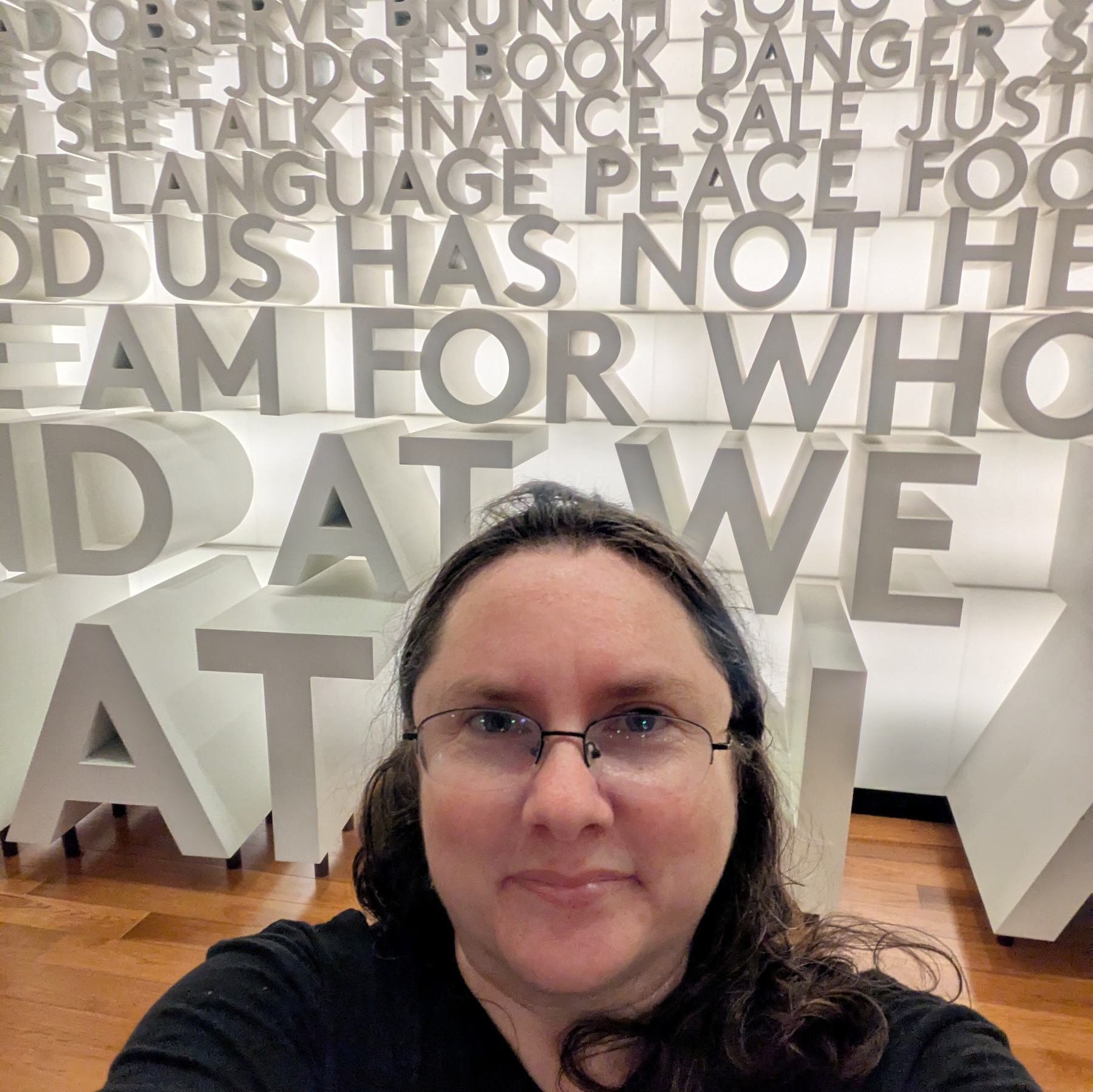
A white woman with dark hair and glasses stands in front of a wall with several words in 3d on it. The word 'BOOK' is centered over her head.
Kimberly Hirsh in front of the wall of words at
Planet Word Museum in Washington, DC

Hi there! I'm Kimberly Hirsh. My pronouns are she/ her/hers. I'm somebody's mom. I work as a school librarian. I have a PhD in information and library science. I love to read, play tabletop and video games, and make things. I used to perform in theater and improv comedy and I may one day again. I have been extremely online since 1993 and still enjoy tinkering on the web. I manage multiple chronic illnesses. I'm married to my kid's dad. We have a cat.

Want to get in touch? You can reach me by email.

Recent posts

On Millennial burnout

Some notes on Millennial burnout. This started as a Twitter thread because I needed a frictionless place to write my initial ideas, and apparently I was hoping they would get some attention. (They didn’t, really, and that’s fine now that I’ve slept on it.)

Anne Helen’s excellent piece on Millennial burnout sketches out a framework for us to think about why (white, middle class) Millennials are burned out. She admits that a framework is not a solution, and in her newsletter that acts as a sort of commentary track she talks about both why she didn’t use academic jargon (BLESS HER) and also didn’t offer a solution (which I’m sure is disappointing/frustrating for some people). Tiana ClarkĀ offers a valuable critique about the limits of this sort of generational thinking and its failure to capture the experiences of people of color. Helen published additional perspectives on what Millennial burnout looks like for different people: black women, first-generation immigrants, queer people, chronically ill people, people with disabilities, people at the intersections of more than one of these identities, and more.

I’ve collected some less in-depth pieces on the phenomenon in my Pocket, like Kristin Iversen’s Why Millennials Are Always Tired (found via Holisticism’s newsletter), which approaches Millennial exhaustion more from the perspective of the youngest Millennials, as opposed to Helen’s piece coming from the perspective of older Millennials. (Jesse Singal’s Don’t Call Me a Millennial – I’m an Old Millennial is my favorite piece that makes it clear how old Millennials and young Millennials differ and what the inflection points are for Millennialness.)

Helen says:

You don’t fix burnout by going on vacation. You don’t fix it through ā€œlife hacks,ā€ like inbox zero, or by using a meditation app for five minutes in the morning, or doing Sunday meal prep for the entire family, or starting a bullet journal. You don’t fix it by reading a book on how to ā€œunfu*k yourself.ā€ You don’t fix it with vacation, or an adult coloring book, or ā€œanxiety baking,ā€ or the Pomodoro Technique, or overnight fucking oats.
This is basically a caricature of my life. I have been an avid follower of Lifehacker, obsessed with Inbox Zero, installed and uninstalled Headspace and Calm, prepped meals for the week ahead, used a Bullet Journal for approaching five years, read and re-read Unf*ck Your Habitat, have the immense privilege of being able to take a beach vacation annually, have a huge stack of adult coloring books, anxiety baked my way through my Master of Science degree, powered through PhD writing using the Pomodoro Technique, and had overnight oats for breakfast every day for a week. (Other things that won't fix it: mason jar salads. An Instant Pot. Subscribing to every self-care newsletter and podcast. Witchery.)

And I agree with Helen that

...individual action isn’t enough. Personal choices alone won’t keep the planet from dying, or get Facebook to quit violating our privacy. To do that, you need paradigm-shifting change.
But at the same time, I can't sit and wait on that paradigm shift. Helen doesn't have a plan of action, but I need one. So that's what I nattered about in that Twitter thread. And here it is, summed up:

We have to perceive ourselves, and by extension others, as creatures of inherent worth, not merely parties to transactions, in spite of existing within an economic system that views us exactly as such.Ā Tiana ClarkĀ points out that being a literal commodity was an actual, physical reality for black people until 1865. I think our economic system still relies on people seeing themselves as engines or tools.

I think we have to reject that idea with our whole hearts.

When I was a freshman in college, I saw a clinical social worker in my school’s Counseling and Psychological Services department. I saw him once and never again, because he enraged me. But now, almost 20 years later, I’m realizing he was really right in one thing about his assessment of me. He’d asked me to tell him about myself. And after I did, he’d pointed out that everything I’d told him was about my achievements: the grades I’d gotten, the scholarships I’d won. I left angry. Of course those things were how I defined myself. Of course those things were what made me a person of value in the world.

My 18 year-old-self had completely bought into the idea that her value could be measured and had to do with the production of valued things. (In my case, scholarly output. That’s still the valued thing I try to produce.)

Almost-38-year-old me is ready to reject that idea. I have value because I am a person who exists. I don’t need to be productive all the time.Ā I feel a sense of purpose when I work, but that work is not what makes me a person.

The current version of me is ready to move into this way of thinking.

But, as I admitted in my Twitter thread…

I’m not there yet.

–

For more on “fixing” Millennial burnout, read Jessanne Collins’s Having a Kid Was the Unexpected Cure for my Millennial Burnout. It resonates with my experience as a mother of a young child.

Noah Smith identifies another piece of the burnout puzzle when he says Burned-Out Millennials Need Careers, Not Just Jobs. (Ask any stereotypical Millennial about their #sidehustle.)

Many thanks to Austin Kleon for first running Anne Helen’s piece across my radar.

Featured image is my favorite panel from Joss Whedon’s run on theĀ Astonishing X-Men, Vol 3 #22, drawn by John Cassaday. Colors by Laura Martin. Letters by Chris Eliopoulos.

I found this Man Repeller post viaĀ  the Holisticism newsletter. (One of my favorite reads every week.) It captures one of the important ideas I’ve been working with for several weeks now.

As I was trying to settle on a word for 2019, I went looking to a couple of oracle decks for inspiration: Lucy Cavendish’s Oracle of the Mermaids and Oracle of the Dragonfae. I didn’t find my word there, but I did pull one card from each deck that caught my eye and seemed like it captured some energy I wanted to live in 2019.

From theĀ Oracle of the Mermaids, Sanctuary:

and from the Oracle of the Dragonfae, Melusine:

I didn’t know until I read the card descriptions in the deck guidebooks that Melusine is actually the mermaid depicted in Sanctuary. So I chose Melusine twice.

Who is Melusine?

If you’re big into mermaid mythology, you know her already. And even if you aren’t, you probably do, because this is her, too:

Starbucks Logos

You can read her legend at Wikipedia if you want. But here are the two things I’m taking away from Melusine:

  1. That I do need to enforce more boundaries. I'm lucky to have a lot of family support, so I do get a fair amount of me-time as compared with most moms of young children, but I don't use it wisely and I want to start doing that.
  2. That I need to really lean into being myself. In any version of the story, Melusine and her loved ones face the consequences of keeping a part of yourself hidden as well as of not respecting boundaries. Enforcing boundaries and being yourself can be balanced, and I want to work on that balance.

Submitted a solo-authored manuscript today, so in true millennial fashion, I feel like I deserve many high fives.

2019 Word of the Year: PHASE

It’s January 9 and I’m finally ready to talk about my intentions for this year.

I selected PHASE as my word of the year because I wanted to capture my intention to be chill in the face of cyclical experiences. To accept that my energy will ebb and flow. To surf the big waves when they come, being as productive as I can, and then to rest at low tide, letting my body recover. To recognize that whatever hard parenting moment I’m having at any time is just that, a parenting moment, even if it’s a moment where my kid doesn’t sleep for longer than two hours at a stretch for four weeks, because eventually we’ll come back around to a 6, 7, 8 hour stretch.

One of my favorite lines from the Aeneid is Book I, line 199: “dabit deus his quoque finem” (forgive the lack of macrons, please) - which comes from an even better couplet:

O socii—neque enim ignari sumus ante malorum— O passi graviora, dabit deus his quoque finem.
 

As happens so often, translating this directly is a challenge. And I don’t have my Fagles at hand and I’m not content with the Williams or Dryden translations at the Perseus Project, so I’ll paraphrase. At this point, Aeneas and his friends/comrades, who have sailed away from Troy, narrowly escaping death at the hands of the Greeks in the Trojan war, are shipwrecked at Carthage. And he rallies them, telling them, essentially, “We’ve been through bad stuff before; we’ve endured harder challenges than this;Ā god will give an end to these things, also.” It’s the Wheel of Fortune in the Tarot. It’s the Circle of Life.

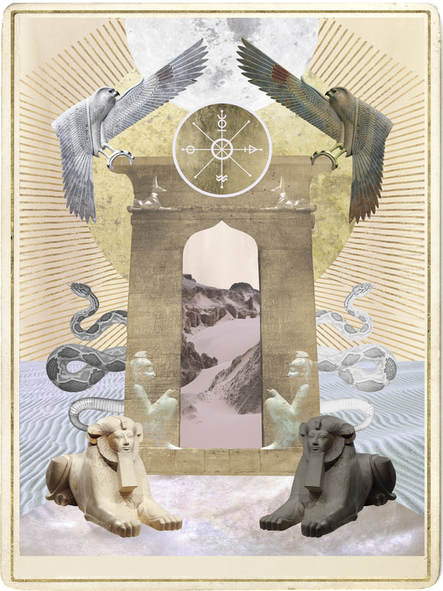
[caption id=“attachment_6507” align=“aligncenter” width=“443”]Wheel of Fortune from the Moonchild Tarot Wheel of Fortune from the Moonchild Tarot.[/caption]

Each of us has survived up to this point, and whatever we’re dealing with now, things will change before too long. And that might mean they’re worse, or it might mean they’re better, but whatever they are, they’ll be different.

That’s the key interpretation the Tarot reader gave me of the Wheel of Fortune right before my birthday, and it is the energy that I, as a chronically ill woman, as a mother, need to embrace. It is one of my key lessons in life: you’re strong, you’ve gotten through everything so far, you’ll get through this too. Don’t get too comfortable, don’t get too complacent, don’t despair too much.

So PHASE is my word, which captures cycles like the moon, which captures stages of projects, which in its verb form can be defined as “to adjust so as to be in a synchronized condition.” Also, it’s what you call it when Kitty Pryde uses her power.


I’m not big on resolutions, but here are the things I’m feeling/trying this year:

  • Embracing the PHASE energy.
  • Really owning my Mer-Goth/#seawitchvibes aesthetic.
  • Reading for pleasure more.
  • Having a good time.
That last one came from a fun Twitter autotext meme:

I think my phone’s keyboard is on to something.


Featured image is the 2019 Celestial Calendar by Rivtak. I put one on my Christmas list and got it. You can get your own here.

I’m lucky: they gave me a canonical #spidersona, trying to figure out how to make a better world for her kid while dealing with the daily tasks of early parenthood.

Writing music and reading music are different music. My writing music is video game or film scores. My reading music is chill beats, piano, quiet instrumental stuff. What about you? What’s your writing music? What’s your reading music?

I need to be reading & writing about information literacy as a sociocultural/sociotechnical practice, but I think swiss cheese Mom-brain is incompatible with Practice Theory. I just can’t handle words like “ontological” and “epistemological” when I’m running on 2 weeks of poor sleep because of my kid teething and never napping.

I’m trying to find a word to help me navigate these times in 2019. Something having to do with cycles… Being like the moon or like water… Working hard at high tide? Still figuring it out.

Today I listened to Lindsay Mack’s amazing first episode of the new version of her podcast, in which she discusses birth, death, and thresholds with doula/mom/actor/comedian Erica Livingston of Birdsong Brooklyn. It was so phenomenally healing. I might try to listen again and take notes so I can share the moments that really stood out. I haven’t fully processed my birth trauma, even though my kid is 26 months old. I so appreciate being given permission to see myself as postpartumĀ forever, because that’s the reality of parenthood, isn’t it? Thank you so much Lindsay and especially Erica for this wondrous bit of medicine.