
Just testing status format in WordPress. Nothing to see here…
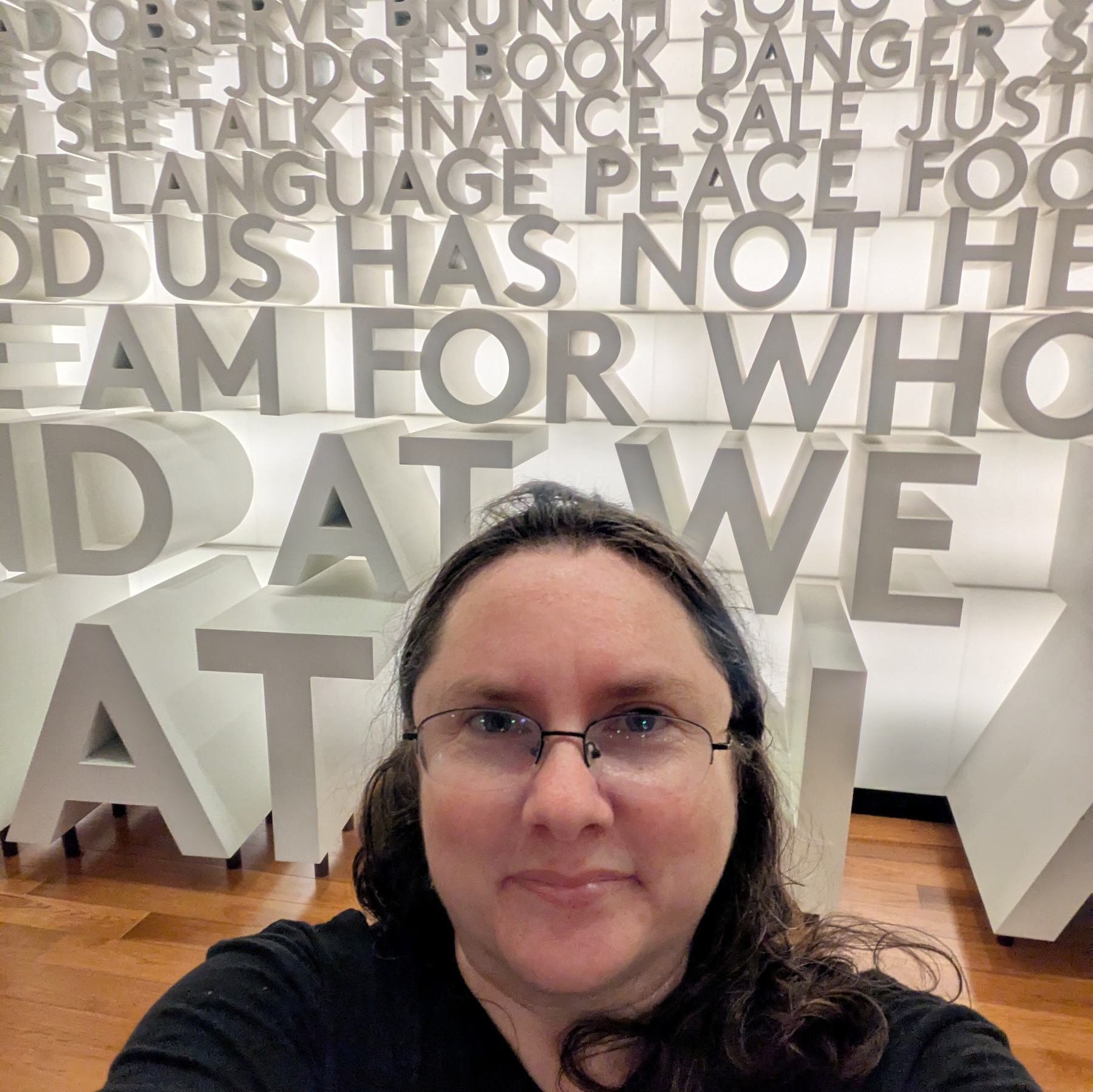
Planet Word Museum in Washington, DC
Hi there! I'm Kimberly Hirsh. My pronouns are she/ her/hers. I'm somebody's mom. I work as a school librarian. I have a PhD in information and library science. I love to read, play tabletop and video games, and make things. I used to perform in theater and improv comedy and I may one day again. I have been extremely online since 1993 and still enjoy tinkering on the web. I manage multiple chronic illnesses. I'm married to my kid's dad. We have a cat.
Want to get in touch? You can reach me by email.
Recent posts
Doing my part to fix the internet
I happened upon this tweet from my friend Whitney the other day:
Another good read from the Hot Garbage newsletter: https://t.co/GtVOPhhXjQ
— blorp (@WhitneyEllenB) March 17, 2017
It links to Vicki Boykis’s post, Fix the internet by writing good stuff and being nice to people. Boykis articulates a problem that I’ve been chafing against recently, that I had chalked up to nostalgia. In the early days of the web, and even as the web came into what I consider its adolescence, she writes:
People used to write blogs. Long blogs. Rambling blogs. Blogs they weren’t sure anyone was reading. There was a LOT of noise. But there were also blogs that had fun stories, long posts about how to do something, analyses of government issues, of cooking techniques, of the Civil War. People used to write stuff other people wanted to read.And then traces the process of consolidation of content and the move of the web from a medium where content was the product to a medium where content is the wrapper and eyes on ads are the product:
Whereas before content used to be spread out on numerous domains in numerous ways, content now mostly makes its home on the three domains that are most hostile to thoughtful human discussion: Twitter, Medium, and Facebook.Now, she says, those of us who use these services are generating content that they are leveraging to make money off of us. Theoretically, we're getting their services in trade for this content, but we aren't where they make their money. We trade our content to them, and they trade our attention to advertisers.
The internet is broken; this is how it is broken. And, she insists, it is in our power to fix it. She identifies five steps we can take to do so:
- Write your own blog on your own platform.
- Share good content.
- Acknowledge creators by paying them.
- Use adblockers.
- Engage in dialogue with people who are different from you.
So tell me: are you seeing this post somewhere in the world? Where?
Of course, that process really only addresses Boykis’s first step. I took a social media hiatus recently and tried to remember how I used to use the internet. And it really was blogs, forums, and LiveJournal. I’m certainly not going back to LJ, and so far I haven’t found forums that satisfy me, but good blogging is still happening, so I loaded a bunch into Feedly. Then I returned to social media a bit more consciously, and I do think I’ve been sharing good content then. But - you guessed it - now, I’m going to share that good content here.
As for the third step, I do this a little bit already, via Patreon. There I support Kim Werker, Emm Roy, and Kate Allan. I keep an eye out for other creators I like to support directly. Serendipitously enough, two posts came across my radar on Feedly from Geek and Sundry introducing their new partnership with Nerdist, Project Alpha. It’s a subscription platform providing exclusive content and other content in advance, and I think I’m going to try it out. I’m also probably going to try Seeso, too.
I have been taking a break from adblockers, but I definitely feel it’s time to get them back into my life.
As for number five, here’s where things get tricky. I can track down good blogs and engage in conversations there. But some of the most important conversations in my life are happening in proprietary spaces: Facebook Groups, Twitter, and Tumblr. As a new mom, Facebook Groups are an invaluable resource. As an academic and professional, Twitter is where many of the important conversations in my areas of interest happen. And fandom, well - it kind of lives on Tumblr these days, doesn’t it? If you have managed to move to engaging these platforms almost exclusively via your own hosted platform, how are you doing that? And are you doing it on mobile devices? Because that’s where a lot of my internetting needs to happen.
For the time being, I think my long form writing will happen exclusively here, but it will probably be a process to move short-form here.
Self-Care in Difficult Times
We live in a scary time. Many of us have been living in a scary time for hundreds of years. Some of us are only recently becoming aware of how scary life can be. And some of us always knew, but were able to set it aside. There are valuable discussions in the world about privilege and how it enables you to act like the world isn’t as scary as it is, but this isn’t one of those. This is about, wherever you are in realizing the world is scary, how you might handle it to keep yourself sane and whole in mind. I will acknowledge up front that some self-care techniques involve material goods. Please know that I’m keenly aware that all of my ideas are not accessible for all people. I don’t believe that makes them worthless. Do what you can, when you can.
Lately, I feel my resilience is strained. I imagine it as a wide rubber band. As it gets stretched, it gets thinner and thinner. It threatens to snap, and if I don’t deliberately create some slack, it will snap. Here are things going on with me that make self-care both difficult to achieve and especially necessary:
1. I am a graduate student. And being a graduate student is hard. It’s not intense physical labor, but it is intense mental labor. It is time consuming. It is never off in the way that some jobs are. There is always more work to do, and in my case much work leftover from the past. I am constantly filled with a sense that I am not being productive enough. Even as I write this post, I’m thinking about other things I could be reading and writing.
2. I am a new mom. I’m so lucky to be a new mom; it is a blessing that came as a happy accident after I had basically given up on getting to be a mom. I struggled with polycystic ovary syndrome for years before falling pregnant; I so appreciate this gift. AND YET. Being a new mom means my body belongs to someone else in a very real way. It means that at almost any point in time, I might need to stop any activity I’m doing - and this activity is usually schoolwork, food prep, or laundry - to attend to a tiny, helpless human’s needs.
3. I am a research assistant on a project focused on equity. My work that’s not for class is focused entirely on promoting cultural competence and culturally sustaining pedagogy, ensuring equity in schools, especially as it relates to race.
4. I deliberately chose my coursework this semester to require me to encounter issues of equity. Because I know that this is an area where I need to grow, I registered for a course called Decolonizing Methodologies and am serving as teaching assistant for a course called Information Services in a Diverse Society. These courses require me to grapple with issues of colonization, inequity, and intersectionality.
5. My usual take-a-break spaces - social media - are (rightly) full of news and protest. I’m a cat videos, cute doodles, and friends’ jokes girl. I would not suggest that we should remove the politics from our social media feeds, but I am not used to the current ratio of news to cat videos. I think it’s excellent that people are using these tools for resistance, and I myself have followed many organizations and people of late to increase my awareness. So I have deliberately transformed the ratio in these spaces for me. BUT it means that what used to consist of taking a break is now more getting aware. So I need to take a break in different ways.
So. Now that I’ve explained what’s straining at my resilience rubber band, let me share what I’m doing to give it some slack.
First, I’m staying engaged so that I feel in touch with the world. I have followed the New York Times, the Washington Post, and Teen Vogue on Twitter. While the combination of new motherhood and chronic illness keeps me from feeling confident in my ability to physically show up for protests, I am engaging in craftivism; I crocheted a pussy hat for a friend who was going to the Women’s March. I am going to make one for myself, as well; I’m also planning to contribute to the beanies for this Black Lives Matter march in Seattle and the crafted hats for the March for Science. I signed up for Kim Werker’s Craft + Activism newsletter, which sends me things to read and do. I sent emails and postcards to my senators; I used the Ink Cards app so that I could send the Women’s March postcards while nursing my baby.
Second, I’m escaping as I need to. This looks different for everybody, but for me it has meant watching old seasons of Project Runway, trying out the new CW series Riverdale (it’s not good and yet I’m enjoying it anyway), listening to Pop Culture Happy Hour episodes both old and new, reading Mark Waid and Fiona Staples’s Archie reboot, and reading Glen Weldon’s The Caped Crusade: Batman and the Rise of Nerd Culture. (I’m just sort of generally fueling a new crush on @glenweldon. My husband was all “But he’s gay so don’t expect it to be requited” and I was all “That really doesn’t matter because a crush is not a thing that needs to be requited anyway what with me being happily married to you and all. And him being married too. And famous.”) Check your library for access to escapist reading material, y’all.
Third, I’m trying… a little… to take care of my body. I’ve gone for a few walks. I’ve cooked my own meals. I’ve delighted in warm beverages. I’m still not showering often enough (#thanksbaby) and I haven’t gone for a swim since probably September, both of which would make me feel immensely better, but still. I brush my hair most days. I live in my body so I should really care for it, and I’m making at least some effort. For a person with clinical depression (even in remission), this is an achievement.
Anyway. These are the things I’m doing to care for myself. Self-care can be an act of resistance, so please don’t tell yourself that it is unimportant, that you are unworthy, that there are more important things in the world. If we’re going to have the stamina to fight the good fight, we need to give ourselves a break from time to time.
The best I can do is not a fixed point.
Still reading the advanced reading copy of the @unfuckyourhabitat book. There’s a whole section called “The Perfection Paradox,” about letting go of your perfectionism, and not using perfectionism as an excuse to not get started on something. I don’t consider myself a perfectionist; I, in fact, chafe when other people do. I’m a graduate student and my advisor called me a perfectionist once and I was all, “No, that’s not the problem!”
And it’s true: I don’t mind things being imperfect. (A Latin teacher maxim: “Perfect means finished,” because perfect tense is the tense we use for completed action. We don’t want to be perfect, because then there’s nothing left to do, and what a sad state that would be!)
So I’m not a perfectionist. But I’m a do-my-bestist, or some more elegant way of expressing that idea. I feel like if I’m going to bother doing something, I don’t want to half-ass it. I want to give it my very best, or why bother. But if it’s not perfect even after I’ve given it my best, that’s fine.
The problem is, I conceive of “my best” as a fixed point, my best ever, not the best I can do right now. I struggle with chronic illness and right now I’m 38 weeks pregnant. One of the lessons that pregnancy has taught me that chronic illness never did is that my-best-right-now sometimes needs to be good enough; my-best-ever is not always attainable. I am only really internalizing the lesson here at the end, though, and I have this section of the #ufyh book to thank for that, partly.
My best at a given moment is defined by a number of factors. How much sleep have I gotten? How much physical pain am I in? Is there anything going on in my social or emotional world that is eating a lot of my attention? My best is variable. I can only do the best I can do right now, and I need to not compare the best I can do right now to the best I could have done at some other time. Before I got pregnant, I was doing really well healing my chronic illness; it wasn’t gone, but I was barely symptomatic. I had plenty of energy and almost no pain. I could churn out a solid, well-written ten-page paper in two days, no problem. I would just sit down and write for six hours, go to bed, then get up and finish it the next day.
Once I got pregnant, things shifted. I often had to choose: is this reading for class going to be done thoroughly, or am I going to skim it and then take a nap? Or take a nap and then skim it on the bus on the way to class, even?
I wish I had learned to be this gentle with myself when I was ill; in the long run I would’ve gotten more done. When I was at my most symptomatic and working as a librarian at two different middle schools, and was supposed to give each of them 50% of my working time but desperately wanted to give each of them 100% of my energy, as soon as I realized that what I wanted was unattainable, I shut down. If I couldn’t do my best, I would do only what had to be done. Because, inexplicably, I would rather do simply what is sufficient than something beyond sufficient but not my best. I guess because I think that people can tell when you’re doing the bare minimum, and somehow it’s less upsetting for people to think you’re just getting by, than for people to think you’re trying hard and you’re not getting it done? I don’t know. Brains are weird.
Regardless of what was going through my head at the height of my illness five years ago, I’m realizing that now, as I embark upon motherhood at the same time as I am pursuing a graduate degree, I’ve got to learn to settle for my-best-in-this-moment. It is actually the literal best I can do, and it’s better to do that than to shut down or, alternately, to be very unkind to myself and rail at myself for not doing as well as I would have liked.
Let’s all care about things!
I was a teenager in the 90s, so I’m used to everybody else having this constant air of detached irony, but I’ve never really been into that. Often friends tell me they are impressed by how when I pursue a passion, I go full-tilt.
You guys, don’t worry about whether caring about something looks cool. Because you know what? Caring about something feels awesome.
I firmly believe that the act of caring is the most important part, much more important than what you care about. I have cared about books, musical theater, the environment, middle school feminism, more musical theater, Latin, the humanities, basically any kind of theater really, teaching, kids, Joss Whedon both as a person and an artist, fantasy novels, crafting, having a baby, getting healthy, loving my family, improv comedy, school and school and school… Sometimes I get down on myself for not caring enough about the “right” things, but I think my caring about stuff that seems frivolous sort of bleeds out into the world and makes a difference even if the stuff I’m caring about isn’t, you know, IMPORTANT…
Am I giving you permission to be deeply interested in some sphere of activity aimed at harming other people?
NOPE. I wouldn’t call that caring.
Multiple meanings are fun, right? There’s another thing I care about: puns.
Care. Love. Passion. Giving a shit. I really think it’s the best thing you can do, and there are so many different ways to do it. If it seems overwhelming, just pick one thing, and DECIDE to care about it. Try it out. If it isn’t the right thing, there are basically an infinite number of things you might care about, so try a different one.
SHOW UP, YOU GUYS. I promise it’s worth it.
How I Bullet Journal, Summer 2016 Edition
I’ve been bullet journaling for almost two and a half years, and I finally feel like I’m hitting my stride with it. I take so many notes for graduate school that I fill up two Moleskines a year. I thought I would take the opportunity of switching to my second volume to share how I use the Bullet Journal system, and which parts I leave out. You can find pictures to go with these on my Instagram account.
My notebook of choice is the Moleskine Classic Collection Large Hardcover Squared Notebook. I began with a lined notebook, because when I first started I wanted to use something that I already had on hand; I wasn’t sure this system would work for me and I didn’t want to invest money in something I wasn’t going to keep using. I switched to a softcover squared notebook for my next journal, but I’m pretty hard on my journals, shoving them in purses and backpacks where they might be near drinks or food that could spill on them, so after the pocket on that softcover gave up the ghost, I switched to hardcover. I love Moleskines for their simplicity and sturdiness.
I love having an index, but I found that with monthly pages and collections all in one index, I was having a lot of trouble finding collections. For this reason, I’ve now divided the index; months go on the left, collections on the right.
In the bottom right corner of my index spread, I have this key. I found that I didn’t use the signifiers Ryder Carroll originally suggested such as an asterisk for priority or an exclamation point for an idea, so I just stopped including them in my key. I never left enough space to the left of my bullets for them anyway.
I tend to use the event bullet when I’m making a daily list; this keeps me from getting too ambitious and giving myself too many “today to-dos.” On each day, I set out specific tasks from my larger monthly list that I want to do; I leave a blank line and then items after that blank line are my rapid-logging for the day. I fill in the event bullet when the event is over.
When I started, Ryder was using boxes for tasks and bullets for notes; I actually like this bullet for tasks and dashes for note system much better.
You’ll notice there’s no bullet for migrating a task backward to the Future Log. That’s because I don’t use the Future Log; I tried but I never looked back at it, so I stopped including it.
Similarly, I usually would forget to refer to the monthly calendar; it wasn’t a good planner because I wouldn’t check it, and it wasn’t a good log of what had happened since I would forget to add things to it after the first of the month. I use Google Calendar for tracking future events, meal planning, and setting reminders. I also refer back to it when I need to know what happened in the past. So my monthly spread just begins with the task list.
I’m a doctoral student, so my work-related collections tend to focus on revising papers for publication, designing new studies, and the grant-funded project that will support my assistantship for the next 3 years. You’ll notice that in my “To Revise” list, I’ve used threading to point to revision notes in an earlier notebook.
School is out right now, and I don’t really feel like going back to my old notebook for examples of these, but I plan to write another post in September about the way I handle specific spreads and collections in the school year: weekly reading, notes on readings for literature reviews, and data collection and analysis.
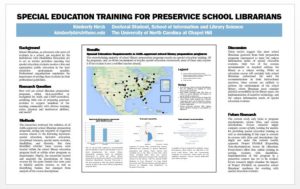
Poster Presentation at ALA 2016: Special Education Training for School Librarians
I will be presenting the results of my study, Special Education Training for Preservice School Librarians, as a poster session at ALA 2016 in Orlando, FL on Saturday, June 25. You can find me in the exhibit hall from 12:30 pm to 2:00 pm. Here’s a preview:
Effortless Clarity
I experienced a rare moment of effortless clarity in improv practice yesterday. I’m on DSI’s hip-hop improv team Versus, and yesterday we were practicing infusing our scenes with emotion.
Our director, Rose Werth, instructed us to get on stage, choose an emotion, play in silence for about 15 seconds, and then speak when we were ready.
I got up on stage with Kit FitzSimons. Our suggestion was stargazing. I sat down. I chose “curious/confused” as my initial emotion. I knew, having played with and watched Kit for almost a year, that in that 15 seconds of silence he was going to commit to some very detailed object work, and I didn’t want to do my own object work that might conflict with what he was doing. So I gazed up at the stars. Looked over at him. Watched him fiddle with knobs on an invisible object. Looked back up at the stars. Looked back at him. Watched as he looked through an invisible eyepiece. Realized he was putting together and testing a telescope. Looked back up at the stars. Looked at him. Stood up. Cocked my head to the left. Took one step toward him. At which point he said,
“I’ve got it.”
And we were off. Over the course of the scene, we revealed that our characters were on a date and he was putting together this telescope as a gift for me, but I was constantly trying to help and provide advice and generally, in as polite and loving and in-a-new-relationship a way as possible, tell him he was doing it all wrong.
At one point, he said, “Well, I’m not a professional astronomer.”
And I paused, then said, “But I am.” And then proceeded to prove that assertion over the course of the rest of the scene.
When we were done, Rose and some of our other teammates said, “That was such a smart choice, for you to be a professional astronomer.” I really didn’t know how to respond, because in that pause before saying, “But I am,” I had thought, “There is only one best way to respond to what Kit just said.” So it hadn’t felt like an especially smart choice to me, but more the only one that made sense. So I just mumbled “Uh-huh” or nodded or something and then shared a look with Kit to sort of check in and see if he was thinking the same thing as me, which he seemed to be, and then practice moved on.
But after practice I continued to think about this moment, and why it had been so impressive from the audience when it felt so obvious on stage. I tried to imagine myself a year ago, in the middle of taking 401, watching more experienced improvisers. If I had seen that scene, would I have been impressed in that moment?
And I decided I would. I decided that the very act of effortlessly making that choice, of listening and recognizing and following what seemed like clearly the best path, doing that was impressive, especially because it was something that in the past I was so proud of doing consciously and with great effort. And I decided that it was a gift to have people outside the scene present to verbalize that I had done it, and it was also a gift to have a scene partner who had intentionally set it up and trusted that I would make that choice.
DSI founder, owner, and three-times-my-teacher Zach Ward often tells students (usually in 301) that to him, improv looks like all of that code from The Matrix. He sees the underlying patterns in scenes, not the details on top. And that often involves automatically recognizing the natural consequences of what has happened earlier in the scene. And, thinking more about that moment in practice, I realized: this was a Matrix moment.
I’ve struggled to create my own metaphor to describe that moment. In that moment I was on stage, all possible choices of how to respond to Kit’s offer were laid out before me like so many possible paths, like trails of light. The one I chose glowed brightly, and all the rest were so dim as to not even be noticed or considered. It was so clear and so obviously right. It was the answer.
I’ve also thought about what kind of ingredients go in to the improv cocktail that makes that moment happen. How can we manufacture effortless clarity?
Well, two years of practice doing improv certainly helps. Thinking about improv academically, reading all you can about it, reflecting on both what you do and what you see, all of that helps. It gets you to a place where you can recognize the underlying patterns that make comedy happen.
But there are other components, and I think the most important, and probably easiest (but also most time-consuming) to manufacture, is the relationship between scene partners. Get on stage with somebody that you’ve played with a lot, preferably in a variety of styles (short form, long form, weird formats); that way each of you trusts the other to knock down anything you set up. Get on stage with somebody you’ve watched a lot; when you’re in a scene with someone, no matter how hard you’re listening, you’re focusing on yourself in a way that you won’t as an audience member. As an audience member watching the same players in a variety of shows, you’ll get to know their personal patterns of play and be able to respond to them on stage. And get on stage with somebody you’ve talked to about improv and how it works, a lot.
Probably you’re not going to become improv BFFs with every potential scene partner. But the closer you can get, the more effortlessly you’ll be able to apply everything you’ve learned about improv in the past.
Advanced Improv Notes: Referential Humor
This winter, I took the Advanced Harold class at DSI Comedy Theater. DSI uses forums for class discussion, but being The Hermione Granger of Improv, I basically turned them into my personal improv blog for 6 weeks. Looking back over my notes, I found some themes being repeated over and over, so I thought I’d consolidate them thematically here. PLEASE NOTE: as thorough as my nerdy notes are, they are no substitute for taking a class with a teacher, practicing with a coach, or getting up on stage in front of an audience. So get out there and DO THOSE THINGS.
Previous posts in this series:
—-
I’ve mentioned before, and will again, that I’m the founding producer of the Improvised Whedon Company. We draw our inspiration entirely from pre-existing work, and I love it. I love fan culture, fanworks, and fandom, and this team is one of the things I’m proudest of working on, ever.
In our practices, we spend a lot of time asking ourselves, How reference-heavy should we be? The answer depends on our audience. For an audience at a comedy theater, we strive to be reference-light. If a scene relies on a reference for its humor initially (like this one), it has to have its own game established pretty quickly. In this case, “What other sharp objects can we use to unintentionally threaten the pilot?” stands alone even if you don’t know the origin of the game. For an audience at a fan convention, we can be fairly reference-heavy.
In a Harold or other montage, references can be sprinkled in for fun. The best thing is something that is funny on its own, but extra funny if you catch the reference. I think the easiest way to make this work is to start with a reference but create a whole world around it, and the easiest way to do that is with mapping. So, for example, the DSI House Harold Team Blandly Handsome had a show replete with Star Wars references. It occurred to me that a fun idea to play with is all the normal kinds of stuff that could happen in that world. Something that would have simultaneously been a reference to both Star Wars and Clerks, but still be funny on its own, would be a scene where contractors working on the second Death Star are discussing how they can prevent the vulnerabilities that were present on the first Death Star. Even if you’ve never seen Star Wars or Clerks, the idea of contractors trying to avoid past mistakes is very grounded, creates real stakes, and yet still leaves lots of room for silliness.
THE KEY: A reference-heavy show should be like any other show, founded in good scenework where you establish relationships, explore a world, and heighten the stakes. It should be accessible for audience members who have never seen the source of the reference, and extra fun for audience members who have.
Working with scene partners who live and breathe references
You’re going to encounter this at some point, somebody who just drops references all over the place. (I actually really enjoy this in a scene partner, but not everyone does.) You should only ever not catch a reference once. Get thee to Wikipedia.
But I’m not going to go to Wikipedia in the middle of a show!
Nope, you’re sure not. So you have a few options:
1. Accept the reference as if it were any other new piece of information added to the scene by your scene partner, as though they had invented it on the spot.
2. Pick a strong emotional response to the reference, even if you have no idea what your scene partner is referencing.
Tools to help you get references:
Blog posts about this:
Know Everything (Will Hines)
Improve Your Knowledge of History (Alex Fernie)
Acknowledgments:
I am indebted to the following improvisers for teaching me or talking me through the ideas in this post: Jonathan Yeomans, Kit FitzSimons, Zach Ward.
Advanced Improv Notes: Consequences
I just finished taking the Advanced Harold class at DSI Comedy Theater. DSI uses forums for class discussion, but being The Hermione Granger of Improv, I basically turned them into my personal improv blog for 6 weeks. Looking back over my notes, I found some themes being repeated over and over, so I thought I’d consolidate them thematically here. PLEASE NOTE: as thorough as my nerdy notes are, they are no substitute for taking a class with a teacher, practicing with a coach, or getting up on stage in front of an audience. So get out there and DO THOSE THINGS.
Show me the consequences.
Playing consequences can come into play in one of two ways. It can either be the way we initiate a scene, or it can be used in a spread/tag out/time dash/callback. Regardless of which way you do it, it’s one of the most fun and rewarding things we can do, and a great way to hold an audience’s attention.
Initiate with consequences.
If the scene premise requires that one player demonstrate success or failure, instead initiate the scene about the consequences of that success or failure. The consequences are more interesting than watching the player do the thing anyway.
Leave room for consequences.
If the people in a scene have just had something big happen, don’t necessarily edit on that as a button. Give them a little room to play with the consequences of whatever just happened. Of course you don’t want to let a scene go on too long, but if it looks like the players are going to dig into consequences, give them a little time to do so.
Skip to consequences.
In addition to initiating with consequences or playing them directly within a scene, you can edit and then play with them in a later beat or scene, spread to them, or tag out/double tag out and show them. When you do this, make sure you get right to it: jump into the consequences immediately. My favorite example of this is from “Coach Feratu,” an episode of Rick and Morty.
This scene sets up that there’s a vampire in the school. And you almost immediately get this follow-up. You never see them fight the gym teacher vampire, because nobody cares about that.
CONSEQUENCES: They’re kind of the most interesting that happens, either on stage or in life.