
The concept of the body as canvas becomes more powerful if the canvas is dead. - Caitlin Doughty, Smoke Gets in Your Eyes and Other Lessons from the Crematory
💬📚
The concept of the body as canvas becomes more powerful if the canvas is dead. - Caitlin Doughty, Smoke Gets in Your Eyes and Other Lessons from the Crematory
💬📚
We are all just future corpses. - Caitlin Doughty, Smoke Gets in Your Eyes and Other Lessons from the Crematory
💬📚
Encountering a corpse forced the man who would be Buddha to see life as a process of unpredictable and constant change. - Caitlin Doughty, Smoke Gets in Your Eyes and Other Lessons from the Crematory
💬📚
I just bought the Kindle edition of both volumes of Briana Lawrence’s mixed media magical girl series, Magnifique NOIR, and I am psyched about this magic. Cosmic Green’s outfit is a dream. All the characters are gorgeous. 📚
Burnham’s “Let’s fly” is probably the best captain catchphrase but Dal’s “Go fast” might be a close second. 🖖🏻
I have a vague feeling I’m at risk of becoming the first victim in the X-Files episode “Clyde Bruckman’s Final Repose”:
Why did this woman collect dolls? What whas it about her life? Was it one specific moment where she suddenly said: “I know: dolls”?
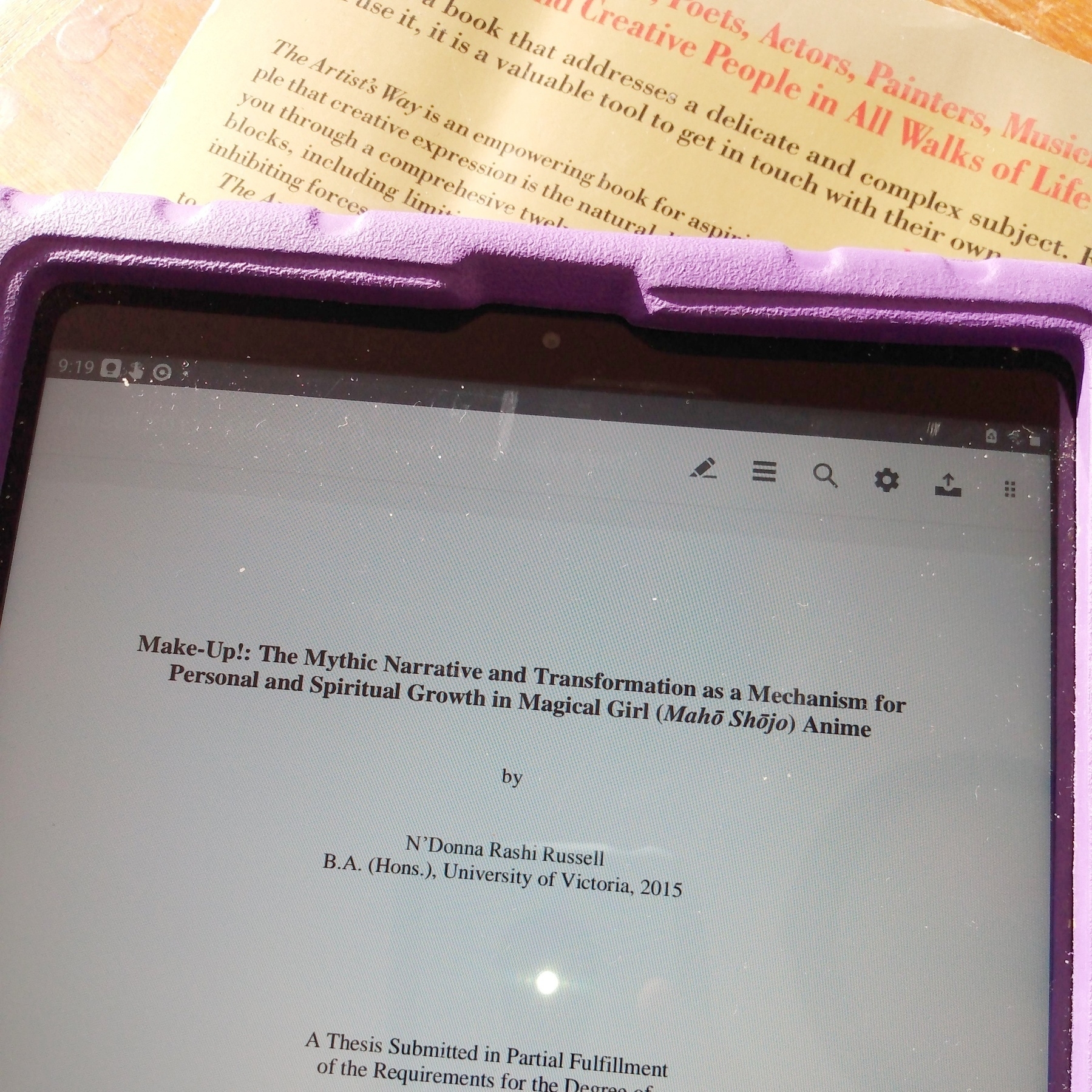
Reading misuthewitch’s thesis for my Artist Date today.
[Image Description: A tablet in a purple case displays a paper titled, “Make-Up!: The Mythic Narrative and Transformation as a Mechanism for Personal and Spiritual Growth in Magical Girl (Maho Shojo) Anime.”] 📺
I’m RSVPing yes to .
Excited to chat about how we track and share book stuff! 📚
It was my half birthday almost 2 weeks ago, so it seems like a good time to check in on whether I’m being the person I want to be at 40. Here are the intentions I set:
So how am I doing?
For #1, pretty well. There are a lot of maybes right now. Maybe I’ll submit a paper for that conference. Maybe I’ll go to that webinar. Maybe maybe maybe. This fits in with the need to be super flexible as a caregiver and a person with chronic illness.
For #2, awesome if I do say so myself. My kid definitely knows I love him - and making sure my loved ones feel loved is my highest ambition, if that imagine-your-own-funeral exercise is any indication. I’m also doing pretty well with being mostly gentle. I step away if I’m too frustrated to be kind, saying out loud, “I’m frustrated.” A+, me.
I am slowly taking care of my body, though not making any clothes yet. I’ve made having a cup of warm lemon water in the morning a habit and have gotten into a routine of eating nutritious breakfasts that don’t have a ton of sugar in them and meet my target dietary restrictions (eliminate gluten and corn, limit dairy and nightshades).
This is another one where progress is happening, but it’s slow. My consulting work for Quirkos is the main way I’ve been doing this. This is on the back burner a bit while I’m doing the postdoc.
Pretty pleased with myself, actually. I’m doing okay.
An undergrad sent me a message thanking me for my post A Start-to-Finish Literature Review Workflow and asked the question:
Is there an exhaustive way of making sure that the literature gap you have identified is genuinely a gap?
The short answer is, no. There isn’t. But there are ways to get close.
In my experience, the best way to begin is with a specific research topic in mind, but before you have fully developed a question. You get familiar with the literature using the tips from step 4 in my workflow: Identify potential literature.
After you look at the abstracts for these and eliminate the ones that are outside the scope of your topic, pay close attention when you’re doing your Abstract-Introduction-Conclusion extraction reading to suggestions for future research. In my experience, this is the most fruitful way to find gaps. Both my Master’s paper and dissertation research questions were suggested in the future research section of other scholars’ work.
As H. L. Goodall says in Writing the New Ethnography,
To locate a gap in any scholarly literature requires that you read a lot. (emphasis original)
Goodall offers some more specific advice as well:
I don’t think I can give better advice than that. I’ll close out with more from Goodall:
You are reading for the storyline. You may not be sure what you are using it for, at least not yet. But that is all right. Be patient. Ideas, and uses for them, often take time.
You are also reading to find out what is collectively written about an idea, what individual voices have to say about that collective idea, and for an opening that you can address.
There’s no shortcut, I’m afraid. You have to jump into the literature before you know what the gap is. When everything you’ve read is referencing everything else, it’s safe to trust you’ve got a good sense of the topic and know where the gaps are.