
I know this isn’t what actually happened, but I like to imagine that I summoned into being the latest issue of Josh Radnor’s Museletter. I had a dream last night in which he and I were friends.
I fell into a new COVID-19 spiral today. This went beyond anxiety and felt closer to depression. The world started to take on that bell jar feeling. For me, it’s not about being suffocated; it’s about distance. It’s about feeling as if there is an impenetrable plate of glass between me and the rest of the world.
I immediately unsubscribed from my email newsletters that are about the actual news, because what set this off was not fear for my own life or the lives of those I love, but disgust with the behavior of humans, especially those with a lot of power. I don’t care to go into the details, but it launched me into a feeling of hopelessness and I thought, I won’t be able to fight back against this sort of thing if I just keep steeping myself in news about it. So as I said, I unsubscribed and appointed W. my official news source.
I’m attempting to combat the feeling by sitting in the sunshine and reading The Artist’s Way.
Nobody has time for depression that they have the power to push away; so often depression itself takes away that power. Mine hasn’t taken it away yet, so here I am trying to shake it off.
📚 The library is closed, limiting my book borrowing options, but the gym is also closed, freeing up some book buying funds, so…
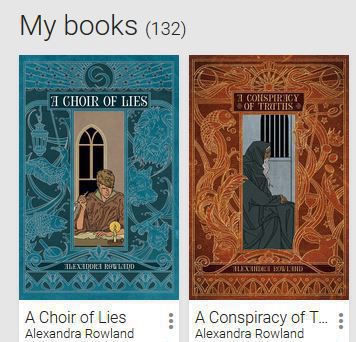
It’s nice to see that Alexandra Rowland has written a book for/about me. 📚
I’m having a down day. Not helping is this (extremely informative but also depressing) piece from The Atlantic, The Four Possible Timelines for Life Returning to Normal. I’m extremely privileged/blessed/lucky to have financial security right now, something I know is not certain for many, many people. Acknowledging that, this has disrupted my work in a way that is very specific to me (and other people doing research similar to mine, I imagine). Specifically, a lot of my research proposal hinges on cosplay being a blended affinity space, where fellow travelers/affines meet both in person and online. In particular, they have historically met at fan conventions. The experts in that Atlantic piece - a public health expert and an epidemiologist - suggest that large gatherings - including conventions - are probably off the table for a long time. Likely at least four months, maybe as much as a year or more.
I had hoped to finish data collection by August.
This doesn’t wreck my dissertation by any means, but it means a pretty thorough rethinking of my argument for the research’s unique contribution and value.
More gold from McSweeney’s: Self-Isolation or Graduate School?
McSweeney’s Frog and Toad are self-quarantined friends by Jennie Egerdie is my favorite art to come out of COVID-19 so far.
The Punky Brewster episode “The Perils of Punky” aired in 1985. In it, Punky’s dog is turned into a skeleton. It gave me nightmares about my own dog turning into a skeleton. Even now I can’t handle stories of undead pets. Punky Brewster is why I can’t watch Frankenweenie.
Don't wait until you know who you are to get started, scholars.
This is part two of a series in which I’m writing up how Austin Kleon’s work particularly relevant for scholars, researchers, and academics. For a quick overview of his book Steal Like an Artist, you can watch Kleon’s TED talk.
You can find the previous post in this series here.
2. Don’t wait until you know who you are to get started. Kleon argues that it is in the act of making stuff that you discover who you are. This is true for research and academic writing, as well. It’s possible that this applies mostly to early career scholars, but I think scholars have the opportunity to reinvent themselves many times in a career, so it can apply more broadly.
Don’t wait until you have a research design to start thinking and writing about a topic. If there’s something you’re interested in, go ahead and start reading in that area. Write up your reading notes. They will come in handy when you’re ready to design your research.
Don’t wait until you have a narrow field of expertise to conduct a study. My first study was on the leadership practices of school librarians. My second was on school library preparation program’s special education courses. My dissertation is about the information literacy practices of cosplayers. These are not all related at all, but I learned different things during each one. (Or, in the case of my dissertation, am still learning.) The first study used a survey methodology, the second content analysis, the third ethnographic methods. I also conducted two small-scale studies for my coursework. If I waited to find my one true calling until I started designing studies, I probably never would have designed any studies. (I’ve actually designed many more than I’ve completed; maybe I’ll use those designs eventually. I really like designing studies. I’ve thought about hiring myself out as a sort of “research best friend” to talk people through their study design process.)
Kleon encourages creatives to copy their heroes. Scholars can copy - but not plagiarize - the work of others in a variety of ways. My favorite is to apply someone else’s research methods to a new population or scenario, adding on something extra to make the study uniquely mine. For my Master’s paper, I copied Daniella Smith’s methods, using the Leadership Practices Inventory. Dr. Smith used this to measure the self-perceived leadership practices of preservice school librarians, people who were training as school librarians but were not yet employed as such. I used the same instrument to measure the self-perceived leadership practices of National Board Certified school librarians - school librarians with at least three years of professional school library experience who had submitted to a rigorous certification program. This is a very different population, but I used the same instrument. I also added a second instrument, which I had developed to measure school librarians’ ability to implement professional guidelines, then investigated the relationship between leadership and that ability. I copied, but it was not a perfect copy. (And as Kleon points out, it never can be - in the case of research, something about your settings or materials or analysis is bound to be different.)
For my dissertation, I am building on the methods of Dr. Crystle Martin’s dissertation, using her interview and online artifact analysis methods with cosplayers. She used these methods with World of Warcraft players. Again, a different population. I also, in my original design, added face-to-face observation - something that built on her work but made it my own. (In the wake of COVID-19, I am sadly not sure how much face-to-face observation I will be able to do. We’ll see.)
Next time: Write the book you want to read.
Steal Like an Artist for Scholars
Austin Kleon is one of the creative people who have had the greatest influence on my thinking about art, life, and parenthood. I actually had a bit of a freakout tonight whenI couldn’t find my copies of Steal Like an Artist and Keep Going. (I’ve loaned my copy of Show Your Work to a friend.) They turned up, though, and thank goodness.
For years, I’ve thought someone should write up how his work is particularly relevant for scholars, researchers, and academics. (Often, one person is all three, but it felt worth listing them separately here.) Maybe somebody has, but I haven’t seen it, so I’m going to do it. For a quick overview of Steal Like an Artist, you can watch Kleon’s TED talk.
I’m going to do this as a series of 10 posts, one post per point on Kleon’s list/chapter in the book. First up:
1. Steal like an artist. Kleon points out that nothing is wholly original. With scholarship, it is a key part of designing research to situate our planned work in the work that came before it. We have a whole section of most scholarly writing devoted to this: the literature review. Kleon suggests that we build a family tree of thinkers, finding one who influences us and then learning everything about them, then learning about three people who influenced them, on and on up the chain as far as we can go. This is basically what citation chaining is. Kleon focuses on backward citation chaining. I wonder if the academic’s process of forward citation chaining might be useful for other creatives; what would Kleon think about finding other people who have the same influences as you and exploring their work downstream? I imagine this wouldn’t be as easy to do as it is for researchers, who can simply pop a reference in Google Scholar, Scopus, or Web of Science and track down the things that reference it, but it might still be valuable to do.
Kleon recommends saving your “thefts” for later. Scholars can do this by keeping up with the work in their field (I’m personally a fan of subscribing to journal table of contents by email and setting up Google Scholar alerts), skimming it, and keeping a research notebook to help them keep track of all of the things they’ve read.
One thing that applies perhaps more uniquely to scholars - though maybe works for other creatives, too - is to look for places where other scholars have explicitly called for work that builds on theirs. I don’t know to what extent other people mine the “Future research” sections of studies for their own work, but I have found it immensely valuable. Both my Master’s paper and dissertation topics came from paying close attention to where other scholars have called for work that builds on theirs. It’s been particularly rewarding to do this with my dissertation, as Dr. Crystle Martin, whose dissertation inspired mine, is on my committee and this is the first time she’s really seen someone build on her work. Why do we do all of this work if all that is going to happen is that it will sit unread somewhere? I suppose some people do it because they have to for job security or being competitive on the job market, but I like to imagine that most of us at least started with a plan for doing our research because we thought it could improve the world somehow. Drawing on other scholars’ work to build ours brings that work out of archives and into the world.
As Kleon quotes Mark Twain saying,
It is better to take what does not belong to you than to let it lie around neglected.
Next time: Don’t wait until you know who you are to get started.