
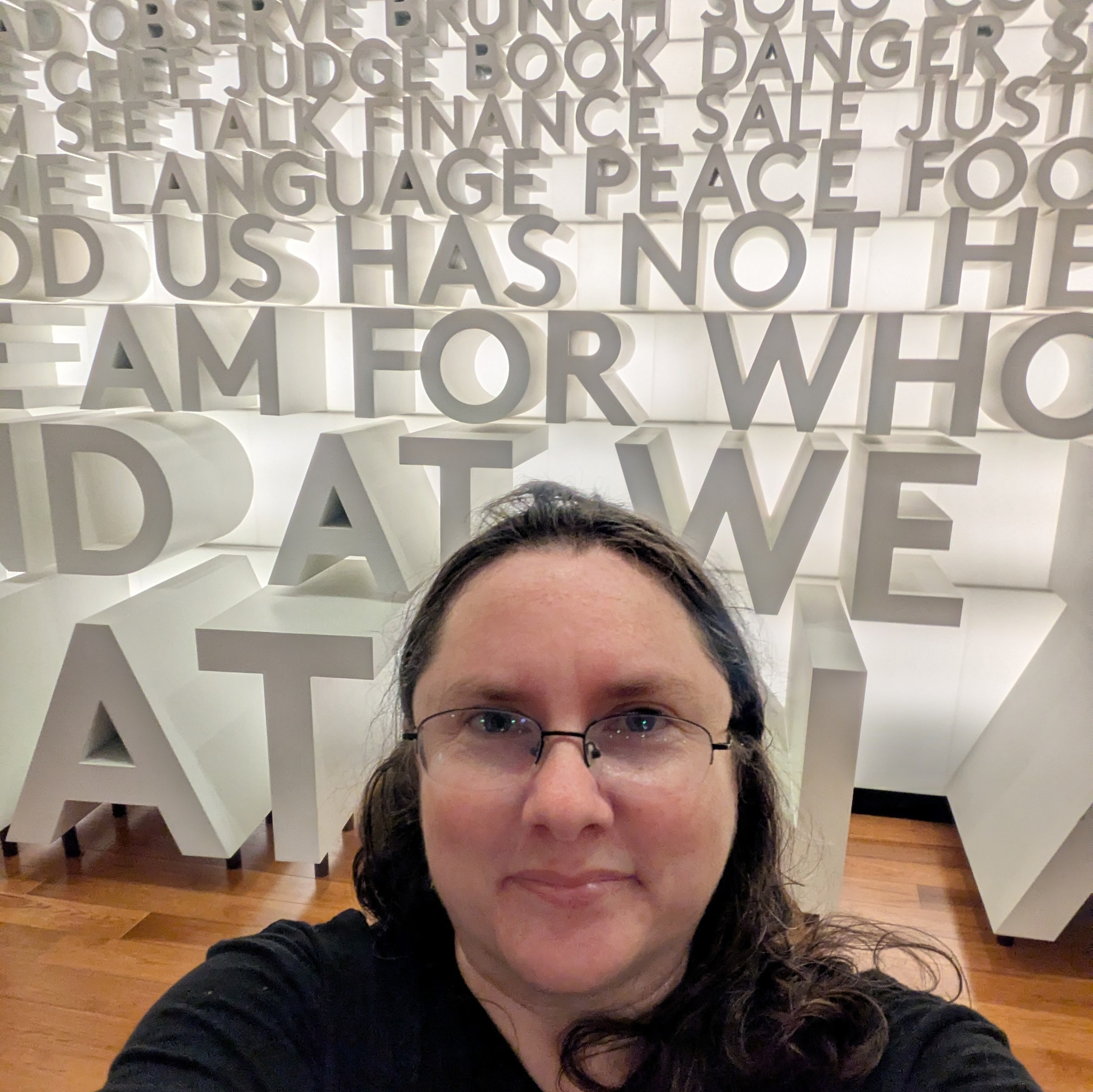
Planet Word Museum in Washington, DC
Hi there! I'm Kimberly Hirsh. My pronouns are she/ her/hers. I'm somebody's mom. I work as a school librarian. I have a PhD in information and library science. I love to read, play tabletop and video games, and make things. I used to perform in theater and improv comedy and I may one day again. I have been extremely online since 1993 and still enjoy tinkering on the web. I manage multiple chronic illnesses. I'm married to my kid's dad. We have a cat.
Want to get in touch? You can reach me by email.
Recent posts
🔖 Read:
- The old internet by Rebecca Toh
- How and why to keep a commonplace book by Ryan Holiday
- What is a commonplace book and why you need one by Aly Juma
- Getting started with the web by Mozilla Developer Network
- Installing basic software by Mozilla Developer Network
- How do I start to design my website? by Mozilla Developer Network
- How does the Internet work? by Mozilla Developer Network
- What is the difference between webpage, website, web server, and search engine? by Mozilla Developer Network
- What is a web server? by Mozilla Developer Network
- How do you set up a local testing server? by Mozilla Developer Network
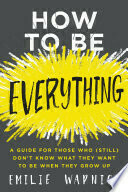
Finished reading: How to Be Everything by Emilie Wapnick 📚
📽️ Watched Star Wars: Episode I - The Phantom Menace.
This isn’t as bad as I remembered. It’s still full of appalling spacified racial stereotypes and there’s literally a Looney Tunes-style sound effect after Jar Jar accidentally falls and lets loose a bunch of “bombads,” but some of it is gorgeous to look at: the palace of Naboo, the underwater jellyfish bubble buildings where Gungans live, and the Senate chamber. The pod race completely deserves to have inspired the video games it did. Darth Maul actually says words, which I had forgotten and let’s all admit that his double-bladed light saber is still cool. Also Warwick Davis is just kicking it with Jabba at the pod race and ET is a senator?
All of this to say: I definitely won’t watch it again before my kid inevitably makes me, but when he does make me, I won’t be as grouchy about it as I thought I would be.
If I could give you a piece of advice today, it would be not to try carrying four ninja turtle figures in one hand, a big folding Radio Flyer wagon in the other, and then walking down uneven, slippery stone steps. Because I did that two days ago, and I sprained my ankle.
I think it’s a mild sprain - I could walk on it after just a couple of minutes, though not without pain. It swelled up but wasn’t discolored at all. NSAIDs and acetminophen both help. Ice made it feel worse and walking on it feels better than trying to stay off of it.
I’ve had a more intense sprain before, where I couldn’t put any weight on it. The treatment for that was an air cast ankle stirrup splint, crutches, and over the counter pain reliever. I went to my local medical supply store yesterday and picked up an air cast. Walking on it immediately felt easier once I switched from a fabric ankle brace to the air cast. Crutches while keeping up with a three-year-old seemed like a bad idea if they weren’t totally necessary, and since I can put weight on it, I don’t think they are. My mom loaned me a trekking pole that is helping a lot. I’ve got ibuprofen and acetaminophen that I can take in alternating cycles so when I hit the mid-point of one’s effectiveness I take the other. My dad encouraged me to consider going to orthopedic urgent care, which I will if it seems to get worse instead of better, but right now it seems like the swelling is going down and the pain is decreasing, so I’m hoping that won’t be necessary.
I’m pretty relieved that I knew what to do here. I think knowing what to do and where to get supplies made this whole thing much less scary than it would otherwise be.
💻 Completed the remaining 8 challenges in the Basic CSS portion of freecodecamp’s Responsive Web Design certification (again).
📚 Read X-Men: First Class Vol. 1, #s 1 - 3.
🔖 Read:
- 3 ways to make Spotify’s killer feature even smarter by Xiomara Blanco
- These five tricks will make your Spotify Discover Weekly playlists bang every week by Dave Fawbert
- Update: Creating and managing a lifestream as an Early Career Academic by Kay Oddone
- ‘Commonplace Books’: The Tumblrs of an Earlier Era by Alan Jacobs
💻 Completed the first 36 (of 44) challenges in Basic CSS for freecodecamp’s Responsive Web Design Certification (again).

Finished reading: X-Men: Season One by Dennis Hopeless and Jamie McKelvie 📚