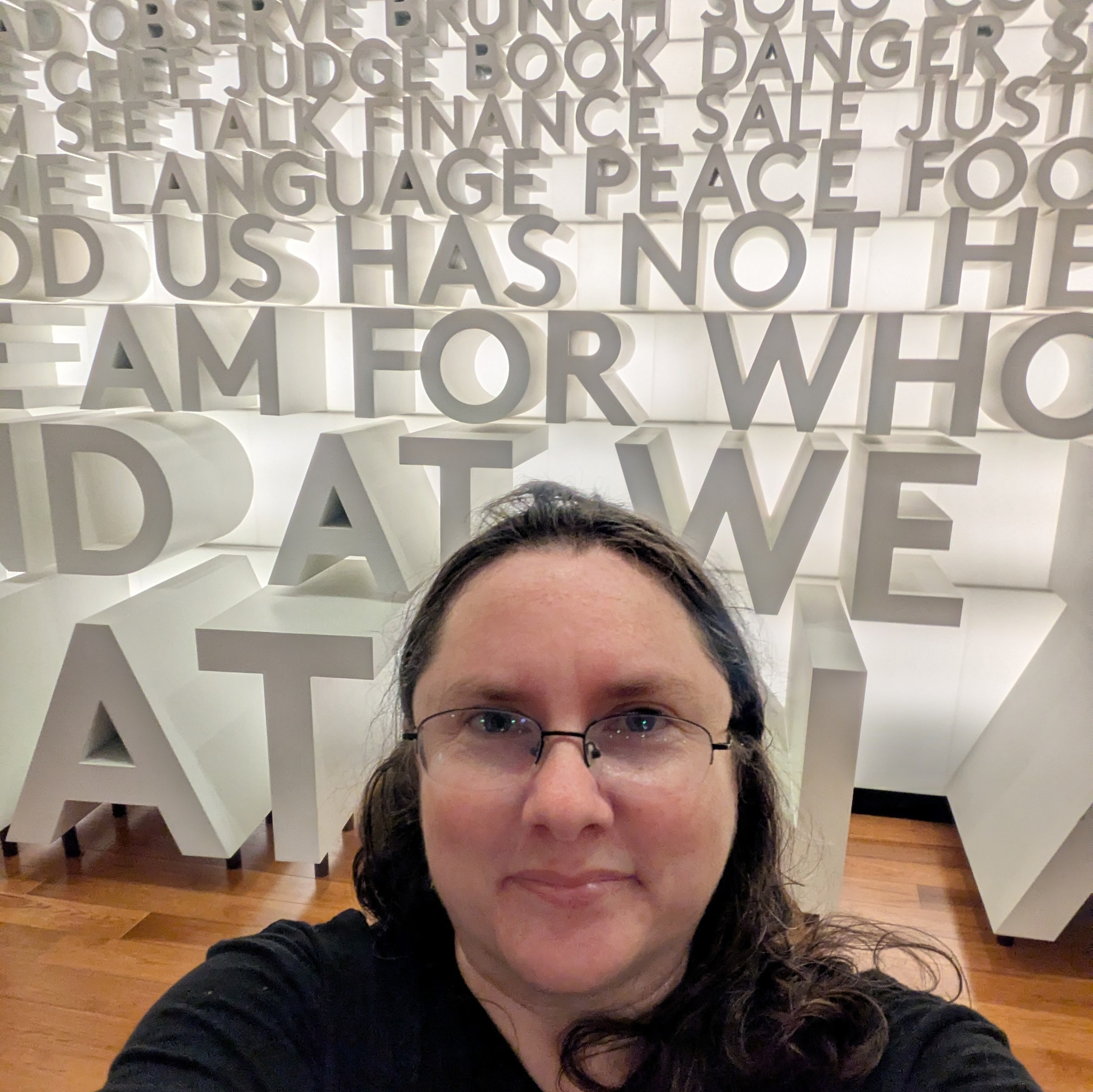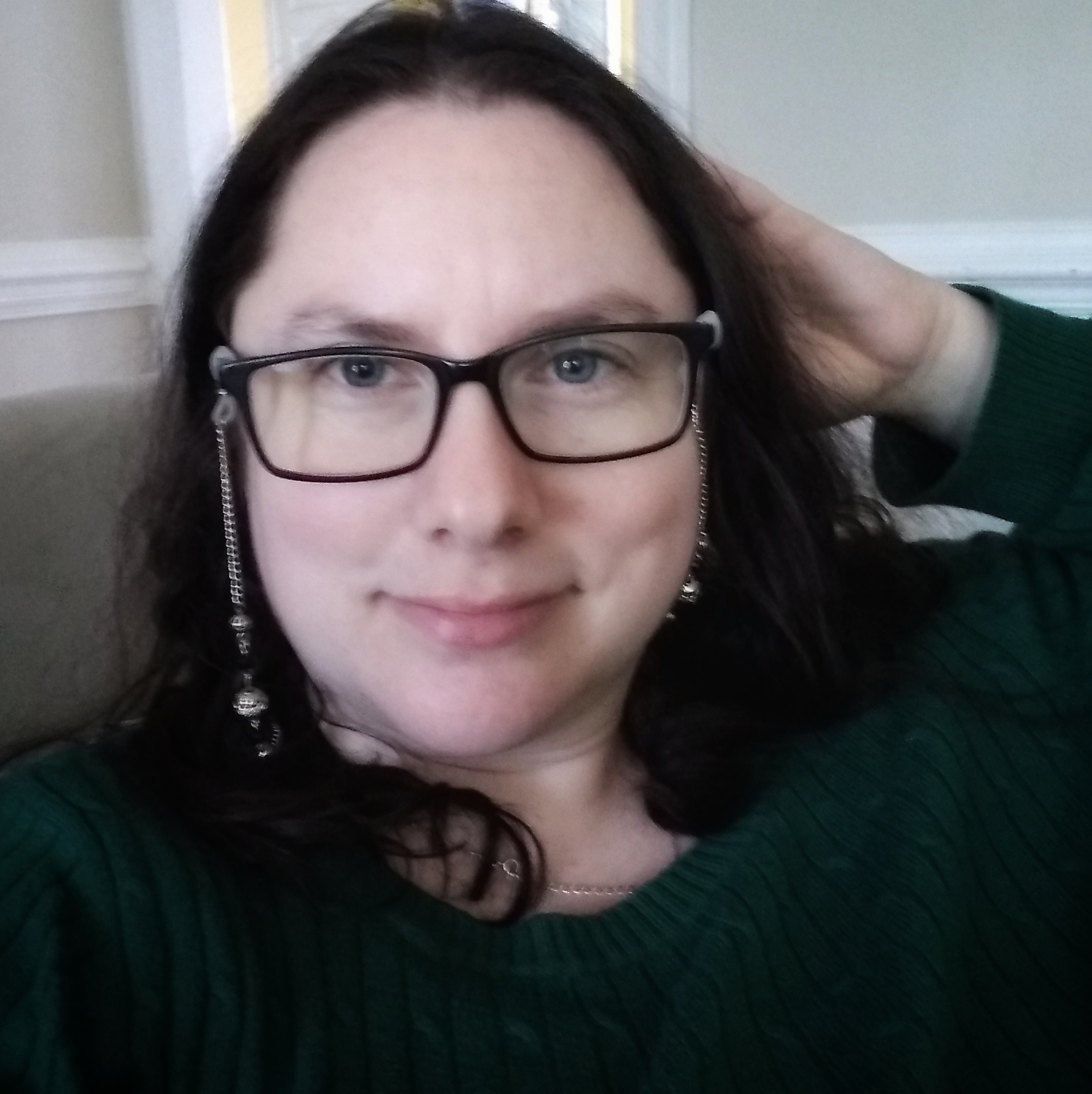
Key summer goth accessories:
- parasol
- handfan
- cooling scarf
- sunglasses
- sunscreen
- scent of cloves & absinthe
Key summer goth accessories:
The end of this keynote gets at exactly what I was talking about in my last post.
When we own our own data, We can look back at who we were who we thought we were. We can see who we really were, who we are, and, most importantly, the trend of our becoming who we want to become. With our own data, we can curate, we can shed who we were to become who we want to be, and we can write the end of our own story.For this is the true power of owning our own data: to understand the cycles of contractions and expansions, to understand our hero’s journey, and to write our own story.
This is just me, thinking out loud, so expect it to be rough, incomplete, unpolished. But I thought it was a train of thought worth stopping, so here we go.
When you’re driving down a city street at a cool 35 mph while “Belle” plays on repeat one for the 1000th+ time in recent months and your toddler is in the back seat sulking because Daddy has to go to work today and separation from Daddy is painful, your mind wanders. It does if you’re me, anyway. Mine wandered to the way in which the only thing I seem interested in besides sleep lately is tweaking my personal website. Then I thought:
As I'm building my website, it kind of feels like I'm building myself.
Identity construction is kind of an obsession of mine, specifically the idea that we create our own identities through narratives we tell about ourselves. Sure, there are identities the world forces upon us, but our narratives interact with those. Most of my work in my doctoral program has touched on identity in one way or another:
And my favorite fictional works often have to deal with reconciling different pieces of one’s identity: Spider-Man, Sailor Moon, and Buffy the Vampire Slayer all come to mind. (And the X-Men; I was just reading an old Chris Claremont book - Uncanny X-Men #129, 130 - somewhere in there - where Nightcrawler thinks about how he’s decided not to disguise himself as a normal human; I think there’s something to unpack there.) So, I guess superheroes are what I’m talking about, and I’m sure lots of work has already been done on how superhero identity plays out, including Brownie & Graydon’s book.
So I was thinking about how building my website feels like building myself, and I thought… hasn’t this been true since I first started building websites in 1995? I got my first personal domain in 2001, and building an online space to represent myself has always meant choosing what I want the world to know about me, who I want to seem to be, and by defining who I want to seem to be, am I not defining who I want to actually be?
Then I thought about social media and all the ways we’ve used them to represent ourselves, and all the ways that has gotten away from us. Before we knew how bad Facebook was, when my husband would add a new friend on Facebook, he would immediately peruse their profile to find out what books and movies they liked; what we like contributes to the picture of who we are, but what we want people to know we like does even more so, I think.
My train of thought loses steam here, but I’m definitely interested in digging into the intersection between technology and identity more. Our tools shape not only how we think, but who we are.
True fact: 100% of my group cosplay ideas are aimed at getting @tceles_b_hsup in a long wig + bish af.
Â
To distract me from my current “The world is a garbage fire” emotional spiral, here’s a bunch of labels I’m okay with, woo-woo or otherwise.
đ Gee, J. P. (2004). Situated Language and Learning : A Critique of Traditional Schooling. London, United Kingdom: Routledge.
Gee introduces the concept of affinity spaces in this book, pointing out that popular culture is ahead of schools in the construction of âspecially designed spaces (physical and virtual) constructed to resource people tied together, not primarily via shared culture, gender, race, or class, but by a shared interest or endeavorâ (2004, p. 4). He argues that âpeople learn best when their learning is part of a highly motivated engagement with social practices which they valueâ (Gee, 2004, p. 77) and offers affinity spaces as an example of a space that facilitates this kind of engagement.
Gee contrasts affinity spaces with communities of practice as proposed by Lave and Wenger (1991), arguing that defining a community implies labeling a group of people, including determining âwhich people are in and which are out of the group, how far they are in or out, and when they are in and outâ (Gee, 2004, p. 78). Talking about spaces instead of communities removes this concern of membership; people who are present in a space may or may not be part of a community.
Gee identifies some key components of any space, not just an affinity space: content, generators, content organization, interactional organization, and portals. Content is what the space is âabout,â and is provided by content generators. Gee uses the example of a video game, which generates a variety of content (words, images, etc.). The space is then organized in two different ways: content is organized by the designers, whereas interaction is organized by the people interacting with the space, in how they âorganize their thoughts, beliefs, values, actions, and social actionsâ (Gee, 2004, p. 81) in relationship to the content. This interaction creates a set of social practices and typical identities present in the space. The content necessarily influences the interaction, but interaction can also influence content. For example, with a video game, player reactions to the game may influence future updates to the game. Finally, Gee defines portals as âanything that gives access to the content and to ways of interacting with that content, by oneself or with other peopleâ (Gee, 2004, p. 81). In Geeâs video game example, this could be the game itself, but it could also be fan websites related to the game. Portals can become generators, âif they allow people to add to content or change the content other generators have generatedâ (Gee, 2004, p. 82). A video game website might include additional maps that players can download and use to play the game or offer recordings of gameplay to serve as tutorials or entertainment. A generator can also be a portal; for the video game example, the game disc or files both offer the content and can be used to interact with the content.
Gee builds on this description of a space to describe âaffinity spaces,â a particular type of space that young people today experience often. The âaffinityâ to which Gee refers is not primarily for the other people in the space, but for âthe endeavor or interest around which the space is organizedâ (Gee, 2004, p. 84). He defines an affinity space as a space that has a number of features:
âCommon endeavor, not race, class, gender, or disability, is primaryâ (Gee, 2004, p. 85). People in the affinity space relate to each other based on common interests, while attributes such as race, class, gender, and disability may be used strategically if people choose.
âNewbies and masters and everyone else share common spaceâ (Gee, 2004, p. 85). People with varying skill levels and depth of interest share a single space, getting different things out of the space in accordance with their own purposes.
âSome portals are strong generatorsâ (Gee, 2004, p. 85). People can create new content related to the original content and share it in the space.
âContent organization is transformed by interactional organizationâ(Gee, 2004, p. 85). Creators of the original content modify it based on the interactions of the people in the space.
âBoth intensive and extensive knowledge are encouragedâ (Gee, 2004, p. 85). Specialized knowledge in a particular area is encouraged (intensive knowledge), but the space also encourages people to develop a broad range of less specialized knowledge (extensive knowledge).
âBoth individual and distributed knowledge are encouragedâ (Gee, 2004, p. 86). People are encouraged to store knowledge in their own heads, but also to use knowledge stored elsewhere, including in other people, materials, or devices, using a network of people and information to access knowledge.
âDispersed knowledge is encouragedâ (Gee, 2004, p. 86). One portal in the space encourages people to leverage knowledge gained from other portals or other spaces.
âTacit knowledge is encouraged and honoredâ (Gee, 2004, p. 86). People can use knowledge that they have built up âbut may not be able to explicate fully in wordsâ (Gee, 2004, p. 86) in the space.
âThere are many different forms and routes to participationâ (Gee, 2004, p. 87). People can participate in different ways and at different levels.
âThere are lots of different routes to statusâ (Gee, 2004, p. 87). People can gain status by being good at different things or participating in different activities.
âLeadership is porous and leaders are resourcesâ (Gee, 2004, p. 87). No one is the boss of anyone else; people can lead by being designers, providing resources, or teaching others how to operate in the space. âThey donât and canât order people around or create rigid, unchanging, and impregnable hierarchiesâ (Gee, 2004, p. 87).
Gee argues that as young people encounter more and more affinity spaces, they see a âvision of learning, affiliation, and identityâ that is more powerful than what they see in school (Gee, 2004, p. 89).
Gee, J. P. (2004). Situated Language and Learning : A Critique of Traditional Schooling. London, UNITED KINGDOM: Routledge.
Lave, J., & Wenger, E. (1991). Situated learning: Legitimate peripheral participation. ; New York: Cambridge University Press.
Me, to my colleagues: I could really use a tote bag for the flight home. Y’all think I’ll be able to find a tote bag at this librarian conference? #alaac19
Still blogging infrequently and mostly absent from social media, but this is a huge piece of work. I hope to write up some reflections on what I learned through this process before too long.
Dear Colleagues-
Today, we are excited to announce that the Project READY (Reimagining Equity and Access for Diverse Youth) online racial equity curriculum is live and accessible at ready.web.unc.edu. Learn more at Booth 2650 at ALA Annual in Washington, DC.
A historic milestone was quietly reached in the American public school system during the 2014-2015 school year: for the first time in history,youth of color made up the majority of students attending U.S. public schools. Creating inclusive and equitable school and public library programs for Black youth, Indigenous youth, and Youth of Color (BIYOC) requires knowledge about topics such as race and racism, implicit bias and microaggressions, cultural competence and culturally sustaining pedagogy, and equity and social justice. Research shows, however, that few library and information science (LIS) masterâs programs include these topics in their curriculum.A recent survey focused specifically on early career youth services librarians found that only 26.8% of respondents said that social justice was included in a substantive way in their masterâs curriculum; 37.2% said that cultural competency was substantively included, and 41.8% said that equity and inclusion was substantively included. Related to these findings, a majority (54.08%) of respondents said that their masterâs programs did not prepare them well for working with youth of color and other marginalized youth.
In 2016, The School of Information and Library Science at the University of North Carolina at Chapel Hill, the School of Library and Information Sciences at North Carolina Central University, and the Wake County (NC) Public School System (WCPSS) were awarded a three-year Continuing Education Project grant from the Institute of Museum and Library Services (IMLS) to develop Project READY to address this existing gap in professional development opportunities for youth services library staff.  The curriculum aims to:
The curriculum consists of 27 modules, designed to be worked through by individuals or small groups. Modules are organized into three sequential sections. The first section (Foundations) focuses on basic concepts and issues that are fundamental to understanding race and racism and their impact on library services. The second section (Transforming Practice) explores how these foundational concepts relate to and can be applied in library environments. Finally, the third section (Continuing the Journey) explores how library professionals can sustain racial equity work and grow personally and professionally in this area after completing the curriculum.
The curriculum represents the work of 40 researchers, practitioners, administrators, and policymakers, and youth from a variety of racial and cultural backgrounds. It is grounded in the work of scholars of color and Indigenous scholars who have thought and written about issues related to institutional and individual racism, equity, inclusion, and social justice.
We hope this curriculum will benefit and inform the work of the many organizations and individuals that are working to improve the quality of life and educational opportunities for BIYOC.
We will be promoting the curriculum on the exhibit hall at ALAâs annual conference in Washington, DC - Booth 2650. We invite you to stop by and preview Project READY!
Sincerely,
Sandra Hughes-Hassell, PhD Professor She/Her/Hers
Casey H. Rawson, PhD Teaching Assistant Professor She/Her/Hers
Kimberly Hirsh, MAT, MSLS PhD Student She/Her/Hers
I’m still on hiatus from social media activity and comments on my blog posts are still closing after only 1 day. But there are some things that I want to capture in this space immediately, rather than waiting until I “come back,” and there are some things that I think could benefit other people by being public, so I’m going ahead and posting. This is one of those things.
I went to the doctor yesterday. I needed refills on my prescriptions. And I’d also noticed recently that a number of chronic illness symptoms had crept up on me slowly over the past… year and a half? Six months, at least. So I went in expecting to discuss those symptoms with her.
When she asked how I was, I gave her the list of symptoms:
“Your thyroid numbers are good,” she told me. I looked at them. She was right. They weren’t just normal; they were in what I know to be the optimal range for me. They were excellent.
I’d noticed that a lot of these symptoms were also consistent with diabetes. “Your blood sugar is at the high end of normal, but it’s lower than it was six months ago. It’s moving in the right direction.” So I’m still prediabetic. But not yet diabetic.
This is where most doctors would tell me I was fine, or I need to eat more protein, or it’s because I’m the mom of a young kid.
“But you’re having these symptoms, so you’re not okay,” she said. I love my doctor. “Have you noticed any pattern?”
I told her no. They have snuck up on me, sort of one at a time over months and months, and so I haven’t been tracking them.
“Well, they could be a food sensitivity. Or another autoimmune disease.” There’s a high level of comorbidity with autoimmune diseases, such that having one makes you a lot more likely to later acquire another. “But I don’t even know what to test without more information. So come back in two to four weeks with some data and we’ll decide what to test.”
I really wanted to be able to just increase the dose of one of my current medications to fix this, but apparently, that’s not an option. Straightforward dietary changes that have helped in the past, like cutting out gluten and corn, which I’d been doing for the past two months, didn’t seem to be helping. So here we are. I’m spending the next month collecting data on everything I can think of, looking for relationships. I’m tracking which symptoms I have on what days, what I eat, how I sleep, and anything else that comes to mind; the app I’m using, Flaredown, lets you add tags freely so I can track things like travel and even whether my kid naps.
…
EsmĂŠ Weijun Wang, who writes a blog for ambitious people dealing with limitations, writes:
My work, although it may not look like work to most, is to take care of myself. I must care for my health with as much attention as I once paid to the documents I was hired to edit, or to the long hours spent at the office on Saturdays. Aggressive pursuit of one's ambition is a skillset that, I hope, has not left me. In the meantime, I am aggressively pursuing a dream of recovery.Similarly, I'm going to collect data on my own health with the attention I would use to collect data for a study, to analyze my own journal with the same tools I would use to conduct content analysis.
…
I don’t have a pat conclusion to this. I’m disappointed it’s not a straightforward fix. I’m optimistic that we’ll be able to work something out to help me. I’m relieved that I don’t need to make any drastic changes to my diet before I’m done traveling at the end of the month.
And I’m tired. I’m very tired.
I thought to myself yesterday, “I can’t believe that I’ve got another fifty or sixty years in this meat cage, dealing with these flare ups.” But I do. I will. And I’ll get through it, with the support of my family and friends and science.
â¤ď¸ď¸â¤ď¸ď¸â¤ď¸ď¸â¤ď¸ď¸
Austin Kleon talks about daily blogging as being related to the ideas of stock and flow, and I think that really gets at what you’re talking about here. I love thinking about it this way, the way little ideas become big ones and how much easier it is to iterate, flesh out, and track our own thinking when everything is in one place.