
Hey friend! Do you have a website and/or blog? I want to visit it! Tell me about it, please.
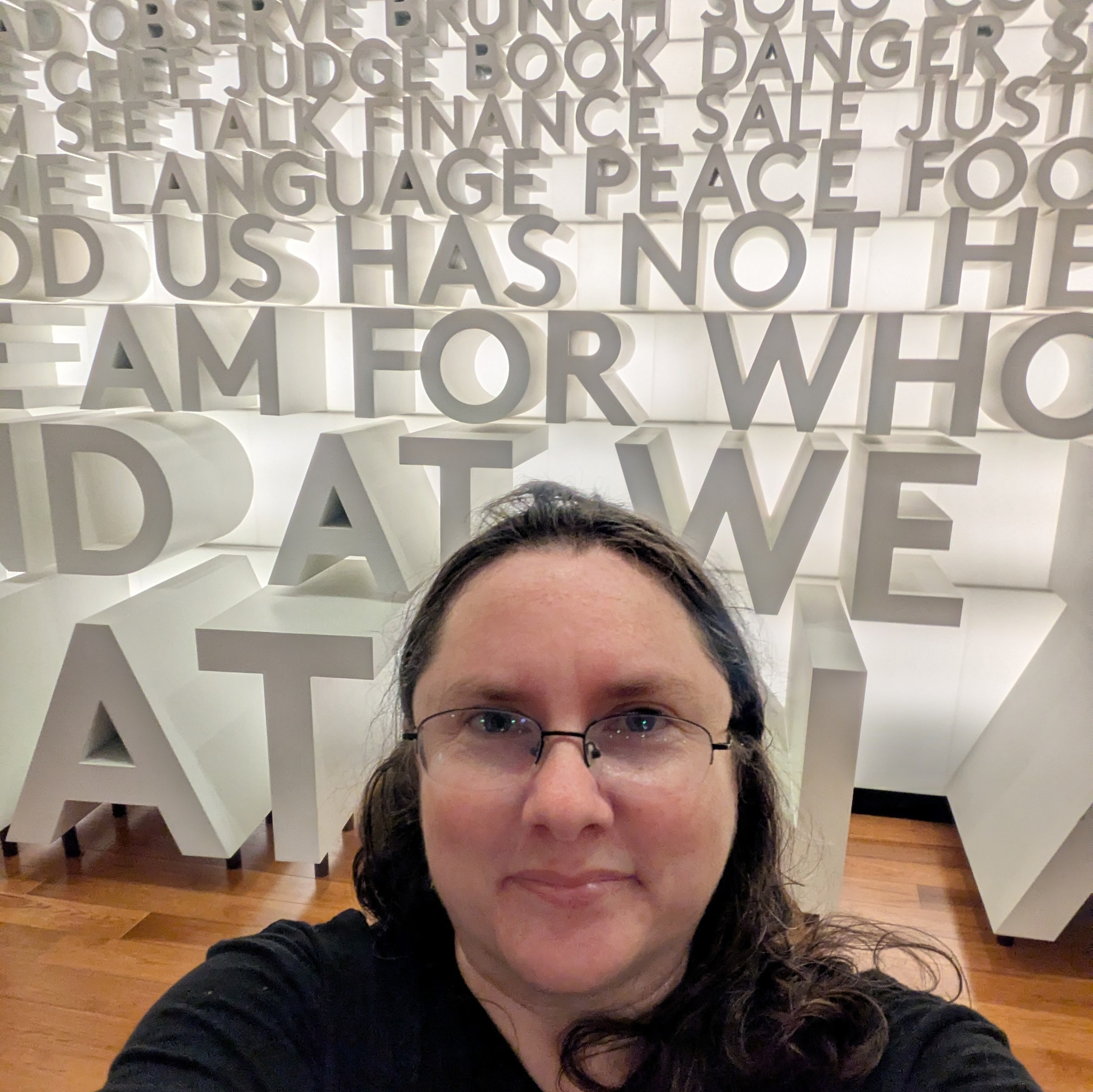
Planet Word Museum in Washington, DC
Hi there! I'm Kimberly Hirsh. My pronouns are she/ her/hers. I'm somebody's mom. I work as a school librarian. I have a PhD in information and library science. I love to read, play tabletop and video games, and make things. I used to perform in theater and improv comedy and I may one day again. I have been extremely online since 1993 and still enjoy tinkering on the web. I manage multiple chronic illnesses. I'm married to my kid's dad. We have a cat.
Want to get in touch? You can reach me by email.
Recent posts
Instant Pot
Bought an Instant Pot at the urging of fellow co-working parents and I don’t know how long it’s been since I was this excited about a purchase.
It's my birthday.
I’m 37 today. It’s a number that sounds grown up. I think I felt more grown up at 27, though.
Maybe I’m Benjamin Buttoning. (Making that reference dates me. The fact that I’m pretty sure I’m repeating a joke I think I’ve already made on this blog and don’t care is also proof of my age.)
It only just occurred to me that reverse Benjamin Buttoning is just normal aging.
I have neither read nor seen The Curious Case of Benjamin Button.
I find myself craving inspiration in the form of people sharing their stories with humility. I’m over gurus and authorities.
I long for stories of vulnerability and authenticity.
I miss distant friends.
Yesterday I found out that my thyroid is out of whack again. I’m trying to remember everything I learned before, not just about how to heal, but also how to cope.
I feel despair often, but then there’s this:
My kid is giggling in the tub right now and there’s no better sound in the world.
Roxane Gay
It feels perfect to come across this on my 37th birthday.
A good night
Tonight I went to Goth night at a Tarot-themed bar/lounge. I ate delicious Indian food from the restaurant next door. I got a spot-on, meaningful Tarot reading, for only $5. I had a strong drink. I danced to dark alternative music with my dreamy spouse and lovely sister while my friend spun records. For a brief time, I let my stress fall away and felt like a well person living in the world.
It was beautiful and I hope to do it again.
I've forgotten how to feel better.
Most of my adult life has been impacted by chronic illness. I’ve got two: Hashimoto’s thyroiditis and polycystic ovary syndrome. (I also have depression and anxiety, but they seem to be symptoms of those two physical illnesses, because when those are well-managed, the mental illnesses are barely noticeable.) I spent many years learning to manage them, and they were fairly well-managed before I got pregnant and for the first two trimesters of my pregnancy. Most importantly, I developed several strategies to use when I feel like absolute garbage.
I can’t remember any of them.
Breastfeeding is a funny thing; it basically takes whatever you knew about your hormones - whether they were affected by PCOS or not - and makes all of that invalid. Now your estrogen is suppressed, you’re producing prolactin, and when it comes to menstruation, all bets are off. So you might, for example, find yourself having your period for 4 or 5 weeks in a row, then not for a week, then again for several more days.
Which might, purely hypothetically speaking, leave you feeling fatigued, lightheaded, and with a sensation of pins-and-needles in your feet.
Perhaps from anemia.
I have, in fact, found myself in this situation, and I have seen my doctor, and she has assured me that yes, this is probably related to breastfeeding, and we’re doing blood tests to figure out next steps in fixing my symptoms, even if the menstrual wonkiness persists. So I’m doing what I can, medically.
But let’s say she puts me on an iron supplement tomorrow. (Likely.)
It’s still going to take some time to feel better. And I don’t know what to do in the meantime, because I can’t just retreat from life.
How old is my kid even?
I’ve been saying my kid is 22 months old for a few days but I’m just now realizing he’s only 21 months old. This is going to be so much easier when I can just say, “Two.” Right now, “One” doesn’t seem to give him enough credit for all the growing he’s done in the past 9 months.
Headcanon
At age 22 months, M. is generating Curious George/Pigeon crossovers, so yeah, definitely my kid.
What Kimberly Wrote, Through 7/9/18
My makerspaces lit review is now at just over 15 pages. It’s mostly cutting and pasting from synthetic notes rather than new writing. That feels a little like cheating but it also feels really nice to know that all the writing I’ve done since January is actually useful. There are lots of wacky little comments to myself like “Do a better job paraphrasing instead of quoting here,” and a few places that need to be better synthesized or fleshed out. Goal 1 is just to get it done. Goal 2 is to go back and make it better.
Now: July 2018
Here’s a complete list of everything I’ve got going on right now. And by “going on,” I mean a level of intensity ranging from “thinking about maybe doing it” to “seriously working on it.” (Categories come from the Integrative Nutrition Circle of Life exercise.)
Spirituality
- Lindsay Mack's Tarot for the Wild Soul July Tarot challenge
Creativity
- Things of Bronze podcast
- Blogging
- Indiewebifying kimberlyhirsh.com
Finances
- Reducing grocery spending via using my Soda Stream, freezing leftovers, and eating out of the pantry/fridge/freezer
Career
- Writing culture online curriculum module for Project READY.
- Reading the archives of YALSA’s The Hub ya lit blog and trying the books mentioned there
Education
- Working on the Makerspaces section of my comprehensive literature review
- Developing workflows that will allow me to chip away at the other sections while im still writing this one.
Health
- Visiting my doctor for my quarterly follow-up
- Focusing on hydration
Home Cooking
- Cooking meals from the PCOS Diva Summer Meal Plan
Physical Activity
- Swimming with the Total Immersion Effortless Endurance self-coaching course
Home Environment
- Putting together a list of tasks for the handyman
- Reading Unf*ck Your Habitat
Relationships
- Celebrating my 9th wedding anniversary
Social Life
- Planning birthday celebrations
Joy
- Watching GLOW
- Playing video games
- Delighting in my kid's ever-improving communication skills