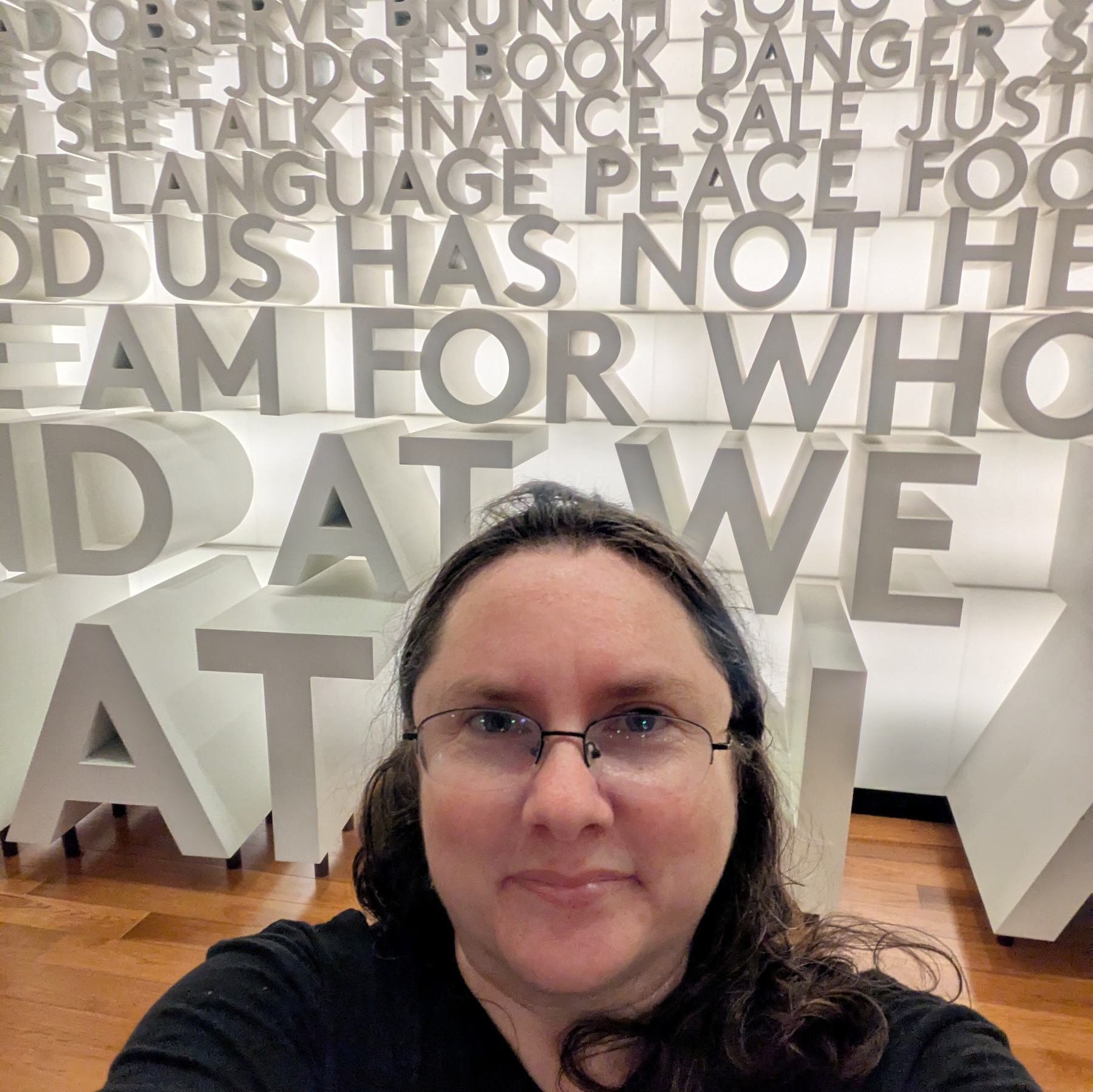
A white woman with dark hair and glasses stands in front of a wall with several words in 3d on it. The word 'BOOK' is centered over her head.
Kimberly Hirsh in front of the wall of words at
Planet Word Museum in Washington, DC

Hi there! I'm Kimberly Hirsh. My pronouns are she/ her/hers. I'm somebody's mom. I work as a school librarian. I have a PhD in information and library science. I love to read, play tabletop and video games, and make things. I used to perform in theater and improv comedy and I may one day again. I have been extremely online since 1993 and still enjoy tinkering on the web. I manage multiple chronic illnesses. I'm married to my kid's dad. We have a cat.

Want to get in touch? You can reach me by email.

Recent posts

Poetry Friday

Gelett Burgess. 1866– 36. 
The Purple Cow 
(Reflections on a Mythic Beast Who’s Quite Remarkable, at Least.) 

I NEVER saw a Purple Cow; 
I never hope to See One; 
But I can Tell you, Anyhow, 
I’d rather See than Be One.

Oh how I love this poem.  It is so silly.

📚 Weekend Wonderings

This week’s question is brought to you by yesterday’s Free Comic Book Day, my pleasure in watching “Spiderman 3,” and my boyfriend’s birthday weekend.  Also my recent reading of Flight volumes 1 and 2, and my upcoming reading of Flight volume 3 and Kazu Kibuishi’s Daisy Kutter.

How can graphic novels bring unwilling readers into the literary world?

What I’m looking for here is a discussion of what makes graphic novels unique, what makes them literature, and what we can do to get reluctant readers to pick up a graphic novel.  For a long time, graphic novels and comics have been pooh-poohed as not “real books.”  This is a sentiment that advocates of kids and YA lit understand keenly, since children’s literature is also treated this way.  Graphic novels and comics are considered “kid stuff” by the uninitiated, and while those of us who are fans of graphic novels and comic books have fought against that for a long time, perhaps it’s time to embrace it a little and say “Okay.  These are for kids.  Let’s get them in the hands of kids!”  That’s not to say adult stories can’t be told in the graphic novel/comic book medium, but just that instead of kicking and screaming, “It’s not just for kids!” we should say, “It’s not just for kids, but it is an excellent way to draw kids into reading.”

What do you think?

Last Week’s Question: What is the purpose of a book review?

You can find answers at the original post and MotherReader.

Books to Read: My Area of Expertise

My Area of Expertise: The Ancient Mediterranean.

The Lightning Thief, Rick Riordan
The Sea of Monsters, Rick Riordan
The Titan's Curse, Rick Riordan
Iris, Messenger, Sarah Demming
The Last Girls of Pompeii, Kathryn Lasky
Ithaka, Adele Geras
Troy, Adele Geras 
Nobody's Princess, Esther Friesner
Corydon and the Island of Monsters, Tobias Druitt
Corydon and the Fall of Atlantis, Tobias Druitt
Goddess of Yesterday, Caroline B. Cooney
The Shadow Thieves, Anne Ursu
The Siren Song, Anne Ursu


Other suggestions please?

Free Comic Book Day Tomorrow

At the beginning of the school year, the school newspaper sent a kid around to interview all the new teachers.  He had lots of questions, boring ones like "Where'd you go to college?" (which he managed to misquote me on), and less boring ones such as, "What cartoons do you like?" but the question that nearly stumped me because my heart was torn in two was "Who's your favorite superhero?"

In the end, he quoted me as saying I liked the X-Men, I think.  But what I really said was, "Spiderman!  No, wait, the X-Men!  Well, I like all the X-Men but I like Kitty Pryde the best.  So.... AH!  This is such a hard question!  I guess I'll go with Kitty Pryde and Spiderman."

This brings me to tell you about tomorrow.

Tomorrow is an important day.  Cinco de Mayo.  My boyfriend's birthday.  Free Comic Book Day.

It's appropriate that Free Comic Book Day is my boyfriend's birthday, as he is the one who got me into comics.  It's also appropriate that Spiderman 3 is coming out today, the day before Free Comic Book Day and my boyfriend's birthday.  It's such a unique confluence of events that brought us here.

So, go get a free comic book.  You might run into MJ there, in which case she'll say this:

(They actually made that a line in Spiderman 2 and I about died of happiness.)


Poetry Friday

Still more Catullus.  Latin text from The Latin Library; translation/adaptation mine.

V. to Lesbia Let us live my Lesbia, and let us love, and let us assess the gossip of too severe old men at a single penny! Suns can fall and return: When our brief light has once gone out, We must sleep one perpetual night. Give me a thousand kisses, then a hundred, then another thousand, then a second hundred, then still another thousand, then a hundred. Then, when we will have made many thousands, we will mix them up, so that we do not know, nor will any bad person be able to envy us, when he knows there to be so many kisses. V. ad Lesbiam

VIVAMUS mea Lesbia, atque amemus, rumoresque senum seueriorum omnes unius aestimemus assis! soles occidere et redire possunt: nobis cum semel occidit breuis lux, nox est perpetua una dormienda. da mi basia mille, deinde centum, dein mille altera, dein secunda centum, deinde usque altera mille, deinde centum. dein, cum milia multa fecerimus, conturbabimus illa, ne sciamus, aut ne quis malus inuidere possit, cum tantum sciat esse basiorum.

Other Catullus Translations of Mine: I. to Cornelius II. The Tears of Lesbia’s Sparrow III. The Tears of Lesbia’s Sparrow

Meme: First Book

A meme of my very own!

What’s the first book you remember reading?  Give us the title, author, date of publication, and your age when you read it.  Look it up at Amazon.  Is it still in print?

Mine is Stop!  Go!  Word Bird by Jane Belk Moncure, published in 1981.  I was three when I read it.  It is no longer in print.

(If you want to leave out any of the information aside from the title, feel free.  Especially your age when you read it, as some people may be embarrassed because they started reading especially early or especially late, though I can’t imagine anyone in the litosphere criticizing anyone else based on when they started to read.)

Reading the Classics: Peter Pan

Here’s a new feature for lectitans: Reading the Classics.  I’ll be reading classic books and posting my thoughts on them, links of interest, etc.  The first book I’m using for this feature is J. M. Barrie’s Peter Pan.

In case you didn’t know, Peter Pan is about Wendy Moira Angela Darling, her brothers, and their adventures in the Neverland with a boy named Peter Pan.  Peter ran away from home shortly after his birth, and refuses to grow up.

It may strike you as odd that I went to the age of 25 without having ever read Peter Pan, especially having been exposed to many incarnations of it.  I didn’t spend my life avoiding reading it.  I just never thought about picking it up, until I recently started reading J. V. Hart’s Capt. Hook and decided I should perhaps read the source material first.

Reading Peter Pan was like coming home.  As a child I watched the Betty Comden/Adolph Greene musical Peter Pan (starring Mary Martin as Peter) time and time again.  I loved that musical.  I still do.  The musical is quite faithful to the book, and so I found myself reciting lines as I was reading, and exerting great control over myself to keep from bursting into song.  I especially enjoy the aspects of Barrie’s writing that sound as though he himself were reading a child a bedtime story.

Peter Pan is on first glance a simple story, but it has inspired so many imaginations and led to so many adaptations and spin-offs that I can’t help but examine it on a deeper level.  I have nothing new to say about the book, I fear; its themes are clearly growing up and the passage of time.  What I find interesting and haven’t read a lot about is the contrast between Wendy and Peter.  Peter never wants to grow up, and Wendy is very eager to be a grown up.  She wants to do grown up things, keep a grown up house, raise children as grown ups do.  Playing at being a little mother is what Wendy does best.  I identify with her heavily, especially in the 2003 film adaptation, where she is the storyteller and likes to swordfight.  (The newest Wendy is by far my favorite Wendy.)

I don’t particularly like the Disney Peter Pan, though I find Disney’s Tinkerbell charming.  The musical is my favorite adaptation.

For me, the most interesting character is Captain Hook.  Cyril Richard’s Captain Hook in the musical first sparked my love of pirates.  Ask any of my friends or students, and they’ll tell you I have a pirate problem.  It didn’t start with Captain Jack Sparrow.  It goes all the way back to Capt. Jas. Hook and his beautiful red coat.  Captain Hook is an adult, but he lives in the Neverland.  How did an Etonian end up in the land of children’s imagination?  I guess I’ll have to read Capt. Hook to find out.

My favorite adaptation/spinoff from the Peter Pan story is Christopher Golden’s Straight on til Morning.  It’s a dark version of the tale, set in the summer of 1981 (a grand time if you ask me).  I highly recommend it.

Peter Pan seems above review to me; what is there to say about its quality?  Time. popularity, wars over its copyright, and its many derivative works have revealed all that’s necessary in that case, I think.  I enjoyed reading it.

For a comprehensive look at Peter Pan and the works it inspired, read Little Willow’s article, Peter Pan and Friends.
Weekend Wondering

There has been much debate recently about blog reviews and their trustworthiness.  Becky has an excellent summary of the whole affair over at Becky’s Book Reviews.  This week’s question is inspired by this debate.

This week’s question:

What is the purpose of a book review?

Is it to make an audience aware of a book they might have overlooked?  Is it to steer an audience away from a book that may waste their time?  Is it bad to only write one kind of review: positive or negative?  Is it good to think about who might like a book, even if the reviewer finds it unsatisfying?

I’ve been pondering all of these sub-questions myself.  I haven’t weighed in on the great blog review debate, because I feel like I’m so new to the whole litosphere that I can’t make a well-educated statement.  For my book reviews, I will say this: I won’t review a book I didn’t finish, and I won’t finish a book I don’t like.  It follows, then, that I will only review books I like.  There is a great range, however, in my depth of appreciation for a book.  Some books (Millicent Min, anyone?) I adore.  Others I like but don’t love (The Last Dragon).  I don’t write traditional reviews.  When I write a review, I start with a quick summary.  I then try and get to the larger themes of the book, what the book means on a universal level.  Lastly, I recommend the book for certain reader groups.  I am not looking to be unbiased or provide critical analysis; that’s just not what I do here.  This is a personal reading journal, and so my reviews are personal reviews.  If you are looking for objective reviews, you should probably go someplace else.

Last week’s question: How much can we know about the author herself based on the content of the book?

This question provoked a lot of discussion.  You can find answers at the original post, Tea Cozy, Cats and Jammers Studio, And if I come to ledges… , Andrew Karre’s Flux Blog, Finding Wonderland, and Bri Meets Books.

Poetry Friday

More Catullus.  Latin text from The Latin Library; translation/adaptation mine.

III. The Tears of Lesbia’s Sparrow [yes, again] Mourn, o Venuses and Cupids, and whatever amount of lovely people there are: my girlfriend’s sparrow is dead, the sparrow which she loved more than her own eyes - for he was honey-sweet to her, and he had known her so well as a girl knows her mother, nor did he move himself away from her lap, but hopping around at one time hither and another time thither he was chirping always to his mistress alone: now he goes through that shadowy journey, from which they deny anyone to return. But let it go badly with you, evil shadows of Orcus, who devour all beautiful things: stay away from my so-beautiful sparow. O bad deed!  O unhappy sparrow! Now by your work my girl’s swollen eyes grow red with weeping.

III. fletus passeris Lesbiae

LVGETE, o Veneres Cupidinesque, et quantum est hominum uenustiorum: passer mortuus est meae puellae, passer, deliciae meae puellae, quem plus illa oculis suis amabat. nam mellitus erat suamque norat ipsam tam bene quam puella matrem, nec sese a gremio illius mouebat, sed circumsiliens modo huc modo illuc ad solam dominam usque pipiabat. qui nunc it per iter tenebricosum illuc, unde negant redire quemquam. at uobis male sit, malae tenebrae Orci, quae omnia bella deuoratis: tam bellum mihi passerem abstulistis o factum male! o miselle passer! tua nunc opera meae puellae flendo turgiduli rubent ocelli.

Other Catullus Translations of Mine: I. to Cornelius II. The Tears of Lesbia's Sparrow IV. to Lesbia

Tithe: A Modern Faerie Tale

When Kaye was a little girl, she had faerie friends.  When she and her glam-rock mom moved, the faeries disappeared.  As Kaye grew older, she began to think the faeries had just been a product of her imagination.  But when she returns to her childhood home, Kaye discovers not only that her faerie friends are real, but that she herself is a faerie.  Her friends convince her to help them escape seven years’ bondage to the Unseelie Court, a court of dark fae.  Kaye enters a frightening world, where magic works and faeries struggle for power.

Tithe is a book for young adults.  It is not a book for children.  If you are a parent considering giving this book to your child, read it first.  I would not put this in the hands of anyone I didn’t consider a grown up.  What does that mean?  I have students to whom I could comfortably recommend this book.  I also have students to whom I would never recommend this book.  Tithe is dark, both in its real-world and its fantastical elements.  Reading through the reviews at Amazon, I found a lot of complaints that it was too grown up to be a young adult book.  I also read a lot of complaints about the behavior of the central characters.

Kaye and her friends are New Jersey trailer trash.  They wander through life without significant purpose.  Kaye is a high school dropout, forced to leave school so she could support her mom’s career in rock music.  Kaye’s friends are ravers.  They smoke, they drink, and they commit acts of debauchery.  The same could be said of any of the faeries in the book.  Tithe presents a view of teenage life that many readers would prefer to ignore.  That doesn’t make it a bad book.  It makes it an honest book.  Even though we haven’t experienced something firsthand, we can see when things are true.  While I would never have been friends with Kaye in high school, my best friend associated with a crowd of kids who would have.  I knew those kids, and I was polite to them, but I avoided them.  That didn’t make them imaginary or contrived.

Tithe’s greatest strength is its examination of illusions, obligations, and consequences.  At various points, Kaye learns that her friends, both human and fae, are not what they seem.  She learns about the nature of obligation.  And her actions have distinct, permanent consequences.  Another strength is Black’s use of traditional faerie lore.  The Seelie and Unseelie courts, as well as the Unseelie Queen Nicnevin, are elements taken from Scottish faerie legend.  Holly Black moves them across the Atlantic and sets them in New Jersey, where broken-down boardwalks are more common than fantastical forests.  Where she works her magic is she makes them seem like they belong there.  There is nothing unnatural about the Faerie we see in Tithe.  At no point did I think, “Faeries?  In Jersey?"  Black’s seamless interweaving of modern and mythical elements is a rare talent.

Tithe made me very uncomfortable.  It also made me cry.  Those two things, taken together, mark good art.  Tithe is, above all, compelling.  When it was over, I was confused because I had been so engrossed in the world of the book.  Lucky for me that Valiant and Ironside are set in the same universe, isn’t it?

Book: Tithe: A Modern Faerie Tale (Affiliate Link)
Author: Holly Black
Publisher: Simon Pulse
Original Publication Date: 2004
Pages: 336
Age Range: Young Adult
Source of Book: Library
Other Blog Reviews: Twisted Kingdom, Stainless Steel Droppings, CheriePie’s Book Reviews, Wands and Worlds