
Posts in "Long Posts"

Starting a podcast: Resources, part 1

Yesterday I mixed and mastered the first episode of my upcoming Buffy the Vampire Slayer podcast, Things of Bronze. This is a great example of a personal project that is helping me gain skills I can use professionally. Connected learning in action! Here are action steps and resources that have helped me along the way.

Finding podcasts

I’ve been listening to podcasts for… a while. I don’t know how long, but at least four or five years. Maybe more. I really got into them for a bit when they were experiencing their renaissance around the release of Serial’s first season. Back then I heavily favored Gimlet productions. I also dipped into The Indoor Kids from time to time and listened to the first thirty or so episodes of Kumail Nanjiani’s X-Files Files, watching along before listening to each episode. That was the show that made me want to start my own podcast; as I listened, especially during the segments where Kumail would dig up old posts from Usenet, I started developing the idea for a Buffy the Vampire Slayer podcast that would, alongside rewatching, draw on my experience as a poster at the official BtVS posting board. So this podcast I’m just starting has actually been in development for four years. More on that later.

You can certainly listen to whatever podcast is trendy at the moment. (In the past year: Missing Richard Simmons, S-Town, Dirty John, The Daily.) Or venerable standbys (This American Life, Radiolab). You’ll definitely learn a lot. But I think you’ll do better with something that you’ll really love. That may be one of those podcasts I already mentioned. But it may be something else. People have written a lot about how there’s a discovery gap in podcasting, and I think that’s right. Until listener’s advisory in libraries expands beyond audibooks and music and starts to include podcasts, you’re going to have to do some legwork. Here’s how I’ve done that.

1. Get recommendations from friends and loved ones. My husband, Will, recommended Pop Culture Happy Hour to me forever before I finally listened to it and loved it. It was a lot like that Modern Family episode about wedge salad. (Sorry, Will.) It kind of seems like everyone I know adores Welcome to Night Vale. Podcasts have a viral-like spread through my community of comedy friends, which is how many folks I know got turned onto The Dollop and Hello from the Magic Tavern. And a recommendation from a friend is how I learned about Buffering the Vampire Slayer, which directly influences some of the topics I choose for Things of Bronze.

2. Let the internet tell you how to start. tl;dr: check out your favorite websites and other media sources to see if they have podcasts, ask your friends (see above), Google a topic plus the word “podcast,” use in-app lists of top or new or trending podcasts, find podcast directories. Or, what I’ve really enjoyed, check out this handy list of podcast newsletters from Bello Collective (more on that later, too). I used the in-app lists to find my current favorite podcast, The Hilarious World of Depression, as well as the super fun bomBARDed.

3. Pay attention to people you like - authors, comedians, actors, whomever - and check out podcasts that feature them as guests and podcasts they recommend. I’ve been dabbling in woo-woo as sort of an emotional antidote to the rigorous intellectual standards of empirical research, spending time especially in the Tarot end of the pool, and through following Bakara Wintner I found her guest appearance on Tarot for the Wild Soul, and via the website The Numinous I learned about Self-Service.

Keeping up with podcasting news and trends

Again, that Bello Collective piece is really handy. The top resources I’ve enjoyed for news are Hot Pod and podnews. They’ve kept me up to date on valuable projects like Preserve This Podcast and debates about recording loudness standards.

Advice on doing a good job

This piece from my podcast boyfriend Glen Weldon (look, the fact that he will never reciprocate my love is irrelevant as we’re both married and unlikely to ever spend much time together) is my favorite.

Developing, recording, editing, mixing, and mastering your podcast

This book, in spite of being ten years old, walked me through this every step of the way. I used Audacity for recording, editing, mixing, and mastering. I didn’t have a lot of money to spend on equipment, so I just used the same laptop I use for everything else and this cheapie mic - perfect because I wanted to be able to travel with it and record both solo stuff and group stuff.

In the future: hosting and marketing! Since I’m not ready to do those things, I don’t have a lot of advice on them, but I’ll be back when I do.

Preparing for comprehensive (qualifying) exams: My process so far

I have been chipping away at the comprehensive literature review my program requires that I write to prepare for my qualifying examination for more than six months now. My progress has been achingly slow. I am finally in a (slow-moving) groove, though, so I thought I’d share a little bit about my process.

I began by following Raul Pacheco-Vega’s advice. I read each piece, doing his Abstract-Introduction-Conclusion extraction process (a process similar to the advice offered in my doctoral seminar, but his is a bit more streamlined). [A note on tools: I do all of my reading digitally as I have limited printing availability, work in multiple offices, and sometimes need to read with a toddler napping on me. I use Zotero, store all my Zotero attachments in Google Drive, sync files to read on my tablet with ZotFile, make those files available offline using Google Drive on my tablet, then read and annotate them in Xodo.]

After this, at first I started writing a rhetorical precis for each piece but I found it didn’t help me that much. I wasn’t ready to write full synthetic notes, because I didn’t have enough of a grip on the literature landscape to determine what would qualify a study as something I would want to come back to and read later for more detail or expand into a complete memo. So I skipped ahead to the conceptual synthesis spreadsheet dump stage, leaving several of Raul Pacheco-Vega’s columns to return to later - I only used the concept, citation, and main idea columns to begin with. I added a column for which type of library setting the paper was addressing, because I thought that might be important later. I used the concept column not to tell me which concept in my lit review the paper was for, as I’ve created separate tabs in the spreadsheet for each of the five areas I’m exploring, but instead as sort of a tags column.
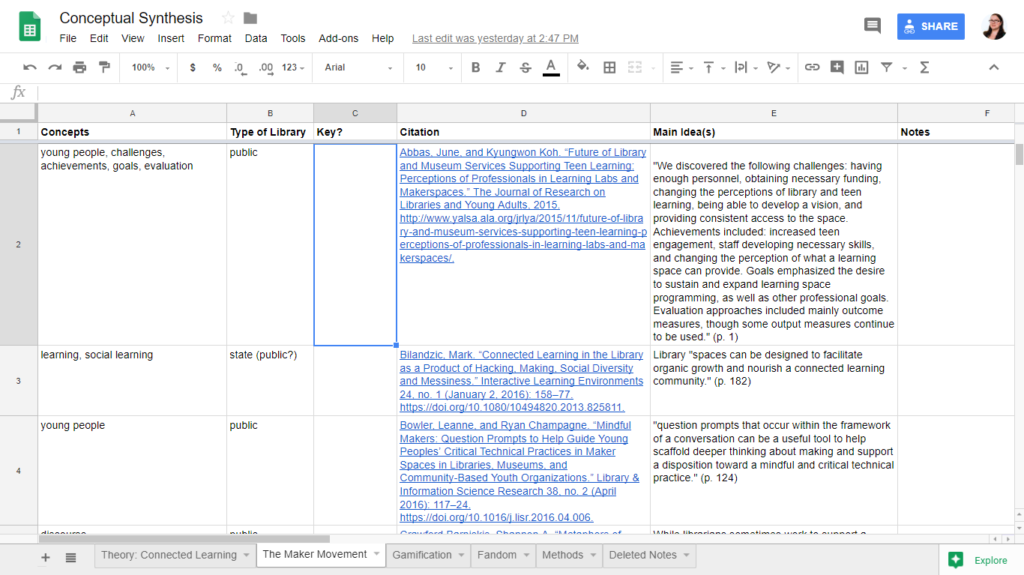
Conceptual Synthesis Spreadsheet

After filling out these columns for all the readings, I went back and re-read the main ideas column. Then I did some concept grouping (not really mapping yet) and a free-write of brief notes about all of the ideas I was synthesizing based on my reading.
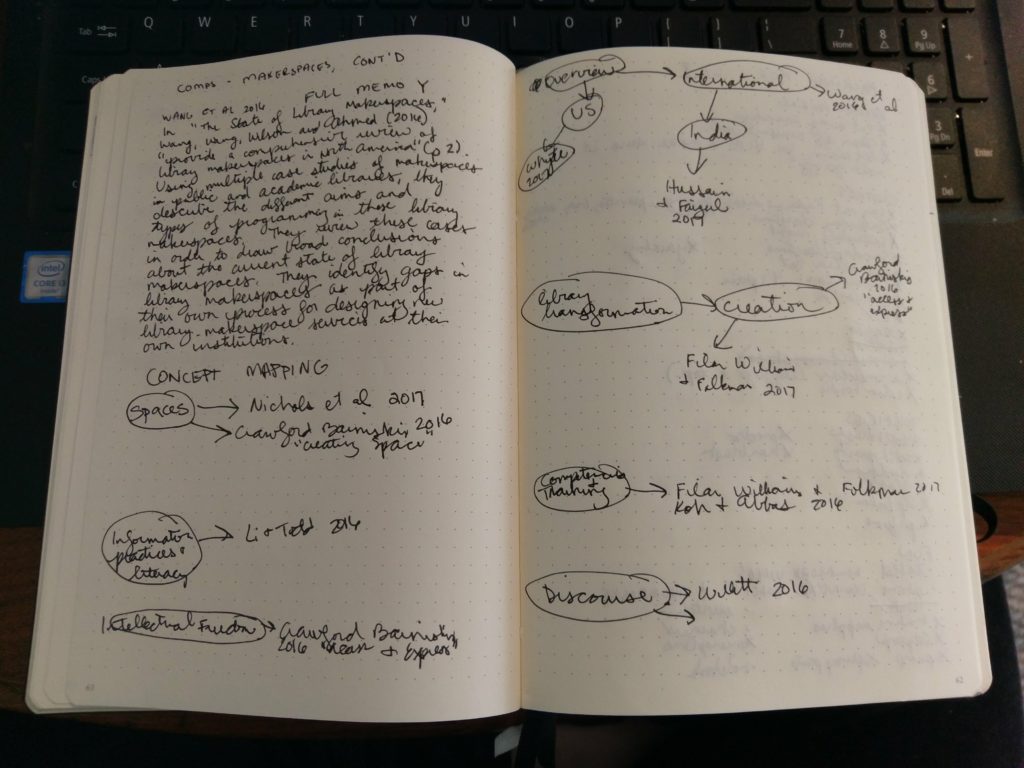
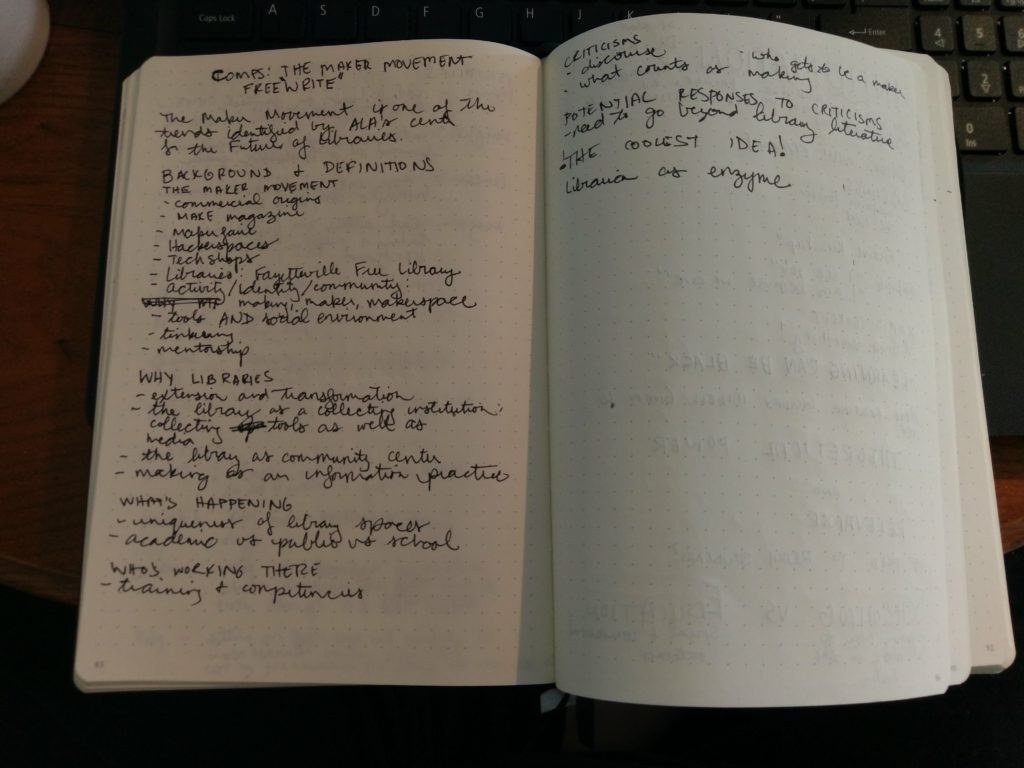
Concept Map Freewrite

Then, based on my concept groupings and freewrite, I created a preliminary outline.
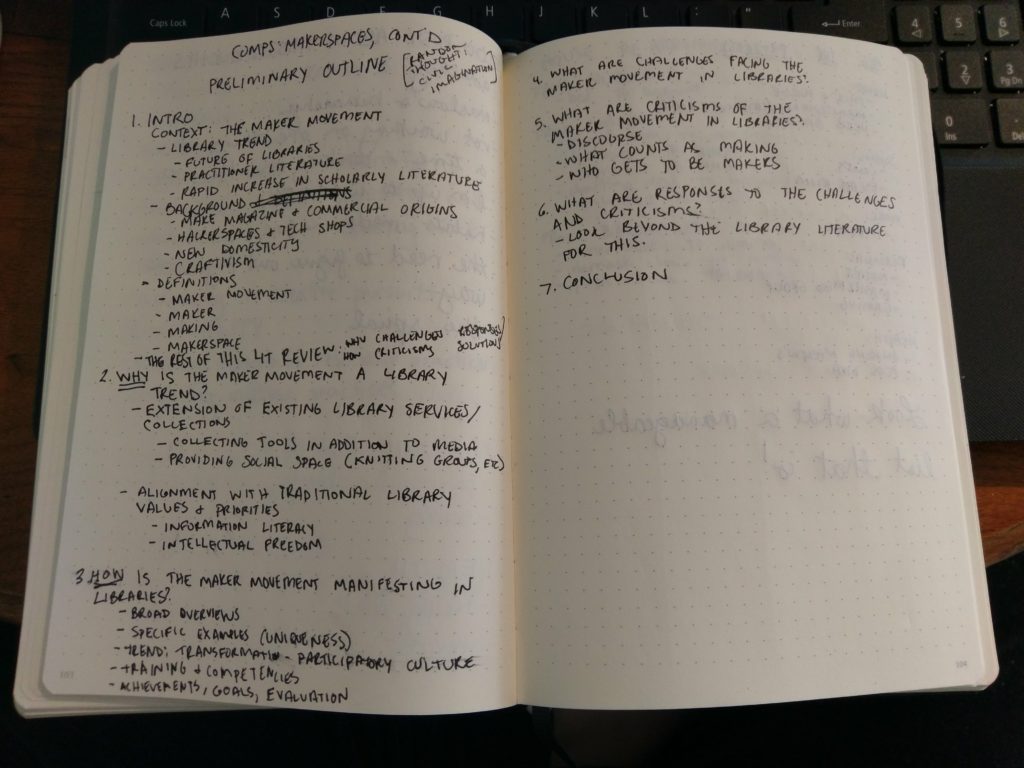
Outline

I typed up this outline, filled in the introduction section based on earlier literature reviews I’d already written, and now I’m ready to come back and go through each study I have in my conceptual synthesis spreadsheet and write a full synthetic note with the ability to tell how helpful it would be to do a close reading and full memo of any given piece.

Imposter syndrome: a scene

Me: I don’t know why anyone would hire me to do anything. I’ve never done anything. My only skill is that I can tell you that somebody else wrote a thing about something.

W: That’s an actual job.

Me: Oh. That’s what a librarian does, isn’t it?

[Note: I know that is not the only thing a librarian does.]

Women are flocking to wellness because modern medicine still doesn't take them seriously

As a woman with chronic illness, both physical and mental, who is a prime target for the wellness industry and a person who has spent a fair amount of money trying to fix myself in the middle of a systemic problem with US health care, I found this piece especially resonant. The points about the accessibility of “wellness” and the role of disparate health outcomes for women of color and low-income women are especially worth noting.

Be Your Own Toddler, Part Two

This is an extension of this earlier note.

A common piece of advice for people with intrusive negative self-talk is to think about how you would respond if someone talked the way about a loved one that you do to yourself. Cognitively, this is helpful. But honestly, for me, it sort of just sits in the “thoughts” part of the cognitive behavioral therapy triangle. For whatever reason, it never seems to shift my thoughts or feelings.

But a couple of days ago, I did something that took that concept a step farther: I literally spoke, out loud, to myself in the same voice I use to soothe my toddler. Halfway between my car and the co-working space, I realized I’d left my phone in the car. Anxiety, she was waiting, and jumped on this: “God, Kimberly, why are you so stupid?” But Mom-Me instinctively said - again, out loud, “It’s okay,” in the sweetest way. In the same way I say to M. when he hurts himself, “That looked like it hurt! It probably doesn’t feel very good. I know it hurts right now, but you’re strong and you’re going to be okay.” And that out loud mom voice made all the difference. So what if I left my phone in the car? It wasn’t a high stakes situation. I turned around and went back to the car and got my phone, and didn’t berate myself for having left it there.

If you’re plagued by negative self-talk, imagine the creature you are most motivated to soothe, and try using the actual audible voice you use for that creature on yourself.

In the meantime, in case you need a mom to say it to you:

I know it hurts right now, but you’re strong and you’re going to be okay.

[Backstory: a friend recently expressed a wish to be able to take a moment out from busy, stressful life, as I had done long enough to share a slice of butter cake with my toddler. I replied that caring for someone else requires setting aside misery, for at least a moment. “Be your own toddler,” I urged my friend.]

It's okay to not be okay.

In my earliest days as a mother, I often found myself perusing the diagnostic criteria for post-partum depression. “I’m not as bad as all that,” I would think, “but I’m also not okay.” It was a huge relief the day I read a blog post that acknowledged that there’s a spectrum of possibilities between diagnosable perinatal mood disorder and unadulterated new mom bliss.

I’ve seen more than one of my friends recently articulate that they aren’t okay but they don’t know how to talk about it. I would speculate that they’re worried people will jump from “That person isn’t okay” to “OH GOD THEY’RE SUICIDAL!” I struggle with this concern myself.

We need to make space for the in-between, and we need to find the people around whom we feel safe expressing when we feel down. I have a few people. If you find yourself feeling this way often, I encourage you to find someone willing to act as a release valve. In my experience, it makes a difference.

Featured Image: Flying or Falling II by John Park

How Facebook Is Killing Comedy

I happened across this piece in Austin Kleon’s newsletter. It beautifully expresses a sentiment that I’ve heard from many of us who were around when the web was first becoming widely available: a desire to return to a time when individuals could publish things and you found them by searching or by word of mouth, not because an algorithm pushed them into a feed. This is not not about comedy, but it’s about a lot more than comedy. It seems more social media sites are adopting algorithms like Facebook’s all the time.

Here’s how I’m responding:

1. Publishing primarily here at KimberlyHirsh.com. Several months ago now I began to explore the IndieWeb movement. I’m still not really doing it fully - not using replies or events yet, for example. But I’ve gotten started and finally found my groove with long posts, status updates, and link-sharing, at least.

2. Using Facebook almost exclusively for its group functionality. Sadly nobody else is doing this with as widespread adoption as Facebook. This is where most of my communities are congregating. But I’ve unfollowed all of my friends and liked pages. If I want to know how a friend who internets mainly via Facebook is doing, I go directly to their timeline.

3. Subscribing directly to content providers in other ways. If I want to see everything, I go with RSS for a full blog feed. If I want more curated content, I go with a newsletter. I use Gmail labels to keep all my newsletters together and deliberately choose when to review them.

4. Observing my own response as I browse social media. If I’m scrolling Twitter or Instagram and I start to feel sad, angry, or bored, I step away. This is more about self-care than defeating algorithms, but it feels related, somehow.

There are scholars doing interesting and important work on this. Here are a few to check out:

Zeynep Tufecki

Safiya Noble

Anna Lauren Hoffman