I’m a great lover of Valentine’s Day as a time to express special affection for friends & family as well as romantic partners. Today is a hard Valentine’s Day. My mom is being readmitted to the hospital. Tell me about someone special to you & how you make sure they know it. 💞
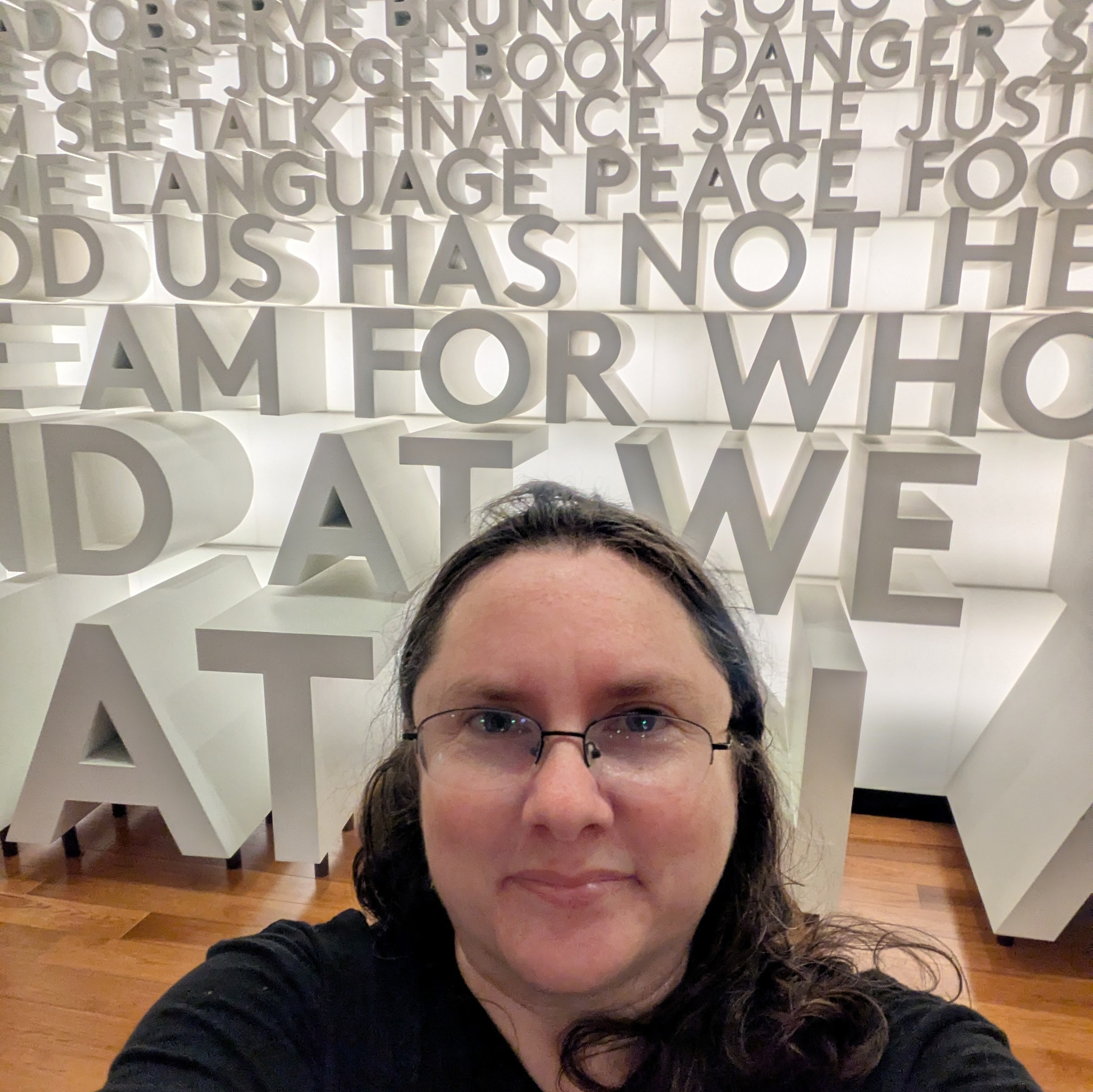
Planet Word Museum in Washington, DC
Hi there! I'm Kimberly Hirsh. My pronouns are she/ her/hers. I'm somebody's mom. I work as a school librarian. I have a PhD in information and library science. I love to read, play tabletop and video games, and make things. I used to perform in theater and improv comedy and I may one day again. I have been extremely online since 1993 and still enjoy tinkering on the web. I manage multiple chronic illnesses. I'm married to my kid's dad. We have a cat.
Want to get in touch? You can reach me by email.
Recent posts
My mom was discharged from the hospital tonight and will be doing the rest of her induction therapy outpatient. Thought you might like some good news tonight, world.
Started Octopath Traveler again tonight and it made me very happy. Last time I played was almost 2 years ago. 🎮
I think the union rep at this postdoc orientation is doing this presentation outside during the Santa Ana winds, which is a choice.
I am having a grumping it out day.
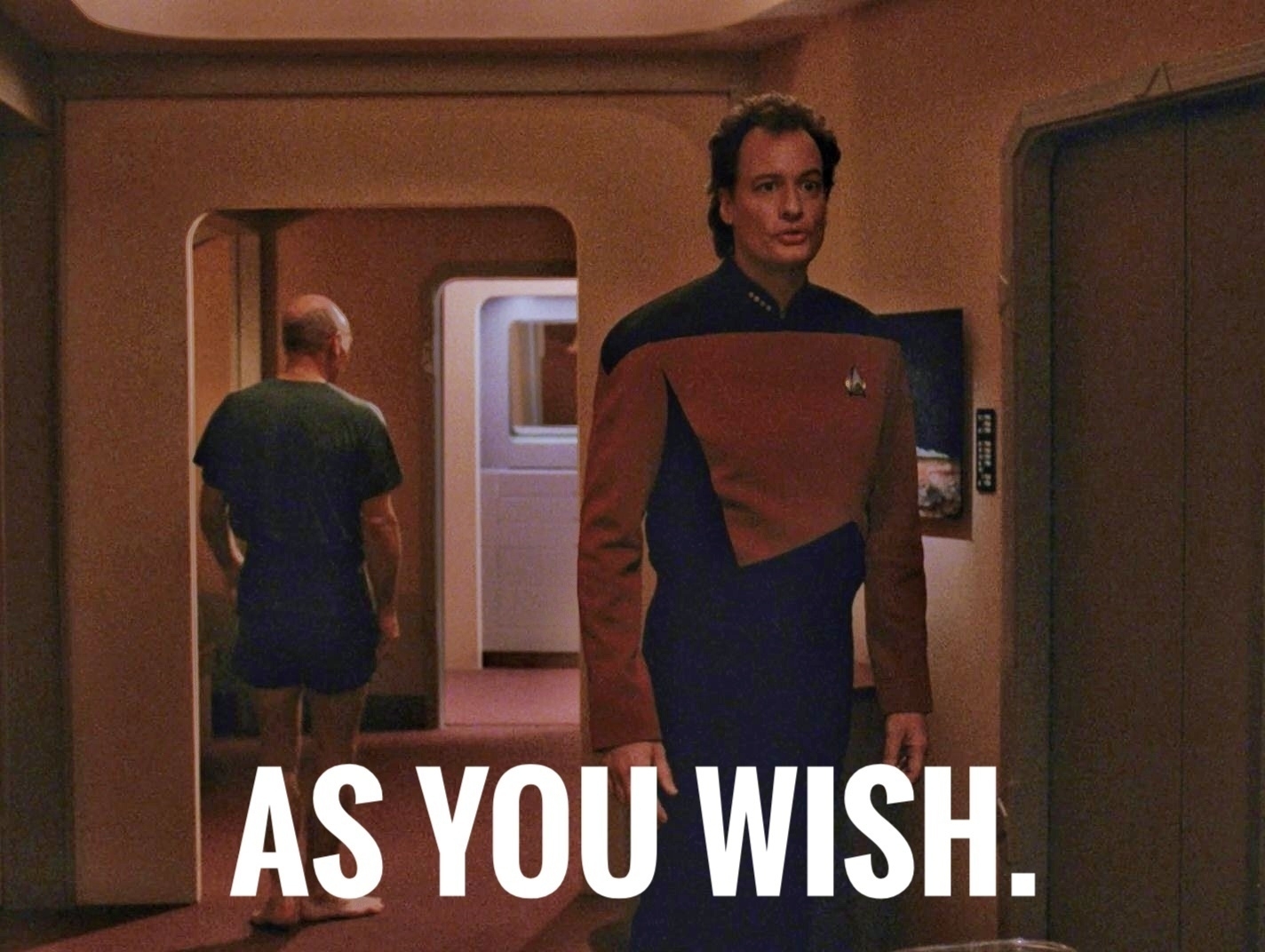
#StarTrek:The Next Generation Season 4 Episode 20 “Qpid” aired 04/22/91. 🖖🏻
Q: You would have me stand idly by as she leads you to your destruction?
PICARD: Yes!
Q: As you wish.
The Princess Bride was released on 09/25/1987.
🔖 Read How to Reclaim Normal Life Without Being ‘Done’.
I appreciate the acknowledgement here that inputs for risk calculation vary widely.
Got an email about my kid’s school moving to endemic risk management instead of pandemic and I get it but I do worry about those of us who are high risk, immunocompromised, or with kids under 5. I hope some guidance appears taking those groups into account.
Write Source 2000: The book that started my obsession with writing craft books 📚📝
I own a lot of writing craft books. There’s the obvious, like Stephen King’s On Writing and Anne Lamott’s Bird by Bird, but I also have more obscure ones like Richard Toscan’s Playwriting Seminars 2.0. I have books about how to write romance, like Gwen Hayes’s book Romancing the Beat and books about how to write science fiction and fantasy, like Ursula K. Le Guin: Conversations on Writing. I have books about writing for different audiences, like children, and in different formats, like screenwriting. I have purchased many more of these books than I have read. In a sense, I have a whole little antilibrary devoted to writing craft.
As I was doing my morning pages this morning, I thought about my affection for freewriting and realized that it first started in seventh grade, when our teacher assigned us the textbook Write Source 2000. This was 1993, so adding 2000 to the end of things made them seem very futuristic. The cover of the book, which can still be purchased used, was very shiny. It’s got a pencil-shaped space craft on the cover and kids looking up at it through a telescope. The third edition is available via the Open Library. I had the first edition, but I suspect they’re very similar. The cover design is the same.
A lot of my initial affection for this book was because of its quality as a material object. The shininess of the cover. The fact that it was a trade paperback, unlike most of our textbooks. The page layouts inside were attractive. And the authorial voice was conspiratiorial:
We’re in this together. You and I. We’re members of an important club - maybe the most important club ever.
The book focuses on learning across settings, writing as a tool for learning, and metacognition (though it just calls it “learning to learn”). I did not realize that this had been my jam for almost 30 years, but I suppose I shouldn’t be surprised.
I’m pretty sure I still have my copy somewhere. If not, I definitely carried it around with me at least through college. I thought about buying it again but now that I know I can read it on Open Library, I feel okay holding off.
This book was the first book I read that talked about how to write, and I loved it for that. I’m pretty sure I was the only kid excited by this textbook. (It also had new-book-smell, which for my money is equal in joy to old-book-smell. Really, if it’s a book in pretty good condition, I probably like how it smells.)
I can’t find the source right now because I’ve read so much of her stuff, but sometime Kelly J. Baker wrote about the idea of writing as a career never occurring to her. It didn’t occur to me, either, though I did it constantly: in my diary, in journals, at school. In fifth grade I wrote a series of stories using the vocabulary list words, and it was all extremely thinly veiled autofiction where the characters names were just my classmates’ names backward. They ate it up.
I started and left unfinished tens of science fiction stories about my own anxieties as a middle schooler, and in high school I wrote a silly children’s book (I think it was called The Hog Prince), Sailor Moon and Star Wars fanfic, and short plays (the plays were in Latin). In college, I wrote more fanfic, all of the school writing assignments, and blog posts.
As a teacher I wrote lesson plans and assessments. As a librarian I participated alongside my students in NaNoWriMo. Working in higher ed K-12 outreach, I wrote blog posts and newsletters.
Writing is, it turns out, a potential career, but it’s also just part of life.
During the next couple of years as I work as a Postdoctoral Scholar, I’m thinking about what I’d like to work on next. I’m pretty sure it will involve reading and writing, because those activities are almost autonomic for me. I don’t know beyond that.
But maybe it’ll involve actually reading more of those craft books.
The Teens Leading Change initiative at the LA Public Library is awesome. A great reminder that there are people committed to doing good work in the world and that teens can make the world a better place.