
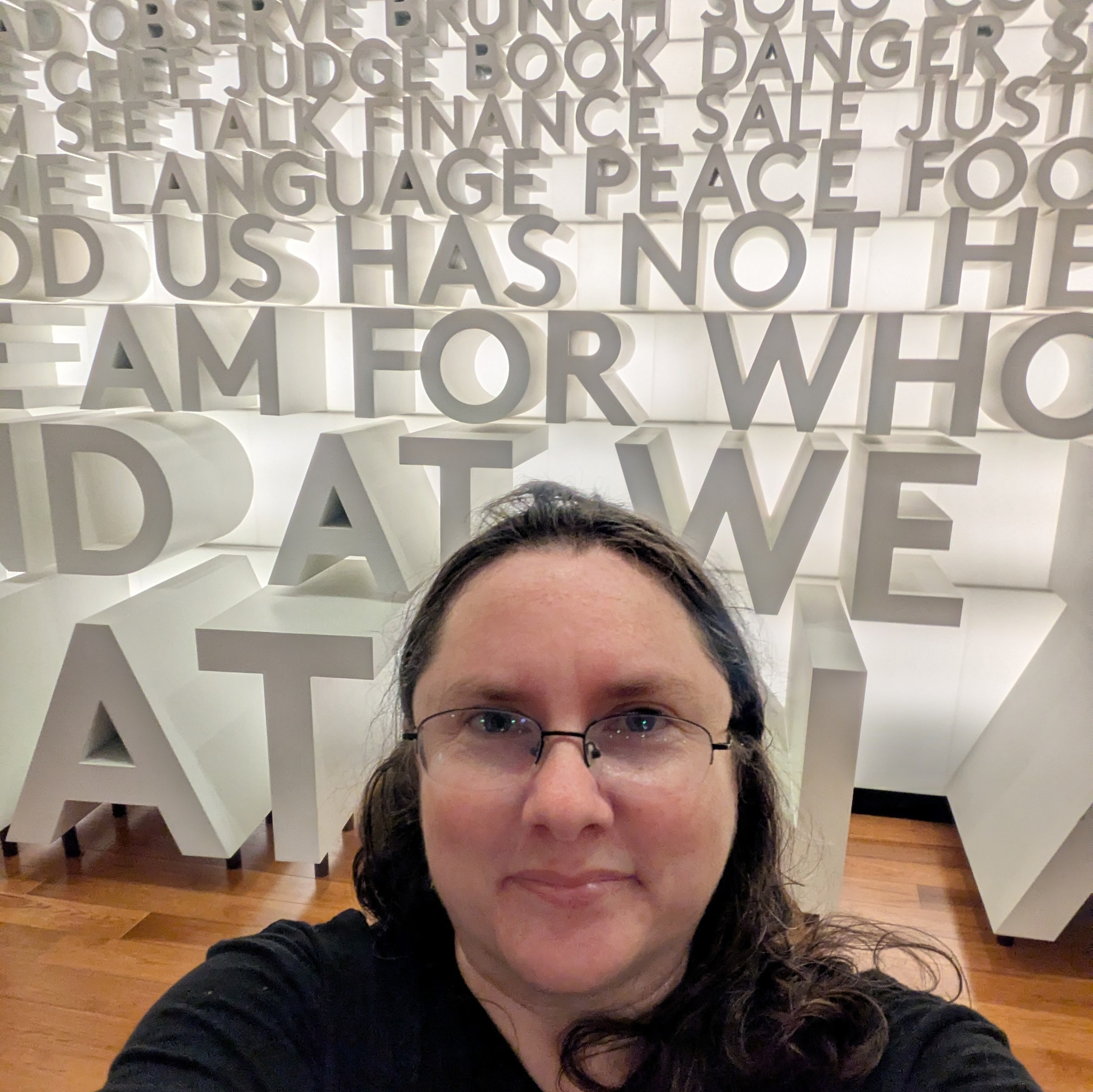
A white woman with dark hair and glasses stands in front of a wall with several words in 3d on it. The word 'BOOK' is centered over her head.
Kimberly Hirsh in front of the wall of words at
Planet Word Museum in Washington, DC

Hi there! I'm Kimberly Hirsh. My pronouns are she/ her/hers. I'm somebody's mom. I work as a school librarian. I have a PhD in information and library science. I love to read, play tabletop and video games, and make things. I used to perform in theater and improv comedy and I may one day again. I have been extremely online since 1993 and still enjoy tinkering on the web. I manage multiple chronic illnesses. I'm married to my kid's dad. We have a cat.

Want to get in touch? You can reach me by email.

Recent posts

Theory to practice: Don’t let the perfect be the enemy of the good

As we work on the Transforming Teen Services for Equity, Diversity, and Inclusion project, one thing I have to be reminded frequently is that creating Connected Learning programming does not require providing for all three spheres: interests, relationships, and opportunities. Frameworks like Connected Learning begin as more descriptive than prescriptive: they say, “This is what’s been happening,” not “This is the only way to make it happen.” People like myself latch onto the aspirational qualities of this description and feel that if they can’t create a Connected Learning experience that encompasses the whole model, we shouldn’t even bother trying.

WE ARE WRONG.

Interests are the sine qua non of Connected Learning, so if librarians or educators start there by genuinely figuring out what youth are interested in and building their programming around that, they’ve gotten started in that direction. When CL happens spontaneously, the relationships and opportunities often come about through the course of the activity. When I started doing community theater as a teenager, I built relationships with peers and adult mentors and I had opportunities to learn things about theater production, to serve on non-profit boards, to act as a stage manager and a publicist. These aspects were not built into the environment explicitly for my benefit; they were natural byproducts of me participating in my interest.

So if you’re a librarian or educator considering implementing Connected Learning, please don’t be overwhelmed by the multiple spheres and various possibilities. If you’re building from youth interests, you can bring in the other components over time.

The creators of Project READY had the same problem: we shared frameworks that it’s easy to feel you must implement perfectly or not at all. We discussed Dr. James A. Banks’s framework for multicultural education, which has four levels of integration, ranging from the contributions approach (what we sometimes call the “heroes and holidays” approach to culture) all the way to the social action approach, in which students actually work to solve social issues. It can be easy to see models where youth contact government officials and make social change and think, “Well, I don’t have what I need to do that, so this model has nothing for me.” But there are two other levels in the model, the additive approach incorporating new multicultural content without changing curricular structure and the transformation approach which involves reshaping curriculum to center multiculturalism rather than adding it on. If your current approach is at the contributions level, moving to the additive approach is preferable to giving up on the whole framework.

As with improving the nutritional quality of your diet, adding more movement into your day, or any habit change, moving in the right direction is preferable to not moving at all. For example, if you learn you have some youth at your library interested in cosplay, maybe you start by hosting some simple no-sew project events. Then over time you can find out if there is a cosplay charity organization in your area and find out if any of those cosplayers would be interested in sharing their expertise, and the youth might build relationships with them as well as each other. And those cosplayers might then introduce the youth to opportunities like participating in contests or engaging in charitable cosplay themselves. You didn’t start with all three parts, but you moved in the direction of Connected Learning at each stage.

Realized today as I was listening to the John de Lancie episode of Gates McFadden Investigates that I would 100% sign up for a Star Trek acting intensive with those two as teachers. 🖖🏻

Today’s 28 Days of Black History post about Jerry Lawson, who led the division that made the first console where players could change out game cartridges, is exactly the kind of thing my vintage computing nerd heart loves. Check it out! 🎮

I just did a search on Google Scholar for the exact phrases “serious leisure” and “pedagogy of play” together and only found one result. I’m going to put on my thinking cap now. It’s very pretty. (It’s invisible.)

Essays on essays on essays

I’m still thinking about essays after reading Jackson Arn’s “Dot Dot Dot Dot Dot Dot​ | Against the Contemporary American Essay. Arn references other people’s writing about the essay without actually linking to that writing, but I have managed to track them down.

The essay, James Wood wrote in The New Yorker, “has for some time now been gaining energy as an escape from, or rival to, the perceived conservatism of much mainstream fiction.”

This refers to James Wood’s Reality Effects, which discusses John Jeremiah Sullivan’s essays.

For Brian Dillon, such an authority on the essay that he authored a book called Essayism, it’s “unbounded and mobile, a form with ambitions to be unformed.”

The full title of Dillon’s book is Essayism: On Form, Feeling, and Nonfiction.

Mary Cappello, one of the most respected essayists around, claims the essay is actually a “non-genre,” mutating too fast for diagnosis.

This is a reference to Mary Cappello’s book Lecture. You can read the relevant excerpt at Literary Hub. I prefer Cappello’s full description:

Midway between a sermon and a bedtime story, the lecture is knowledge’s dramatic form. Nonfiction’s lost performative: the lecture. Cousin to the essay, or its precursor: that non-genre that allows for untoward movement, apposition, and assemblage, that is one part conundrum, one part accident, and that fosters a taste for discontinuity.

Assemblage and discontinuity seem key to the essays I enjoy reading, so I appreciate Cappello pointing them out here.

Arn turns to the personal essay boom of the 2000s, especially the 2010s, and mentions other writers’ explanations for the personal essay’s popularity.

Vivian Gornick, writing in The Yale Review, traces it all the way back to her youth, via the waning of modernism and the rise of the Holocaust memoir; Jia Tolentino, writing in The New Yorker, suspects the feminism-inflected internet economies that helped make her a star.

Arn refers to Gornick’s The Power of Testimony and Tolentino’s The Personal-Essay Boom Is Over. Tolentino then cites Laura Bennett’s Slate piece, The First-Person Industrial Complex.

Bennett mentions “personal essay habitats” like “Gawker, Jezebel, xoJane, Salon, BuzzFeed Ideas.” Bennett says

First-person essays have become the easiest way for editors to stake out some small corner of a news story and assert an on-the-ground primacy without paying for reporting.

Arn also mentions this, that the lack of money for publishing outlets to spend on funding writers’ experiences as fuel for writing makes the personal essay more appealing because everyone is an expert on their own experiences. Bennett goes on to discuss publications’ and editors’ potential exploitation of new writers who think they’re ready for a sensational personal essay to go public and only learn after the fact that they were not. These point to a more structural concern than much of Arn’s discussion of The Contemporary American Essay, which tends to focus on the ways individual writers engage in navel-gazing, write disconnected from broad sociopolitical issues like climate change and the impact of the Internet, and work so hard to be likable.

Bennett points to a gendered element to the personal essay boom, as well:

On its face, the personal-essay economy prizes inclusivity and openness; it often privileges the kinds of voices that don’t get mainstream attention. But it can be a dangerous force for the people who participate in it. And though the risks and exploitations of the first-person Internet are not gender-specific, many of these problems feel more acute for women. The reason—aside from the fact that the “confessional” essay as a form has historically attracted more women than men—is that so many of the outlets that are most hungry for quick freelancer copy, and have the lowest barriers to entry for publication, are still women’s interest sites.

While Tolentino asserted that the personal essay boom was over in 2017, Arn points out that most of the essays in The Contemporary American Essay are personal, constantly making “I” statements. They are also ambivalent, not just about the form of the essay itself, but about whatever they’re writing about. Arn catalogs several times the essayists use “perhaps” or “maybe,” seeming to hedge their bets in fear of upsetting anyone with a firm, declarative statement.

Reading all of the examples Arn pulls out from The Contemporary American Essay, I got the distinct feeling that these essayists were all just reading each others’ writing, going “AHA so THAT’s what an editor wants,” and then putting their own spin on it. It feels like they read the first few pages of Austin Kleon’s Steal Like an Artist but never got to the remixing part. The frequent use of etymology as an in-road to an essay, the perhapses and maybes - I haven’t read the book, but based on Arn’s description there is a sameness to the essays in it.

In the middle of the piece, Arn says

The Contemporary American Essay (let’s call it TCAE) is not the contemporary American essay. I hope not, anyway.

As I was sharing some of the most hilarious-to-me essay quotes with W., I realized that I read essays and most of them don’t make these moves. Yes, there are a fair number of Steven Hotdog essays in my reading, but each of them seems to make the Steven Hotdog format fresh. Why am I getting essays that don’t read this way?

I realized that it’s probably about my genre of choice. TCAE is all about literary nonfiction. This can be treated as a synonym for creative nonfiction, but I prefer to think of it as a subgenre, or a mode of writing. The writers are deliberately Writing Literature. The essays I read tend to be cultural criticism, usually about pop culture, or deft at connecting personal experience with shared experience. They are published in venues that have a specific focus rather than in general interest publications like Harper’s or The New Yorker. Instead, they’re in Literary Hub, Electric Literature, Catapult, Tor.com, StarTrek.com. My favorites are often public writing by PhDs. These are the kind of things I want to write, too.

As often happens, I’ve come to the end of this blog post and am a bit deflated and lacking in a conclusion, so I’ll just point you to one of my favorite essays:

You’ve Reached the Winter of Our Discontent by Rebecca Schuman

In which Dr. Schuman ruminates on the cool Gen X guy as he enters middle age, and how cool isn’t even a thing anymore.

That feeling when you step away from your desk and the good ideas rush in.