My writing process: Structure is central.

A quick note about my own writing and the way I’m working these days. I plan to do a more extensive post on this soon.

Way back in 2001 or 2002, I interviewed Joss Whedon. The questions were submitted to me by Bronzers. My lovely Bronzer friend andyourlittledogtoo asked, “How long did it take to go from the conception of ‘Restless’ until the finished product? And can you explain your writing process?” “Restless” is the finale of the fourth season of Buffy the Vampire Slayer and it’s one of my favorite episodes. You can read more about it just about anywhere on the internet, and you should… But ANYWAY, Joss’s answer has stuck with me for 17, 18 years now:

My writing process is about two things: Structure and emotion. I'm incredibly strict about working out a tight structure, every piece fitting, so there are not too many surprises in a first draft. But it all stems from emotion. What emotion are we in love with here? What do we need to feel? What do they (the characters) need to feel (a dif ques). We build from that. with RESTLESS, i had to throw structure out the window. It was a poem. Though I knew what it meant and what the dramatic flow was, I literally just had to sit there (or lie there - I got my appendix out during that script) and wait for the next thing. It was very liberating for me. When i was BEGGED for an oultline for act 4, i made one -- and then ccouldn't write a word, because it was wrong. Had to wait for the flow.
I think a lot of people write first and structure second. I don't know how common this is in academic writing. I've always been a structure-first kind of gal, though that structure can take various forms. I used to be all-in on outlines, but my professor Barbara Wildemuth really hit mind-maps hard, and now I tend to bounce between synthetic notes, mind-maps, outlines, and memos. And the point when I transition from one to the other, and when I know I'm ready to begin drafting, has everything to do with structure.

Until I know the structure of a piece, I just write in little chunks. As I write, I re-arrange. I toy with new structures. Color-coding with pens is involved. I want to document this piece of my process better in the future, so as I begin my next lit review chapter, I’ll try to.

It feels good to remember that one of the writers who has influenced me the most works mostly from structure first. (How much of “Restless” was induced by the painkillers Joss was on for his appendectomy recovery? We may never know.) It feels good to know that there are as many ways of writing as there are writers.

Current wishlist: everything at this shop, which bills itself as “Goth Mom Central,” but most especially the Strange and Unusual hat, which I desperately want to obtain before I go wander in hot hot hot ATL & DC in June. [Image: woman wearing a black wide-brimmed straw hat with the words STRANGE & UNUSUAL embroidered on it in white text, all caps.]

It’s not noon yet and I’ve had a phone meeting and talked with my insurance agent, so probably I deserve a delicious sandwich and also your admiration? I’m a grown up, is what I’m saying.

Because I was a child when it started, I just started watching 90210 for the first time and I’m baffled that AO3 only has ONE Brandon Walsh/Dylan McKay story. Baffled, I say! What even are you, Internet?

Memo: Connected Learning, Libraries, and Change

The elements of connected learning (interests, relationships, opportunities, sponsorship of youth interests, shared practices, shared purpose, connections across settings, and a focus on equity) illuminate the ways in which connected learning already happens in libraries and the ways in which libraries need to change to expand their support of connected learning.

Libraries have traditionally supported personalized, self-directed, learner-centered, and interest-driven learning (Braun, Hartman, Hughes-Hassell, & Kumasi, 2014; Hoffman, Subramaniam, Kawas, Scaff, & Davis, 2016; Ito & Martin, Fall 2013). They also have facilitated relationships, sanctioning “intergenerational contact centered on youth interest discovery” (Braun et al., 2014, p. 9) and serving as “inclusive spaces that bring many different groups together” (Hoffman et al., 2016, p. 11). As libraries have transitioned from spaces that serve as warehouses for physical resources to spaces where teens can “build skills, develop understanding, create and share, and overcome adversity” (Braun et al., 2014, p. 4) through the proliferation of learning labs and makerspaces, they have embraced shared practices, especially production-centered practices for knowledge creation and sharing. Their position as a third space - neither school/work nor home - allows libraries to facilitate connections across settings, bridging activities from different spheres of learning (Ito & Martin, Fall 2013).

Libraries traditionally have had and continue to maintain “strong ties to non-dominant communities and families” (Braun et al., 2014, p. 9). Because members of nondominant populations perceive libraries “as lifelines to learning, technology, and information… libraries are well-positioned to not only connect formal and informal learning but also to do this for the populations that are most marginalized in terms of traditional academic programs and indicators” (Ito & Martin, Fall 2013, p. 30). These relationships with nondominant communities support libraries working toward the connected learning agenda of expanding access to connected learning experiences to people who may not have them without community and institutional support.

While libraries already support connected learning in many ways, they may need to undergo further shifts to expand their support for connected learning. Library staff must consider not only the physical and digital resources that support interest-driven learning, but also human resources (Braun et al., 2014), building relationships “among learners, between learners and experts or mentors, and between learners and people outside the learning context” (Hoffman et al., 2016, p. 17). In order to help learners to connect their interests and relationships with academic, career, and civic opportunities, library workers must reconsider their roles, learning to consider themselves sponsors and mentors rather than experts or authority figures (Braun et al., 2014; Hoffman et al., 2016, p. 17). Library policies for use of technology and space may need to change to enable learners to engage in shared practices, socializing, collaborating, and publishing their work online (Ito & Martin, Fall 2013). Libraries may also need to change how they evaluate the impact of their services and programs; traditional measures of impact, especially quantitative measures of participation, may not be sufficient to capture the impact of connected learning (Hoffman et al., 2016). Measures of connected learning need to capture the way learners move with their learning across settings; setting specific desired outcomes can facilitate capturing evidence of and communicating the impact of a program.

This shift to full support of connected learning “demands new competencies from youth-serving librarians that graduate programs in library and information science do not always provide, and may require a shift in thinking for some librarians and outside partners” (Hoffman et al., 2016, p. 19). Hoffman and colleagues identify the following “four categories of interrelated knowledge and skill sets… that librarians must have to promote connected learning among youth”:

...they must be ready and willing to transition from expert to facilitator… …[they] need to apply interdisciplinary approaches to establish equal partnership and learning opportunities that facilitate discovery and use of digital media… ...they should be able to develop dynamic partnerships and collaborations that reach beyond the library into their communities… ...they should be able to evaluate connected learning programs and utilize the evaluation results to strengthen learning in libraries… (Hoffman et al., 2016, p. 19)
The need for training to build these competencies can be met by in-house professional development, programs provided by professional organizations, open online learning resources, and formal educational experiences. The ConnectedLib toolkit (“ConnectedLib,” n.d.) is one example of an open online learning resource directed at meeting this need, while the University of Maryland’s Youth Experience Graduate Certificate program (“YX @ UMD – Youth Experience Post-Masters Certificate Program at Maryland’s iSchool,” n.d.) is an example of a formal educational experience designed to build these competencies.

References

Braun, L. W., Hartman, M. L., Hughes-Hassell, S., & Kumasi, K. (2014). The future of library services for and with teens: A call to action. Chicago: Young Adult Library Services Association (YALSA). Retrieved from [www.ala.org/yaforum/s...](http://www.ala.org/yaforum/sites/ala.org.yaforum/files/content/YALSA_nationalforum_Final_web_0.pdf) ConnectedLib. (n.d.). Retrieved April 24, 2019, from [connectedlib.github.io](https://connectedlib.github.io/) Hoffman, K. M., Subramaniam, M., Kawas, S., Scaff, L., & Davis, K. (2016). Connected libraries: Surveying the current landscape and charting a path to the future. College Park, MD; Seattle, WA: The ConnectedLib Project. Retrieved from [connectedlib.test.ischool.uw.edu/wp-conten...](http://connectedlib.test.ischool.uw.edu/wp-content/uploads/2016/02/ConnectedLibraries-SurveyingtheCurrentLandscape-and-ChartingthePathtotheFuture.pdf) Ito, M., & Martin, C. (Fall 2013). Connected Learning and the Future of Libraries. Young Adult Library Services, 12(1), 29–32. YX @ UMD – Youth Experience Post-Masters Certificate Program at Maryland’s iSchool. (n.d.). Retrieved April 24, 2019, from [yx.umd.edu](https://yx.umd.edu/)

When words won't go in your brain

I suffer from migraines. I’ve gotten them since I was around 7 years old. There are any number of triggers: changes in barometric pressure, eating MSG, but the most frequent one is hormones. I’ve got one right now, and though I’m not certain, I think it’s probably hormone related.

When I was in my teens and early twenties, I couldn’t do anything with a migraine. I had to go right to bed, preferably in a dark and silent room, banishing everyone else. This was before triptans got big, so I just guzzled Coca Cola, took some Percogesic (which researching it I now see is just Tylenol + Benadryl), and hid for twelve hours or so. After twelve hours of solid sleep, I usually felt like new.

As a college student and young professional, I tried Imitrex and some other triptans. They always came with nasty side effects: actually increasing the migraine-related nausea if I didn’t take them fast enough, giving me a weird lockjaw-type feeling but in my whole body. So I still mostly drank some Coke, took some Excedrin Migraine or Tylenol Arthritis Strength, and went to bed.

As a young teacher with a limited amount of sick leave, I couldn’t just go to bed. I worked through these migraines many times, doing what I essentially called “subbing for myself” - tossing my original lesson plan for something I would have been comfortable giving to a sub, and asking my students to please work in silence, in a somewhat darkened classroom.

As a parent, I can’t just go to bed. But also, my migraines aren’t usually as bad now as they used to be. I usually can get through them okay with just being chill. I don’t usually need to just go to bed and be left alone.

Usually.

I have one today. We’re in Day 2. My sweet child keeps asking me “Mommy, is your headache gone?” and it breaks my heart every time I tell him it’s still here. The first time I told him that, he said, “But I kissed your head!” I had to explain that kisses can ameliorate pain, but only sometimes take it away entirely, and this was not one of those times.

(BUT HOW CUTE IS HE?)

Anyway. All this to say: when I feel this way, words won’t go in.

I’ve been trying to read, because that’s one of the two key activities in my day. (The other being writing.) I’ve been trying to review my own notes. I’ve been trying to refresh my memory of the Dublin Core. I tried to watch a video that explained Dublin Core, and the professor’s words wouldn’t go in my brain through auditory means any easier than the DCMI specification’s words would go in visually.

There’s a very light halo on my vision in the eye where the headache sits.

Words can come out, apparently, though analytic ones won’t.

It’s possible fiction could make it in. I don’t know.

Anyway, it’s frustrating.

I guess that’s all I wanted to say, really. It’s frustrating that migraines make me unable to work with words, when words are most of my work.

I found this article because I wanted to read romance novels again. I decided to check out the Romance Writers of America website. I noted several announcements in their news section that started to ping my kerfuffle-dar: they’re hiring a DEI consultant (which honestly would be a great idea for most organizations but based on my observations, organizations only do this after an incident), there have been changes in their board membership, special statements from award nominees withdrawing themselves from consideration… So I decided to hunt down the origin of it all and found this handy summary. That summary pointed me to this article, which I found especially interesting because a lot of it centers on my local RWA chapter, which I have been adjacent to in a couple of ways, though never a member.

It’s a great piece because it illuminates the way institutional racism touches an industry, how people can do antiracist work in their own area of expertise, and also serves as a list of authors to check out and books to read.

And now if you’ll excuse me, I’m going to go track down some books about BIPOC & LGBTQ people that definitely have happy endings. And then I’m going to read them.


Memo: Defining Connected Learning

Connected Learning can be conceived of in three ways: as a type of learning experience that occurs spontaneously, as an empirically-derived model or framework for describing that type of experience, and as an agenda for research and design approach for creating learning experiences. The model/framework was first described by Mizuko Ito, Kris Gutierrez, Sonia Livingstone, Bill Penuel, Jean Rhodes, Katie Salen, Juliet Schor, Julian Sefton-Green, and S. Craig Watkins in their report, Connected Learning: An Agenda for Research and Design (2013).

The Connected Learning framework incorporates three spheres of learning: interest-based learning, peer-based learning, and academic learning (Ito & Martin, Fall 2013). These spheres of learning are derived from the HOMAGO framework outlined in the report, Hanging Out, Messing Around, and Geeking Out: Kids Living and Learning with New Media (Itō et al., 2009). This report draws on three years of “ethnographic investigation of youth new media practice” (p. 2) examining how these practices fit into social and cultural worlds and how they are meaningful in youth’s everyday lives. Ito and colleagues found that youths’ new media practices tended to fall into one of three genres of participation: “hanging out,” a friendship-driven mode of participation, “geeking out,” an interest-driven mode of participation, and “messing around,” a mode of participation that tended to bridge the other two, in which either youth deepen their commitment to particular interests as they engaged in social practices, or in which youth engage in expanded social activity via participating in their current interests. Ito and colleagues found that young people transitioned easily between these three genres of participation.

The HOMAGO framework was derived from a study that was designed to describe current practices, especially in informal learning spaces (Ito et al., 2019). This study was not aimed at creating a design agenda for educational experiences or describing formal learning environments. Ito and colleagues (2009) found, however, that formal learning environments were often cut off from peer-driven or interest-driven learning environments. The Connected Learning environment seeks to incorporate academic, civic, and career opportunities with peer-driven and interest-driven learning, describing and expanding access to a mode of learning in which all three of these spheres overlap (Figure 1).

In its initial iteration, the Connected Learning framework encompassed six Connected Learning principles. The first three incorporated the spheres of learning: peer-supported, interest-powered, and academically-oriented. The other three principles described the kind of environments that tend to promote connected learning experiences: being production-centered, having a shared purpose, and being openly networked.

“Connected learning is a framework under constant development that offers principles and examples to be adapted and remixed rather than a template for programs and activities” (Ito & Martin, Fall 2013, p. 31). In the years since the model’s initial development, it has undergone some changes. A number of studies developed by the Connected Learning Research Network have provided new evidence that contributes to revision and refinement of the model (Arum, Larson, & Meyer, Forthcoming; Ben-Eliyahu, Rhodes, & Scales, 2014; Ching, Santo, Hoadley, & Peppler, 2015; Ito et al., 2019; Larson et al., 2013; Livingstone & Sefton-Green, 2016; Maul et al., 2017; Penuel, Van Horne, Santo, Ching, & Podkul, 2015; Van Horne, Allen, DiGiacomo, Chang-Order, & Van Steenis, 2016; Watkins et al., Forthcoming). The three spheres of learning have shifted slightly (see Figure 2): “peer-supported” has changed to “relationships,” to indicate not only peer-to-peer relationships but also relationships between young people and adult brokers or mentors, while “academically-oriented” has changed to “opportunities,” to include not just academic opportunities but also civic and career opportunities.
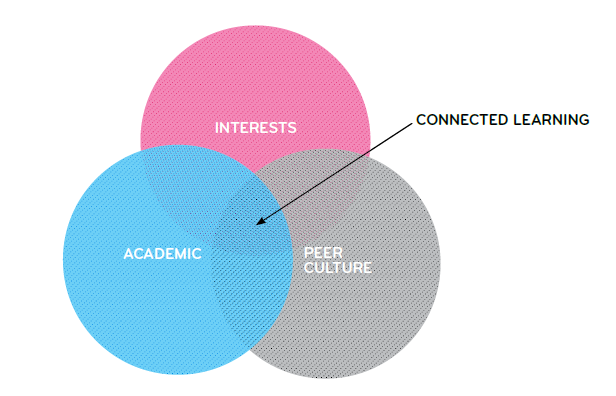
Figure 1. Original spheres of learning.
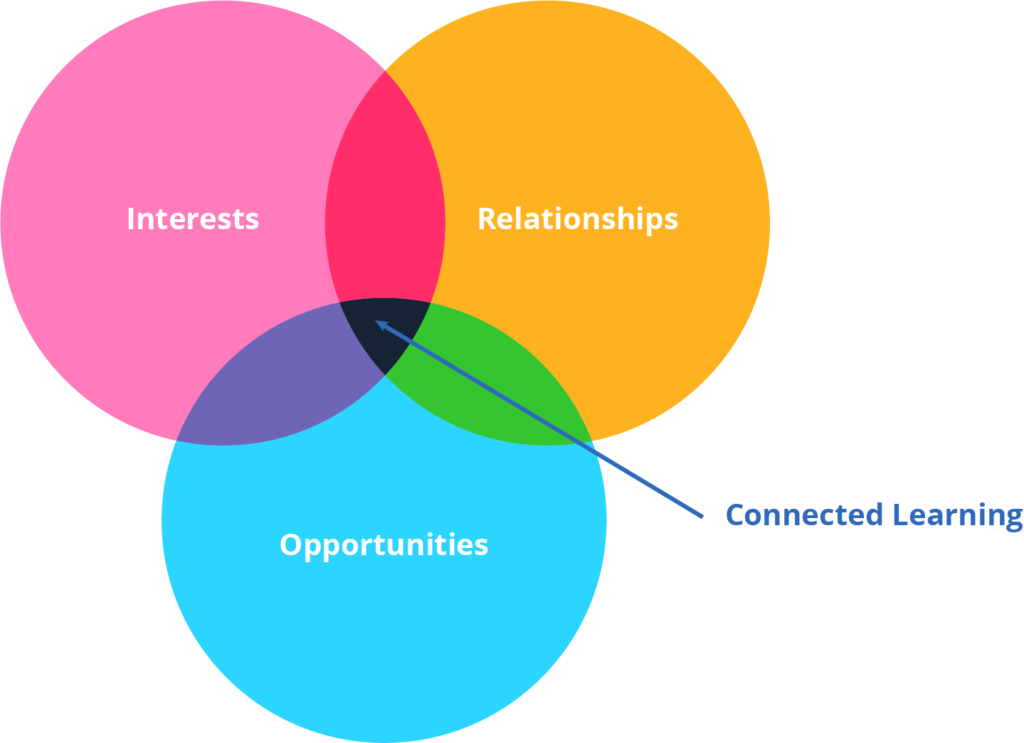
elements of connected learning Figure 2. Revised spheres of learning.

The other three principles of Connected Learning have shifted, as well (“About Connected Learning,” 2017). “Sponsorship of youth interests” is a new principle that was previously woven throughout the others; studies have consistently demonstrated that young people require adult assistance to make connections between their own interests and academic, civic, and career opportunity (Ching et al., 2015; Ito et al., 2019; Van Horne et al., 2016). This principle asks adults to reconsider their role in youths’ learning, to be more than either a “sage on the stage” or “guide on the side,” engaging in actively assisting youth in expanding their networks. “Production-centered” has shifted to being described as “shared practices,” including not just media production as the early model suggested, but also “friendly competition, civic action, and joint research” (“About Connected Learning,” 2017). “Shared purpose” remains, while “openly networked” has changed to “Connections across settings” to incorporate not just openly networked online platforms, but also connections between online and local affinity networks and relationships between home, school, and community.

All of the principles of Connected Learning are directed toward creating learning environments with an equity agenda, in which nondominant youth gain access to learning experiences that have historically been more available to those with privilege and financial access. Without attention to the cultural and social environment, new technologies like those that facilitate connected learning “tend to amplify existing inequity…access to social, cultural, and economic capital, not access to technology, is what broadens opportunity” (Ito et al., 2019, p. 6) (emphasis original).Youth need programs and mentors with social capital to broker connections; if brokering is treated as a market-driven process, this exacerbates inequity.

“The responsibility of providing mentorship, brokering, and connection building to link youth interests to opportunity is a collective one and cannot be shouldered only by families, nor only by schools and other public educational institutions. It entails a broader cultural shift toward recognizing the new learning dynamics of a networked era, paying more attention to learning and equity in online communities and platforms, and providing more educational supports in both formal and informal learning environments.” (Ito et al., 2019, p. 169)

Connected learning has often been conceived of as occurring along pathways, but recent research suggests that it “is more appropriately conceived of as the growth of a network of connections than as a linear pathway or an internalization of skills and knowledge” (Ito et al., 2019, p. 21). Connected learning is best seen “not as a journey of individual development that is transferrable across different settings that a person moves through, but as building stronger, more resilient and diverse social, cultural, and institutional relationships through time” (Ito et al., 2019, p. 167).

References

About Connected Learning. (2017, December 6). Retrieved April 12, 2019, from [clalliance.org/about-con...](https://clalliance.org/about-connected-learning/) Arum, R., Larson, K., & Meyer, W. M. (Forthcoming). Connected Learning: A Study of Educational Technology and Progressive Pedagogy. New York: New York University Press. Ben-Eliyahu, A., Rhodes, J. E., & Scales, P. (2014). The Interest-Driven Pursuits of 15 Year Olds: “Sparks” and Their Association With Caring Relationships and Developmental Outcomes. Applied Developmental Science, 18(2), 76–89. Ching, D., Santo, R., Hoadley, C., & Peppler, K. (2015). On-ramps, lane changes, detours and destinations: Building connected learning pathways in hive NYC through brokering future learning opportunities. New York, NY: Hive Research Lab. [hiveresearchlab.](https://hiveresearchlab.) files. wordpress. com/2015/05/hive-research-lab-2015-community-white-paper-brokering-future-learning-opportunities2. pdf (accessed November 15, 2015). Itō, M., Baumer, S., Bittanti, M., Boyd, D., Cody, R., Stephenson, B. H., … Tripp, L. (2009). Hanging out, messing around, and geeking out : kids living and learning with new media. Cambridge, MA: MIT Press. Ito, M., Gutiérrez, K., Livingstone, S., Penuel, B., Rhodes, J., Salen, K., … Craig Watkins, S. (2013). Connected Learning: An Agenda for Research and Design. Irvine, CA: Digital Media and Learning Research Hub. Retrieved from [dmlhub.net/publicati...](https://dmlhub.net/publications/connected-learning-agenda-for-research-and-design/) Ito, M., & Martin, C. (Fall 2013). Connected Learning and the Future of Libraries. Young Adult Library Services, 12(1), 29–32. Ito, M., Martin, C., Pfister, R. C., Rafalow, M. H., Salen, K., & Wortman, A. (2019). Affinity Online: How Connection and Shared Interest Fuel Learning. New York: NYU Press. Larson, K., Ito, M., Brown, E., Hawkins, M., Pinkard, N., & Sebring, P. (2013). Safe Space and Shared Interests: YOUmedia Chicago as a Laboratory for Connected Learning. Irvine, CA: Digital Media and Learning Research Hub. Retrieved from [dmlhub.net/publicati...](https://dmlhub.net/publications/safe-space-and-shared-interests-youmedia-chicago-laboratory-connected-learning/) Livingstone, S., & Sefton-Green, J. (2016). The Class: Living and Learning in the Digital Age. NYU Press. Maul, A., Penuel, W. R., Dadey, N., Gallagher, L. P., Podkul, T., & Price, E. (2017). Developing a measure of interest-related pursuits: The survey of connected learning. clrn.dmlhub.net. Retrieved from [clrn.dmlhub.net/wp-conten...](https://clrn.dmlhub.net/wp-content/uploads/2014/12/CRLN-Measurement-Paper-120714-for-CLRN.docx) Penuel, W., Van Horne, K., Santo, R., Ching, D., & Podkul, T. (2015). Connected Learning: From Outcomes Workshops to Survey Items. Retrieved from [hiveresearchlab.](https://hiveresearchlab.)files.wordpress.com/2015/05/clrn-from-workshop-to-survey-items-report-may-2015.pdf Van Horne, K., Allen, C., DiGiacomo, D., Chang-Order, J., & Van Steenis, E. (2016). Brokering In and Sustained Interest-Related Pursuits: A Longitudinal Study of Connected Learning. dml2016.dmlhub.net. Retrieved from [dml2016.dmlhub.net/wp-conten...](https://dml2016.dmlhub.net/wp-content/uploads/2016/02/14_vanHorne_CLRNBrokeringPaper040416_submit.pdf) Watkins, C., Lombana-Bermudez, A., Cho, A., Vickery, J., Shaw, V., & Weinzimmer, L. (Forthcoming). The Digital Edge: How Black and Latino Youth Navigate Digital Inequality. New York: New York University Press.

I’ve been solo parenting for almost a week and we’re currently at Defcon Watching “How Far I’ll Go” DisneyMusicVEVO over & over. Single parents, I salute you.